Showing posts with label Aaron Sorkin. Show all posts

Tuesday, January 4, 2022

Loving Lucy; Leaving Desi

Lucille Ball was a comic genius, and Desi Arnaz wasn’t far behind. That’s something of which I’ve been sharply reminded recently, while watching early I Love Lucy re-runs to welcome in the new year. Lucy’s subversion of the “happy homemaker” trope worked for me as a kid growing up in a house with a brand-new TV set. And over a decade later, while a student in Tokyo, I watched with delight as my roommate’s young nephews roared with laughter at Lucy’s antics, dubbed into Japanese.

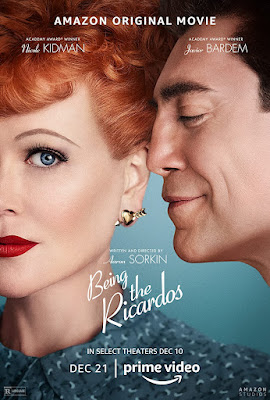
  Despite the joyousness of the sitcom, which ran from 1951 to 1957, most of us know there were cracks in the Ball/Arnaz marriage that kept widening even while the show that celebrated a fictive version of their union was a high-flying hit. Desi may have truly loved Lucy, but his obsessive philandering (coupled with chronic alcoholism) led Ball to file for divorce in 1960, once their last show together was in the can. Given the two stars’ vivid personalities and their long-range impact on Hollywood, it made sense for Aaron Sorkin to undertake a film about the ups and downs of their lives together. And it seems smart of Sorkin, an award-winning screenwriter before he took up directing, to use as his structural framework the week leading up to a particularly fraught live taping of I Love Lucy.

 There’s nothing like a ticking clock to enhance a film’s dramatic appeal. In Being the Ricardos, we move through a fall 1953 work-week, Monday through Friday,  in which a new episode of the show is written, rehearsed, and put on its feet before a live studio audience. Aside from the usual artistic pressures, this particular week presents an enormous challenge, because a blind item in Walter Winchell‘s column has pegged Ball as a member of the Communist Party. Given the political pressures of the era, if the rest of the media turn against her now, the popular TV series will be no more. This possibility hangs over the taping of the episode, while Ball herself pays more attention to another newspaper item, one emphatically implying Desi’s marital infidelity. This is strong stuff, and it leads to a climax that works wonderfully well, combining both victory (Ball’s patriotism is endorsed by her fans) and defeat. It’s the matter in between that I find problematic.

 Though Sorkin appears to have whittled down his Ball/Arnaz saga to one climactic week, he stuffs that week so full of hot-button issues that we can barely keep up. To wit: in and around the tensions provoked by the news items, Lucy and Desi announce she’s expecting a baby. This wasn’t historically true of the week in question, and the pregnancy contributes nothing of value to the specific story being told, though it allows us to see Desi’s clout when he demands that the pregnancy be worked into the show, in defiance of previous TV industry mores. Ball gets a feminist rant too, in support of her Lucy character. And Sorkin jumps outside the structure he’s set up in other ways, adding flashback to earlier points in the life of the couple (their first date, her evolution into a redhead, her insistence that Desi—not some white guy—play her husband on her new TV show). We leap into the future too, with the three key members of the I Love Lucy writing team—now much older and played by different actors—looking back on the implications of that frenzied week as well. The result is a tangle, one that some bravura performances (particularly by J.K. Simmons as William “Fred Mertz” Frawley) can’t unsnarl.

 For those who’ve seen the film, here’s an L.A. Times breakdown of how well it jibes with the historical facts of the Desi/Lucy relationship.


Friday, April 17, 2020

Hildy’s Game: “His Girl Friday”


“Molly’s Game,” which I watched while flipping through Netflix offerings, is a 2017 feature based on the real-life story of Molly Bloom. No, not the earth-mother figure in James Joyce’s Ulysses. This Molly Bloom is a former champion skier, one who was derailed by a freak accident from her quest to join the U.S. Olympic ski team.  Looking for challenges in warmer climates than her native Colorado, she decamped to  L.A., where she soon found herself shepherding a high-stakes celebrity poker game. Though not a gambler herself, she was soon risking her reputation and her legal standing in order to keep raking in a small fortune in tips.

It’s a fascinating story, though one I couldn’t always follow. And I’m still not exactly sure what the film was trying to say.  A corny scene between Jessica Chastain’s Molly and her psychologist dad (played by the always earnest Kevin Costner) didn’t strike me as helpful. Was his attempt to explain her life-choices in analyst-speak meant to seem astute, or oblivious?

In any case, the film was the directorial debut of writer Aaron Sorkin, known for his screenplay for The Social Network as well as such stellar TV as The West Wing. Those who are familiar with Sorkin’s work know that his characters are smart, sassy, and speak very fast. More than one review of the film, which earned an Oscar nomination for Sorkin’s screenplay, mentioned that its characters deliver their lines as if they were part of the cast of His Girl Friday. Exactly! This sparkling Howard Hawks film from 1940 is set not in a high-price gambling den but in the world of journalists and daily newspapers. The cast, led by Cary Grant as editor-in-chief Walter Burns and Rosalind Russell as ace reporter Hildy Johnson, speak their lines at a breakneck pace, as though the fate of the world depends on what they have to say. And perhaps, in a way, it does. Though the portrayal of newsmen in the film is hardly sugar-coated—they’ll do just about anything to scoop the competition—there’s still the sense that the news they deliver is important, that the fate of a city (if not the world) hangs on the stories they uncover. Brutal competition is part of the game, and sometimes they may happen to get their facts wrong. But this hardly means they’re manufacturing Fake News. Theirs is an honorable profession, and Rosalind Russell’s Hildy is the best of the best.

The complication is that she’s Walter Burns’ ex-wife, and is on the brink of marrying a much more sedate type, an Albany insurance man played by Ralph Bellamy in the usual Ralph Bellamy role. (Who knew that 20 years later he’d leave behind his boring-nice-guy image by portraying FDR in Sunrise at Campobello?) Walter wants Hildy back, both as an ace reporter and as a wife, and a dramatic jailbreak by an accused murderer arouses her passion for newsgathering just in the nick of time. You can guess how it all ends.

His Girl Friday was based on a hit play of the era, Ben Hecht and Charles MacArthur’s The Front Page. The play is an effective melodrama, climaxing with the jailbreak. In adapting it for the screen, someone had a bright idea. Since it featured a newspaper editor trying to hang onto his star reporter, why not make that reporter a ballsy female, as well as the editor’s former wife? That brilliant stroke foregrounds the interpersonal story, relegating the murderer’s plight to a secondary role. As always, the battle of the sexes makes for boffo cinema.