Showing posts with label Betty White. Show all posts

Friday, October 18, 2024

Mary and the Bear

It was the long, dark days of the pandemic that introduced me to the pleasures of watching television. Desperate for entertainment, I turned to cable-tv for long-running recent series I’d missed, like Mad Men and Breaking Bad, but also for sitcoms that took me back to my early years.

 After giving some love to I Love Lucy, I settled on the pleasures of The Mary Tyler Moore show, which ruled the airwaves from 1970 until 1977. The show may look dated today, with its multi-camera style and laugh-happy studio audience. But back in the 1970s it was known for tackling social issues that were very much in the air. Its star, as Mary Richards, was an unmarried career gal who had the occasional romance but was much more involved with her job as the producer of a local Minneapolis TV news show. In the early seasons, she had colorful interactions with her landlady (Cloris Leachman) and her best buddy (Valerie Harper). But most episodes featured her interactions with the newsroom gang, the curmudgeonly Lou Grant (Edward  Asner), the acerbic Murray Slaughter (Gavin McLeod), and the irresistibly pompous newscaster Ted Baxter (Ted Knight). The cherry on top in later years was the frequent presence of Betty White as a man-hungry TV personality known as the Happy Homemaker.

 Though the series was played for laughs, at times it  ventured boldly onto serious topics, like infidelity, divorce, erectile dysfunction, and even death. (The “Chuckles Bites the Dust” episode is a comedy classic, in which Mary struggles to avoid laughing at a death that occurs under bizarre circumstances..) 

 Network television seasons were long back then: 24 episodes of this show aired per year. There was occasional follow-through: in season 4, Lou’s wife walks out on him to find herself. Several seasons later, she’s remarrying, and Lou and Mary reluctantly attend the nuptials. But basically the episodes are self-contained: the contents of one show generally do not carry over to the next. This ends up being particularly weird at the end of the next-to-last season, when Ted and new wife Georgette, despairing of having a baby, adopt a polite seven-year-old boy who charms everyone in the news room. The kicker is that Georgette then discovers that, against all odds, she’s pregnant. When the show resumes the following season, Georgette is in the throes of giving birth during a party at Mary’s apartment. But that cute little adoptee is never mentioned. Did he run away? Did they return him to the agency?

 All this comes to mind because we’ve just finished watching the first season of Hulu’s The Bear. Like The Mary Tyler Moore Show it’s an Emmy winner in the field of comedy, though it lacks anything you might call a joke. Inside of being performed in front of a live audience, this story about the running of a Chicago neighborhood restaurant is shot in cinéma vérité style, with the overlapping dialogue coming thick and fast, and home audience struggling to understand everything that’s said. (The show also consistently relies on expletives that Mary Richards has doubtless never used, or even heard.)

 If The Mary Tyler Moore Show occasionally edges into darker territory, The Bear lives there fulltime. Its characters cope with the aftermath of addiction and a brother’s suicide, and shady hangers-on are always lurking around. Funny? I’m not so sure. (Neither are the Emmy voters who chose a different winner in this category for The Bear’s second season.) But the ongoing story—which doesn’t fully come together until the last episode of season 1--is fascinating, and well worth watching. 


Friday, February 18, 2022

By Way of Obit; Yvette Mimieux and Some Others

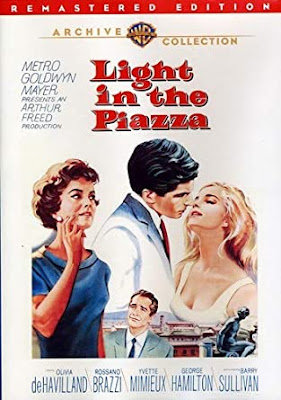
The recent death of Yvette Mimieux, once the radiant young blonde star of Sixties movies, has sent me back into my own past. I  remember her as beautiful and vulnerable in such hit teen movies as Where the Boys Are. I forgive her for kinky tripe like Three in the Attic, and acknowledge that she somehow kept her dignity in a low-budget Roger Corman crime thriller, Jackson County Jail. Her passing led me to watch her screen performance in perhaps her most ambitious role, in 1962’s Light in the Piazza.

 I’ve wondered about Light in the Piazza since I saw the Los Angeles production of the award-winning 2005 Broadway musical version. Though critics cheered, I found the play’s plot logic deeply troubling. The central characters are a mother and her young adult daughter, wealthy Americans leisurely enjoying Italy. To the mother’s dismay, the daughter quickly falls for a handsome young Italian, and he for her. As a wedding is being discussed, we discover a melodramatic complication: Clara once sustained a serious head injury, and she’s mentally and emotionally stunted. Her mother faces a serious dilemma: stop the wedding, or allow her daughter to find a happiness that may be temporary. It all seemed like hooey to me, and I was never convinced that the Clara I saw on stage had the emotional age of a ten-year-old.

 That’s why, in homage to Mimieux, I watched the film, which stars Olivia  de Havilland as a deeply troubled mother. It’s a bit sappy, though Florence and Rome look lovely. The time given to the strain of the relationship between de Havilland’s Meg and her no-nonsense husband (Barry Sullivan) helps explain the puzzling turnabout in Meg’s attitude toward the young lovers. And I saw something in Mimieux’s performance that confirms who Clara is—someone who, for all her charm, will never progress beyond being innocent and girlish. A belated brava to Mimieux.

 Somehow I’ve never had a moment to salute Betty White upon her passing at the age of almost-but-not-quite 100. It’s sad to lose her, but how wonderful that she enjoyed a long, long career, and a life that was happy and productive right up to the end. Some of those we’ve lost recently started out in showbiz at a much younger age than Betty White, but discovered what a mixed blessing child stardom can be. I grew up watching Tommy Kirk in a whole string of Disney hits, like Old Yeller and The Shaggy Dog. He later was a perennial in a series of teen beach movies in the Sixties. Who knew then that his parting from Disney had been abrupt and painful, caused at least in part by the homosexuality he couldn’t hide? Along the way he picked up a drug habit, and at one point (despite his substantial childhood earnings) was nearly broke. Somehow he got through all that, living out his days quietly, far from Hollywood.

 It was just last month that we lost Peter Robbins, not a household name but a voice to be reckoned with. From 9 to 16, he was the original voice of  Peanuts’ Charlie Brown on a number of major TV specials. Eventually mental illness kicked in; at age 65 he  died by suicide.

 Jane Powell, star of Golden Age musicals like Seven Brides for Seven Brothers started in the business at age 14. Unable to go to college because she was her alcoholic mother’s sole support, she continued performing, and married 5 times. Her last and most successful marriage was to Dickie Moore, who like her understood what child stardom was all about.


Friday, May 4, 2012

Old Folks’ Holmes: Sherlock Holmes and Other Old-Timers At the Movies


On a recent flight, I watched the 2011 film, Sherlock Holmes: A Game of Shadows, on one of those tiny overhead screens. Robert Downey, Jr. certainly makes a most unusual Sherlock Holmes: the great detective as action hero. Anyone weaned on the old movies starring Basil Rathbone will immediately see the difference. Rathbone was tall, lean, and dapper, forever associated with an Inverness cape and deerstalker cap. Downey, some five inches shorter, is rumpled, burly, and sometimes bumbling. His disguises can be inept – as when he shows up in grotesque drag regalia – and he’s as prone to solve problems with a well-placed punch as with the cerebral cogitation for which the literary Holmes is so famous.

It was fascinating to see Downey’s take on Holmes (with its obvious appeal to the youth market) because I’d just finished reading a 2004 novella by Michael Chabon. The Final Solution, billed as “a story of detection,” moves Holmes into the twentieth century. The year is 1944, and the 89-year-old Holmes is living in retirement in the Sussex countryside, tending his bees as well as the demands of his aging body. He seems to be long past his years as a crime-solver, but the curious sight of a solemn young boy with a parrot walking on the railroad tracks near his home starts the old juices flowing. A murder and a kidnapping draw Holmes in, and soon he’s cautiously making his way to London to solve a case that’s unexpectedly tied to Nazi Germany and the Holocaust.

The Final Solution is a modest book, with not enough meat on its bones to be an obvious candidate for movie adaptation. (Chabon, much enamored of movies, has struggled to write a screenplay for his Pulitzer Prize-winning The Amazing Adventures of Kavalier and Clay.) What struck me about The Final Solution was its vivid depiction of old age. Chabon’s Holmes is not the cute codger of so much popular media. He’s the Conan Doyle original, but now bedeviled with physical frailty and an occasionally shaky grasp of the world. In the recent past, I’ve spent long hours with people of advanced years, and I appreciate Chabon’s respect for what the elderly can and can’t do.

Hollywood, of course, loves old coots, so long as they conform to certain stereotypes. Male actors like to sink their teeth into roles that let them be crusty and cantankerous but good-hearted: see Clint Eastwood in Gran Torino and Richard Farnsworth, the oldest ever Best Actor Oscar nominee for his role in The Straight Story. The classic old man of recent times is the one voiced by Edward Asner in Up. He’s grumpy but lovable, and ultimately rises above his condition (in quite a literal way) to take on the world. True, Meryl Streep won her latest Oscar for a portrayal of Margaret Thatcher that made old age look realistically daunting. But the British are especially fond of casting aging performers like Judi Dench and Maggie Smith in films (see The Best Exotic Marigold Hotel ) where they can ride motorcycles and perform youthful stunts for comic effect.

There’s an extreme example of adorable oldsters in Betty White’s newest TV venture, Off Their Rockers. The point of this Candid Camera-style reality show involves apparently feeble folk who succeed in punking our nation’s youth with their raunchy sensibilities and unexpected physical prowess (on skateboards and such). White, who acts as host, seems to find this naughty good fun. Personally, I like the idea of treating the elderly and their challenges with respect, rather than reducing then to Gen-Y'ers with wrinkles.