Showing posts with label WGA. Show all posts

Tuesday, May 16, 2023

Striking Out: The Writers' Guild of America and The Mary Tyler Moore Show

The pandemic introduced me to the pleasures of vegging out on the couch most evenings to watch the best in television. It’s allowed me to catch up, belatedly, on now-classic series like Breaking Bad and newer ones like Inventing Anna. But at times I’m looking for something nostalgic and easy on the eyes. Often the passage of time creates a disconnect: my once-beloved Carol Burnett Show seems to me now a bit grotesquely out of date, though its classic movie parodies still give me a chuckle. Still, The Mary Tyler Moore Show (1970-1977) is an amiable, and sometimes hilarious, way to spend 30 minutes with some deeply flawed but lovable characters.

 I think of this show, about a single gal working for a Minneapolis TV news station, as pretty much pure escapism. But a second-season episode (one of the funniest I can recall) reminded me of issues that are in the news right now. It’s all about fallout from a writers’ strike, which briefly decimates the newsroom in which Mary is the Gal Friday to curmudgeonly Lou Grant (Edward Asner). Mary and Lou are officially Management, so they must stay behind when their show’s news writers walk off the job and join the picket lines. Doofus announcer Ted Knight (as Ted Baxter) is dumbfounded by all the issues involved, but his performers’ union requires him to leave too. So Lou and Mary are put in the position of trying both to write the news copy and present it on air. It doesn’t work: Mary’s attempt to put a bit of drama into a weather story is ridiculously ill-considered, and Lou – as on-air presenter – turns out to have a galloping case of stage fright that only a lot of scotch will cure. Fortunately the strike only lasts two days, and everyone lives happily ever after.

 Too bad things don’t end so neatly in the real world. Members of the Writers’ Guild of America (who work in both film and television) are now on strike for real, desperate to improve their take-home pay in an era when TV is dominated by streaming services. In contrast to the big TV networks of old, Netflix and the other streamers notoriously pay only modest wages to staff writers. Nor do they offer the healthy residuals on which writers have long counted as a way to shore up a middle-class lifestyle.

 It doesn’t stop there. As aggrieved writers are quick to point out, studios won’t even discuss another elephant in the room: the advent of ChatGPT as a threat to the writing profession. We all know that writing for movies and TV often tends to rely on well-known formulas. As pointed out in a recent report in The Hollywood Reporter, what’s to stop studio heads from turning to Artificial Intelligence to plan new episodes of old shows?  Said Amy Webb, founder and CEO of something called the Future Today Institute, a long-running procedural like Law & Order could easily make use of ChatGPT for plotting out episodes, then bring in a human writer only to shape and polish. It’s a possibility that WGA members are desperate to hash out with Management, but Management won’t commit.

 As a teacher of screenwriting I know how many “civilians” are out there, hoping to make it as writers in Hollywood. But Hollywood professionals know how easy it is to get cheated out of a living wage.  My former boss Roger Corman would habitually ask an office drone to throw together a first draft over a weekend, then pay a professional only for a rewrite. Have things changed so very much?

 

Friday, April 24, 2020

Not Just for the Money: Hollywood Screenwriters Tell All


When I fell into the movie industry, no one taught me anything about how to write a screenplay. I was an almost-PhD in English, accustomed to reading Shakespeare and abstruse modern novels. On my first day at Roger Corman’s New World Pictures, I was handed a script – it was Charles Willeford’s screen adaptation of his own down-and-dirty Cockfighter – and told to note my thoughts on how well it worked. Somehow I managed to make a good impression. My career as a motion picture story editor had begun.

Roger, in those years, was a master at avoiding the hiring of union screenwriters, who of course were paid more than Corman peons. My good friend Frances Doel, from whom I learned the tricks of the screenwriting trade, was quite resigned to being send home on a Friday afternoon and told to come back Monday with the first draft of some screenplay for which Roger had supplied the premise. She’d slap a pseudonym on the title page, and when a credentialed screenwriter was brought in to improve on her very rough original, the identity of the first writer was our little secret. (We had to come clean just once, when the very gentlemanly William W. Norton expressed a strong interest in meeting with that original writer in order to check out some story points.)

Later, when I worked at Roger’s Concorde-New Horizons, we dispensed with WGA writers altogether. Or, at least, we weren’t WGA signatories. Plenty of writers with guild-worthy credentials but no work on hand were happy to invent new names for themselves so that they could be part of our cut-rate productions.  Henry Dominic, anyone?

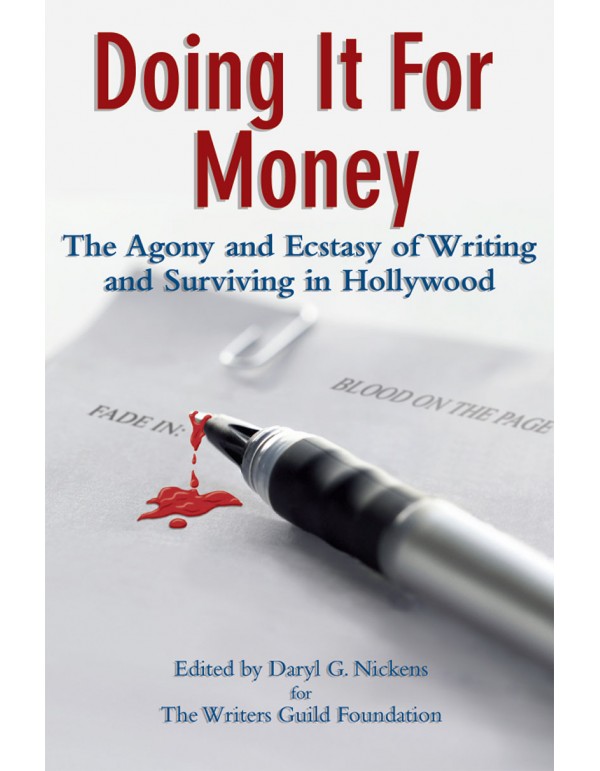
Although I have six Roger Corman screenwriting credits, I’ve never been a WGA member. Still, the guild sends me the occasional check (compensation for overseas screenings of films I’ve written), and I have the greatest respect for the pros who deserve every penny they’ve earned by crafting my favorite movies and TV shows. And I’m happy to endorse a recent publication of the Writers Guild Foundation, edited by screenwriter Daryl G. Nickens. It’s called Doing It for the Money: The Agony and the Ecstasy of Writing and Surviving in Hollywood.

How-to books about screenwriting are a dime a dozen, and I wouldn’t recommend this one as a primer. Though several brief sections offer the reader “Secrets of the Hollywood Pros,” the book’s strength does not lie in providing specific advice on such things as formatting and loglines. Instead, the core of Doing It for the Money  is a series of short essays by award-winning writers on how they’ve handled their own yen to tell stories on the screen. They’re writers, after all, so they express themselves with heart and wit. They’re funny, and often inspirational.

My very favorite section is  by Glenn Gordon Caron. He was once a newbie on a TV sitcom writing staff, led by a man named Steve. Everyone loved Steve’s work, but one week it was Caron’s turn to churn out the first draft. Instantly, the cast turned hostile, refusing to have anything to do with this interloper’s script, and insisting that Steve step in and fix it. Steve, who knew a good script when he saw one, told Caron to re-submit the same draft but add the word “revised version” to the title page. Suddenly everyone was onboard, and Steve announced that Caron had made many of the great fixes himself. With his reputation and his morale saved, Caron went on to a long career, including the wonderful Moonlighting. Like most Hollywood writers, he wasn’t doing it just for the money. .