Showing posts with label Alfred Hitchcock. Show all posts

Thursday, February 19, 2026

Meeting Two Strangers on a Train

A cab pulls up to a big urban train station. A man gets out, but all we see are his snazzy two-toned spectator brogues. Another cab arrives; another man emerges. We spot some his luggage, including a pair of tennis racquets, but also his sensible dark dress shoes. Both pairs of feet stride through the station.. We next discover them beneath the table of a club car, where one man’s foot accidentally nudges the other’s shoe.

 This, of course, is the very enticing opening of Alfred Hitchcock’s 1951 psychological thriller, Strangers on a Train. This film, made midway through a directing career that began in the 1920s and ended with Family Plot in 1976, is considered one of Hitchcock’s most effective in ramping up suspense by way of skillful screen artistry. The original plot, involving two young men who seek to evade the long arm of the law by committing murders on one another’s behalf (“cross-cross”) was concocted by Patricia Highsmith, for whom this was a first novel, five years before she gave the world the talented but lethal Mr. Ripley. Still, Hitchcock and company made some key changes to Highsmith’s story. For one thing, the Guy Haines character is far more culpable in the novel than he is in Hitchcock’s version, wherein (possibly to get past the censors) he can’t ultimately be tempted to follow the murderous path of Bruno (an eerie Robert Walker).  Hitchcock also deleted a key detective character, and added a famous merry-go-round scene that is one of his all-time most climactic. 

 Critics often discuss Hitchcock’s use of symbolic doubling in this film.  It focuses on the similarities (as well as differences) between two young men who accidentally meet in a train car: each of them is burdened by a relative who would perhaps be better off dead. We can’t miss the fact that Walker’s character—wealthy and superficially charming but deeply dissatisfied with his lot in life—responds to Granger’s attractiveness and is determined to bind the two of them together via the committing of two perfect crimes. There’s also the key parallel between two young women who wear thick spectacles: one is violently assaulted and the other soon finds herself in deeply symbolic danger.

 Barbara, the second of these bespectacled young women, is played by Patricia Hitchcock, the Master’s only child. She’s a distinctive character, much  different from her elegant sister (Ruth Roman) who is Guy Haines’ beloved.  Small and definitely rather Hitchcock-like in her appearance, Barbara is introduced as someone who is much fascinated by criminal behavior. The implication is that she shares Hitchcock’s own obvious delight in the macabre . . . until dangerous doings seem to be heading her way.

 Though Pat Hitchcock is fascinating (and Ruth Roman is, frankly, not), the crux of the film involves the interaction of the two male leads. As the preppy tennis player, Farley Granger is appealingly handsome and gentlemanly, which makes him slow to recognize the evil lurking in his fellow passenger. But it is Robert Walker who is unforgettable. We see his Bruno Anthony first as a fancy dresser and a glib talker, someone who can get under the skin of a complete stranger and bend him to his will. With an enigmatic smile on his face, he can pursue a young woman through an amusement park tunnel of love, and then commit a murder that is reflected in her glasses. This moment is perhaps the film’s grim high point: there are other shocks and scares to be had, but somehow the ending just doesn’t live up to what has come before.


Monday, August 4, 2025

Looking Back at “Rear Window”

When I was much younger, I always had trouble with Alfred Hitchcock’s 1955 thriller, Rear Window.  Set in New York’s Greenwich Village, it’s the story of Jeff, a globe-trotting photojournalist (James Stewart), who has broken his leg in the line of duty. Stuck in his tiny upstairs flat, with much too much time on his hands, Jeff has nothing to do but spy on his neighbors, through binoculars, in the apartment building across the way. Critics discuss this film as an exploration of voyeurism, with audience members essentially joining Stewart as Peeping Toms. Some recent feminist scholars have gone further, seeing Rear Window in terms of the notorious “male gaze,” the way movies are designed to reinforce men’s stereotypes about the women they can’t stop watching.  

 My problem with the film was this: I too had endured a broken tibia. In fact, I’d endured two, from ski accidents a year and a half apart. (Yes, I quit skiing thereafter.) So I was sensitive indeed to any inaccuracies about life in a plaster cast. I could well understand Jeff’s restlessness, and appreciated the detail of him desperately trying relieve the itchy skin inside the cast by cautiously inserting a long-handled backscratcher. But! Why was he stuck in a wheelchair throughout the film? Why wasn’t there a pair of crutches around?  Yes, a few weeks in a thigh-to-toe plaster cast can indeed seem like an eternity, but why was Jeff so helpless, and so miserable, when his cast was apparently due to come off a mere seven weeks after the accident, thus implying that the break wasn’t all that drastic? (Try wearing a cast for six months sometime!)  

 Fortunately, my legs are both whole these days (knock wood!), which frees me to appreciate Hitchcock’s work on this clever and  original film. I was not surprised to learn that it was made entirely on the Paramount Studios back lot, with Jeff’s fixed point  of view focused almost entirely on a multi-story apartment building that spreads before him like a stage set. It’s a  midsummer heatwave, which means (in an era before the widespread advent of air conditioning) that life plays out through wide-open windows and on fire escapes. He’s spent so much time observing the building’s inhabitants that he’s given some of them nicknames, like Miss Torso (a curvaceous dancer who seems to have few clothes and a lot of company) and Miss Lonelyhearts (who only pretends to have visitors, and appears on the brink of being  suicidal).

 One neighbor (played by the hulking Raymond Burr) apparently likes growing plants in the building’s small flowerbed, but has no use for his neighbor’s little dog. He also doesn’t seem, from Jeff’s wheelchair-bound perspective, to have the best relationship with his invalid wife. He’s a traveling salesman, so perhaps it’s not odd that he comes and goes at odd hours, carrying a suitcase. But Jeff is quick to cast him as the bad guy in a murder mystery. Is he?

 Jeff’s accomplices in trying to solve this mystery that may or may not exist include a peppery visiting nurse (the always delightful Thelma Ritter) and a gorgeous socialite (Grace Kelly) who’s deeply in love with him. Kelly’s Lisa Fremont makes old-time viewers like me recall what was so great about 1950s fashion.  Lisa claims she’s ready to give up her lavish lifestyle to join Jeff in holy matrimony; he’s skeptical, and perhaps he has reason to be. In the course of this film she shows her underlying pluck, but are they ready for happily ever after? That’s one mystery that Rear Window never solves.


Friday, June 13, 2025

Going “Psycho”

The other evening, in the line of duty, I went back in time and watched Alfred Hitchcock’s 1960 masterwork, Psycho. Ironically, I never saw it in a theatre back in the day. (I was a young teenager at the time, and not especially keen on horror.) Needless to say, I’d heard all the brouhaha, and was aware that Janet Leigh’s character didn’t fare well during her overnight stay at the Bates Motel. But the intricacies of her killer’s identity were beyond me—until I took a long bus ride with a gaggle of other girls, and one filled me in on the entire plot.

 I’ve since seen the film, of course, though it’s been a while. But because I was asked to comment on a new biography about a Hollywood regular (Christopher McKittrick’s Vera Miles: The Hitchcock Blonde Who Got Away), it seemed appropriate to check out Miles’ appearances in films by legends like John Ford (The Searchers) and Alfred Hitchcock. Miles was, I learned, slated to become Hitchcock’s next leading lady, once Grace Kelly decamped for Monaco. After portraying Henry Fonda’s long-suffering wife in The Wrong Man, Miles was his original choice to play the fascinating female lead in Vertigo (1958), until scheduling problems got in the way. Still, she was featured by Hitchcock in the drama that kicked off his well-loved TV series. And for Psycho she played the important (though not especially interesting) role of Janet Leigh’s sister,  searching for the missing Marion Crane and letting out an impressive scream when she learns the truth about the spooky old lady in the big Victorian house.

 Psycho may be today one of Hitchcock’s best remembered films, but it’s far from typical of his oeuvre. Yes, it features a pretty blonde woman in dangerous circumstances, but Janet Leigh’s role in Psycho is far removed from those played by such Hitchcock blondes as Madeleine Carroll, Eva Marie Saint, Grace Kelly and Tippi Hedren. Whereas the usual Hitchcock heroine is elegantly attired, Leigh’s Marion Crane is most familiarly depicted wearing a bra and slip. She’s attractive, but she’s no mysterious glamour girl caught up in international intrigue. The criminal act of which she’s guilty is the sordid little matter of stealing a wad of cash from her employer so that perhaps she can finance a marriage to her not-so-willing boyfriend (John Gavin, a future US ambassador to Mexico).  

 Hitchcock’s decision to cast Janet Leigh, a rising star with a well-publicized Hollywood marriage (to Tony Curtis) as Marion Crane meant that the bulk of his budget went toward her salary. The result was that other aspects of Psycho were necessarily simplified. It was shot, mostly by Hitchcock’s TV crew, in austere black & white, in contrast to such glossy full-color Hitchcock productions as 1958’s Vertigo and 1959’s North by Northwest. But in fact this austerity seems to suit the simple but macabre story.

 One thing I never realized until I read the Vera Miles bio is that Hollywood, in its wisdom, eventually decided to sequelize Psycho. Hitchcock was dead and gone in 1983 when Universal Pictures paid Richard Franklin to direct Psycho II, set 22 years after the original story. Marion Crane played no part, of course, but Anthony Perkins signed on to again play Norman Bates, newly released from a mental institution. And Vera Miles signed on too, to portray the still-grieving sister who thirsts for revenge. Naturally there are mysterious and macabre doings galore . . . and three years later, Perkins himself directed Psycho III, described as a psychological slasher film. Happily, I missed these cinematic gems.  


Friday, January 17, 2025

Whatever Happened to Vera Miles?

Vera Miles? Whatever happened to her? And who was she, anyway? Miles, who’s alive and well at 95, was an Oklahoma-born, Kansas-bred beauty pageant winner who found her way to Hollywood in 1949. She played key supporting parts in films directed by John Ford (The Searchers) and Alfred Hitchcock (The Wrong Man, in which she was the wife of Henry Fonda, playing a real-life jazz musician falsely accused of robbery). She also was several times cast by the Disney folks as a lovable wife and mom, often in tandem with Fred MacMurray or Brian Keith, perhaps reflecting her own real-life role as the mother of four children. She also regularly appeared in featured roles on television. Despite all this, in her forty-five year career she never truly moved beyond second-tier stardom. 

Things might have turned out differently in the late Fifties if Miles, who was then under personal contract to Alfred Hitchcock, had gone through with Hitchcock’s plan to star her as the female lead in Vertigo. Hitchcock favorite Grace Kelly had moved from the soundstages of L.A. to the throne of Monaco, and Miles was singled out as a suitable replacement. Said the Master of Suspense, “Miss Miles is going to be one of the biggest stars of Hollywood because she has understanding and depth and ability and lovely legs.”  To that end, he ordered a fabulous wardrobe for Miles, and cranked up the Hollywood publicity machine. But life intervened. Hitchcock’s need for gall bladder surgery delayed the production, as did time-off requested by the hard-working male lead James Stewart. And then Miles had the nerve to become pregnant with her third child, a move that Hitchcock considered something of a personal insult. (He was to say in later years, “I hate pregnant women because then they have children.”)  So Kim Novak got the plum dual role of Madeleine Elster and Judy Barton instead, though Hitchcock did feature Miles in his television dramas and in a key supporting part as Marion Crane’s sister in Psycho.

I know all the above because of Christopher McKittrick’s new biography, Vera Miles: The Hitchcock Blonde Who Got Away, coming in March from University Press of Kentucky. There’s no question that McKittrick has done his homework. Though he never had the opportunity to speak to Miles directly, he seems to know everything there is to know about her life and times, and in passing fills us in on everyone with whom she ever connected. Though it’s interesting seeing her on the set of masterworks like Ford’s The Man Who Shot Liberty Valance, I was most impressed with Miles’ evolution in later years into a woman who knew how to stand up for herself, one who clearly saw the lack of meaty roles for women and became determined to do something about it. (I’d love to know what she thinks about the current crop of films like Anora, The Substance, and Emilia Pérez—as well as last year’s Poor Things—whereby today’s actresses are coming to dominate the industry in which she once played a significant part. As someone always considered ladylike, she might not be pleased by the outrageous roles Hollywood’s women are now undertaking.) 

McKittrick considers it refreshing that Miles, far from becoming a burned-out Hollywood cautionary tale, largely ran her career on her own terms. As he puts it, “If opportunities like that of Vertigo passed her by because she chose other, more personally fulfilling paths for her life, those were decisions she was happy to make and has continued to stand by in her retirement.”  


Friday, August 16, 2024

Hitchcock-Lite: “The Man Who Knew too Much”


 I’ve never seen Alfred Hitchcock’s 1934 British version of The Man Who Knew Too Much. It’s a thriller, of course, one that climaxes with an assassination attempt planned for a climactic orchestral  moment at London’s Albert Hall. Peter Lorre is involved as a criminal mastermind, so you know that things are going to get seriously creepy.

 More than twenty years later, Hitchcock basically recycled his original plot for Hollywood. His 1956 take on The Man Who Knew Too Much is 45 minutes longer than the British version, and features two of Hollywood’s most popular actors, James Stewart and Doris Day. (Taking advantage of Day’s musical chops, Hitchcock and company make her a retired singing star, and weave into the plot her crooning of a new song, “Que Sera Sera,” which ultimately won an Oscar.)

 As in so many Hitchcock films, the leading characters are innocents who find themselves caught up in an evil scheme they must ultimately help to foil. See, for instance, the classic North by Northwest, in which businessman Cary Grant ultimately helps uncover some serious skullduggery.. In The Man Who Knew Too Much, Stewart and Day play a married couple traveling abroad with their young son. In Morocco they meet a mysterious Frenchman whose sudden death embroils them in intrigue, resulting in young Hank being kidnapped and whisked off to England. Of course the rest of the film involves the couple’s desperate search for their child, certainly a matter of the greatest seriousness. But this is a movie in which Hitchcock’s playful side shines through. Though the kidnapping of a kid is horrendous, we in the audience are never in doubt about Hank’s ultimate safety. That’s because Hitchcock plays down the jeopardy he faces, while devoting much of the film to the comedy of innocents abroad trying hard to grapple with unfamiliar cultures and unexpected bad guys.

 We first meet Ben, Jo, and young Hank McKenna on a bus ride from Casablanca to Marrakesh, where they immediately run afoul of local customs. (As the bus lurches, Hank accidentally snatches the veil off a Muslim woman’s face.) Though they’re surrounded by questionable characters, the focus is on the comic joshing and bickering of husband and wife. He’s an Indiana  doctor, and at one point they humorously note how his various operations back home have helped fund the luxuries they’re enjoying on this trip. And there’s a great deal of comedy in the key scene where they make new friends at an authentic Moroccan restaurant. (The tall, lanky Ben can’t manage the low couches in the dining room, nor can he figure out how to successfully eat with one hand, Moroccan-style.)

 Even after the horror they face when they learn of their son’s abduction, the McKennas are thrust into situations that can only be called comedic. When they arrive in London, a gaggle of British friends descend on their hotel suite, eager to reminisce about old times. While Ben dashes off to confront a certain Ambrose Chappell, who may hold the key to their son’s whereabouts, Jo is ordering drinks and desperately trying to entertain these unwanted guests. Ultimately, the action moves to the Albert Hall for that climactic concert. (Composer Bernard Herrmann, who wrote the score containing the would-be-fatal cymbal crash, makes a cameo appearance as the orchestra’s conductor). When all three McKennas, reunited at last, return to the hotel, they find their guests are still ensconced in their suite, totally snockered.

 The famous Hitchcock cameo? It’s  not one of his better ones--and the same goes for this enjoyable but very slight film.


Friday, June 28, 2024

High Anxiety: Mid-Level Mel Brooks

What would we do without Mel Brooks? He’s been the comic genius behind TV (Get Smart) and recordings (2000 Year Old Man), but I associate him mostly with movies, as a writer, a director, and sometimes a star. His first directorial outing was in 1967, as writer/director of The Producers, which introduced the world to the outrageous combination of Zero Mostel and Gene Wilder, as well as to the most hilariously tasteless production number of all times, “Springtime for Hitler.” I suspect that if you watch the film you’ll agree it runs out of steam midway though, but Brooks would later enlarge it into a Broadway musical blockbuster.

 I’m fond of The Twelve Chairs, Brooks’ off-the-wall 1970 look at Tsarist Russia. (I’ve adopted its original song, “Hope for the Best, Expect the Worst,” as my own personal philosophy of life.) But Brooks’ greatest year was arguably 1974, when he introduced not one but two comedic masterworks, Blazing Saddles and Young Frankenstein. Both showcase Brooks’ talent for parody, his success at spoofing familiar genres like the Western and the classic monster flick. Next came the considerably more effortful Silent Movie, featuring Brooks favorites Marty Feldman and Dom DeLuise, along with a cast of Hollywood stars in cameo roles. In 1977 it was back to a genre spoof: Brooks’ High Anxiety (despite its title’s witty nod to High Society) is dedicated to poking fun at the suspense classics of shockmeister Alfred Hitchcock. Many critics have noted that Hitchcock’s films are themselves frequently tongue-in-cheek, and don’t need to be parodied. Still, there’s fun to be had in seeing how many Hitchcock references you can spot.

 First of all, the jaundiced look at the whole field of psychiatry reminds us of Hitchcock’s 1945 Spellbound. Here Brooks himself plays an eminent psychiatrist, Dr. Richard Thorndyke, who has flown out to California to lead the Psycho-Neurotic Institute for the Very, Very Nervous,  a place that is clearly not as salubrious as it seems. (Thorndyke’s name is an immediate reminder of Cary Grant as Roger Thornhill in  North by Northwest.) Despite his sterling reputation, Thorndyke is suffering from a Brooksian psychological ailment called “high anxiety,” which seems a cross between vertigo and acrophobia. He is not helped by the institute’s location, high above the rocky shoals of the Pacific, and his troubles are compounded when he’s victimized by a flock of pooping pigeons, à la Hitchcock’s The Birds.

 Things go from bad to worse when Thorndyke attends a conference in San Francisco, where he’s housed on the 14th floor of the brand-new Hyatt Regency. This real locale was famous in its day for being built around an enormous atrium that would make almost anyone dizzy if she were on the top floor looking down. Of course there’s a beautiful, mysterious Hitchcock blonde (Madeline Kahn) who needs his help, leading to the film’s single most hilarious scene: when they sneak a gun past airport security by posing as the world’s most annoying traveling couple. Predictably the film’s climax is staged as an homage to Hitchcock’s Vertigo, with Dr. Thorndyke forced to pursue the bad guys up the high twisted staircase of the institute’s bell tower. Of course villains like Cloris Leachman and Harvey Korman get their comeuppance, and everyone else lives happily ever after.  Kudos to the 1940s-style black & white cinematography and the surreal elements borrowed from Salvador Dali’s Spellbound dream sequence.

 I’m told Hitchcock himself was mightily amused. He reportedly sent Brooks a case of six magnums of fine wine with a note that read, "A small token of my pleasure, have no anxiety about this."

 A very happy 98th birthday to the 2,000-Year-Old Man! 


Friday, September 8, 2023

Derailing My Train of Thought

Why do so many movies take place on trains? Of course there are also a good many car movies and airplane movies (think The High and the Mighty, also Flight), but I believe passenger trains have a special place in the hearts of filmmakers. Like airplanes, trains enclose an assorted group of people in a confined space, and potentially expose them to danger. But trains are, far more than airplanes, in direct contact with the external environment. While a train is in motion, threats—human as well as environmental—can come in from outside. By the same token, you can leave a moving train through doors and windows; you can hide in a private compartment, or  ride, in moments of danger, on a train’s roof. And the platforms at train stations introduce a wide (and unscreened) mix of people, some of whom might show up for the sole purpose of causing trouble.

 Why am I thinking about this? Partly because a few days back I started to watch Bullet Train (2022), an action comedy toplined by Brad Pitt and a cast of kajillions, virtually all of them assassins pursuing assorted targets aboard a high-speed Japanese train. I didn’t last long—the ultra-chaotic nature of the film soon derailed me—but the experience got me thinking about trains, both the peaceful long-distance kind that whisked me from Tokyo to Kansai when I lived in Japan and all the trains I’ve encountered on movie screens over the years.

 And then I found myself on a treadmill at my gym, watching what turned out to be the action climax of the 1996 spy film, Mission: Impossible. Yup, it starts off on a passenger train (in Europe, this time). In  pursuit of turncoat spy Jim  Phelps, young Ethan Hunt (Tom Cruise) slithers to the roof of a fast-moving train car, where a helicopter is dangling a cable meant to airlift Phelps (Jon Voigt) to safety. Woe to the chopper pilot, who finds himself (thanks to Hunt’s quick thinking) trapped inside the Chunnel, his whirlybird firmly attached to the train’s roof.  Now that’s entertainment!

 Not all movie trains are sleek and modern. One of the treasures of the silent period is the 1926 flick, The General, in which Buster Keaton (who wrote and directed as well as starred) plays a Civil War-era railroad engineer. Thrills blend with comedy as he rescues his beloved locomotive from invading Union troops, then strategically uses the train to ensure a major Confederate victory. A period luxury train is part of the fun in both screen versions of Murder on the Orient Express, in which a murder in a train sleeping compartment leads to suspicions falling on every one of the passengers in the car.

 At the other end of the spectrum is Snowpiercer (2013), a post-apocalyptic thriller based on a Korean graphic novel. It posits that, as a result of climate change, our planet is uninhabitable. That’s why what’s left of humanity lives permanently on a huge, globe-circling supertrain that crosses and recrosses what remains of our familiar landscape.

 But trains are involved in small, personal stories as well. They’re great places to run up against mysterious strangers who can change your life.  On a train you might encounter a spy (Hitchcock’s North by Northwest) or someone who challenges you to help plan a perfect murder (Hitchcock’s Strangers on a Train). You might discover yourself stuck amid the dangerous silliness of the Ale and Quail Society (Preston Sturges’ The Palm Beach Story).  Or you might meet, as in Brief Encounter’s train station, the love of your life.  


Friday, March 18, 2022

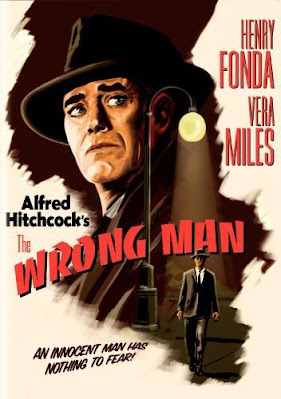
Hitchcock's "The Wrong Man": Realism versus Drama

Alfred Hitchcock made no secret of the fact that he was fond of stories based on the “wrong man” motif. Most famously he used it in the 1959 comic thriller North by Northwest, in which a bland businessman (Cary Grant, of course) is mistaken for someone else, a man who poses a serious threat to a cadre of evildoers. While desperately insisting he knows nothing about the nefarious plot that’s afoot, he is drugged, chased, shot at, and otherwise harassed by the baddies, right up until the ultimate happy ending. Hitchcock biographers have a field day discussing their subject in terms of his belief that human beings are just one small step away from being implicated for something they haven’t done.

 There is in fact a Hitchcock film titled The Wrong Man.  It was released in 1956, with Henry Fonda in the central role and Vera Miles as his wife. The expected Hitchcock cameo comes at the film’s very beginning, when the director himself appears in silhouette, explaining that this film is unique in his canon for being closely based on true events. So deliberately does the script follow the actual “wrong man” story of Christopher Emmanuel "Manny" Balestrero that the film is sometimes referred to as a docudrama. The question is: does this adherence to literal truth enhance or detract from Hitchcock’s particular cinematic gifts?

 Fonda plays a jazz bass player with a steady gig at Manhattan’s then-famous Stork Club. He’s also a devoted family man who loves his wife and is a hero to his two sons. When his loving spouse reveals she’s going to need expensive dental work, he tries to cash in her life insurance policy, only to be fingered by several office workers convinced he’s the man who has twice robbed them at gunpoint. Poor Manny can’t seem to catch a break: storekeepers all over his Jackson Heights neighborhood identify him as the robber who’s been preying on them, and so  he’s dragged off to jail. Meanwhile, of course, the tension within his family accelerates, to the point where wife Rose suffers a serious mental breakdown and needs to be hospitalized. Even when a competent attorney comes to represent Manny,  there’s no relief: two of three witnesses who could clear him of the charges against him have died, and the third can’t be found. It’s only when the actual robber is fortuitously caught in the act that his nightmare (sort of) ends.

 Well, this was reality for one very unlucky man. Which doesn’t mean that his story holds much excitement for the moviegoer. As Manny’s plight got sadder and sadder, I started checking my watch. Fonda’s acting is highly credible, but watching someone suffer—with no wit, no poetry, no lesson learned—was not necessarily how I wanted to spend my evening. Filmgoers back in 1956 apparently felt the same way about this film, though a few intellectual types like Jean-Luc Godard have since given it high praise.

 By way of contrast, Hitchcock shot Saboteur in 1942. This story of an innocent man (Bob Cummings) suspected of bombing the defense plant in which he works plays nicely on the paranoia of the World War II era.  His flight from the law drives him from L.A. through the deserts of the Southwest to New York City, where the climax takes place at (and on) the Statue of Liberty. Romance of course creeps into the story. The bad guys are really bad, though it remains unclear exactly what they’re trying to accomplish, and why their ranks include society dowager types. Implausible, sure. But lots of fun.