Showing posts with label Henry Fonda. Show all posts

Tuesday, April 29, 2025

The Unexpected Mrs. Nixon, Superstar

Hollywood has always had a soft spot for movies about presidents. Both satiric comedies and heartfelt dramas have featured an American president in a leading role. There’s even a musical—an adaptation of the stage hit 1776—that features the song stylings of future U.S. presidents John Adams and Thomas Jefferson.

 Of all the American. presidents, it is Abraham Lincoln who has earned the most screen time. He’s been portrayed by Walter Huston in 1930; by Henry Fonda (as Young Mr. Lincoln) in 1939; by Raymond Massey in 1940’s Abe Lincoln in Illinois; and by an Oscar-winning Daniel Day-Lewis in 2012’s Steven Spielberg Civil War-era epic, simply called Lincoln. This is not to mention a more eccentric 2012 flick, Abraham Lincoln: Vampire Hunter.

 Among 20th century American presidents, the inspirational story of Franklin Delano Roosevelt contending with polio gave rise to 1960’s Sunrise at Campobello. Oliver Stone’s  JFK (1991) is less about John F. Kennedy than about the nagging questions behind his assassination. The up-and-down career of Bill Clinton was pseudonymously handled in 1998’s Primary Colors, in which John Travolta portrays a Clinton-like presidential rogue.

 Then there’s Richard Nixon, whose checkered presidency has been scrutinized in everything from a biographical drama (1995’s Nixon, starring Anthony Hopkins) to an intimate fact-based post-resignation film (2008’s Frost/Nixon) to a wacky comedy, 1999’s Dick. In all of these settings, there’s a role for First Lady Pat Nixon, but she’s always a peripheral character.

 That remains true of most First Ladies. Moviemakers are not terribly interested in their stories, except as they intersect with their husbands’ moments of high drama. (The one big exception is Jacqueline Kennedy, whose post-White House life as the tragic young widow of JFK confirmed her movie star potential. Natalie Portman portrayed her in 2016’s Jackie, earning herself an Oscar nomination.)

 I don’t think anyone is about to make a movie with Patricia Ryan Nixon at its center. In her lifetime (1912-1993), Pat was known as the spouse of Dick Nixon, as an apparently prim and proper helpmeet good at smiling and waving. But my friend and colleague, Heath Hardage Lee, has recently published a biography that turns the spotlight on someone who preferred to remain in the background. Lee’s book, The Mysterious Mrs. Nixon: The Life and Times of Washington’s Most Private First Lady, was recently named to the longlist for Biographers International Organization’s prestigious 2025 Plutarch Award. This well-researched biography explores Pat Nixon’s many appealing qualities—her personal grit, her great skill as a goodwill ambassador roaming the world on the nation’s behalf, her strong commitment to preserving her country’s history and institutions. There’s also, eventually, some revelations about the way her husband’s shadier aides tried—in the second Nixon term—to curb her enthusiasm for the First Lady’s traditional mandate to further her spouse’s White House goals. To read about Pat’s efforts to enhance the role of women in American government and on its courts is to be impressed by a First Lady who was in some ways well ahead of her time.

 Heath Lee’s book, which contains the fruits of interviews with many Nixon aides, friends, and family members, portrays its subject as a woman well worth knowing, even by those who were not fans of her husband’s politics. One of many surprises: Pat and Dick had a cordial and long-lasting relationship with Jack and Jackie Kennedy, both before and after the brutal 1960 presidential race that set them against one another. What I learned in reading The Mysterious Mrs. Nixon is that it’s fascinating to read about the woman who willingly stood behind the famous man.


Friday, January 17, 2025

Whatever Happened to Vera Miles?

Vera Miles? Whatever happened to her? And who was she, anyway? Miles, who’s alive and well at 95, was an Oklahoma-born, Kansas-bred beauty pageant winner who found her way to Hollywood in 1949. She played key supporting parts in films directed by John Ford (The Searchers) and Alfred Hitchcock (The Wrong Man, in which she was the wife of Henry Fonda, playing a real-life jazz musician falsely accused of robbery). She also was several times cast by the Disney folks as a lovable wife and mom, often in tandem with Fred MacMurray or Brian Keith, perhaps reflecting her own real-life role as the mother of four children. She also regularly appeared in featured roles on television. Despite all this, in her forty-five year career she never truly moved beyond second-tier stardom. 

Things might have turned out differently in the late Fifties if Miles, who was then under personal contract to Alfred Hitchcock, had gone through with Hitchcock’s plan to star her as the female lead in Vertigo. Hitchcock favorite Grace Kelly had moved from the soundstages of L.A. to the throne of Monaco, and Miles was singled out as a suitable replacement. Said the Master of Suspense, “Miss Miles is going to be one of the biggest stars of Hollywood because she has understanding and depth and ability and lovely legs.”  To that end, he ordered a fabulous wardrobe for Miles, and cranked up the Hollywood publicity machine. But life intervened. Hitchcock’s need for gall bladder surgery delayed the production, as did time-off requested by the hard-working male lead James Stewart. And then Miles had the nerve to become pregnant with her third child, a move that Hitchcock considered something of a personal insult. (He was to say in later years, “I hate pregnant women because then they have children.”)  So Kim Novak got the plum dual role of Madeleine Elster and Judy Barton instead, though Hitchcock did feature Miles in his television dramas and in a key supporting part as Marion Crane’s sister in Psycho.

I know all the above because of Christopher McKittrick’s new biography, Vera Miles: The Hitchcock Blonde Who Got Away, coming in March from University Press of Kentucky. There’s no question that McKittrick has done his homework. Though he never had the opportunity to speak to Miles directly, he seems to know everything there is to know about her life and times, and in passing fills us in on everyone with whom she ever connected. Though it’s interesting seeing her on the set of masterworks like Ford’s The Man Who Shot Liberty Valance, I was most impressed with Miles’ evolution in later years into a woman who knew how to stand up for herself, one who clearly saw the lack of meaty roles for women and became determined to do something about it. (I’d love to know what she thinks about the current crop of films like Anora, The Substance, and Emilia Pérez—as well as last year’s Poor Things—whereby today’s actresses are coming to dominate the industry in which she once played a significant part. As someone always considered ladylike, she might not be pleased by the outrageous roles Hollywood’s women are now undertaking.) 

McKittrick considers it refreshing that Miles, far from becoming a burned-out Hollywood cautionary tale, largely ran her career on her own terms. As he puts it, “If opportunities like that of Vertigo passed her by because she chose other, more personally fulfilling paths for her life, those were decisions she was happy to make and has continued to stand by in her retirement.”  


Friday, September 23, 2022

Two Who Only Live Once

No, You Only Live Once is not one-half of a James Bond movie. (Sorry about that!) Instead it’s an early film noir, dating back to 1937, about an ill-fated couple who hit the road after the husband’s violent escape from prison. There’s a long tradition in Hollywood of movies that focus on lovers who share a passion for fast cars and lives of crime. When I was coming into my own as a film enthusiast, the unforgettable flick was Bonnie and Clyde, which used the story of two actual Depression-era bank robbers to celebrate the audacity and the undying love of  a doomed pair. Admirers of Bonnie and Clyde tend to think back to films like 1950’s Gun Crazy for a similarly enticing blend of love, sex, and violence.

 But earlier “lovers on the lam” movies, like 1948’s They Live By Night, treat crime sprees with less exuberance. Their emphasis is on social wrongs that trap basically good-hearted lovers in nightmarish situations from which violence seems the only escape. I was interested to see this hold true in You Only Live Once, the second Hollywood film of the great Austrian director Fritz Lang., whose early credits included Expressionist masterpieces like Metropolis and M. Top-billed in You Only Live Once is Sylvia Sidney, a long-lived star who would be nominated for an Oscar more than thirty years later, as Best Supporting Actress for Summer Wishes, Winter Dreams. In You Only Live Once, she’s Joan, an efficient, ebullient career gal, working for a local public defender who adores her. To his dismay, she’s head-over-heels about a young convict, who’s just won release after his third prison stint. As played by rising star Henry Fonda, Eddie is an earnest young man who’s survived a rough upbringing. Ashamed of his past misdeeds, he’s determined to marry Joan and embark on a life of sober domestic bliss.

 After a joyous homecoming, Eddie’s problems continue to mount. Though he’s been promised a steady job as a truckdriver, his unsympathetic boss finds an easy excuse to fire him. A search for another position turns futile: no one wants to trust a guy with a prison record, no matter how much he’s determined to keep to the straight and narrow. (It’s the Depression, of course, so all jobs are scarce, but the film also seems to condemn a system that offers no constructive support to those who’ve left prison walls behind.)

 For Eddie, desperate to support himself and his wife, a return to crime seems to be the only alternative. But when a local bank robbery results in several deaths he swears he had nothing to do with it. No matter: he’s tried and convicted, ending up on Death Row.

 While loyal Joan struggles to free him, his execution date nears. A last-minute exoneration by the governor ironically results in more tragedy, including the death of one of Eddie’s most selfless supporters. Soon he and Joan are fleeing into the hinterlands, living as best they can. (Somewhere in there, Joan has a baby, without ever seeming to have been pregnant or in labor: the Thirties was a great decade for sweeping physical reality under the rug.)

 You Only Live Once isn’t raw and exciting, like such later lovers-on-the-lam films as Badlands and Thieves Like Us. Instead it’s heart-wrenchingly sad, with the intense Fonda and the vivacious Sidney suggesting to the viewer how human potential is wasted when basically good people are trapped by circumstances beyond their control. All they want is to live and love . . . but you only live once.


Friday, July 29, 2022

Choosing the Best Man

 Watching The Best Man, based on Gore Vidal’s hit Broadway play, I’m reminded of how much has—and hasn’t—changed in American politics over the past six decades. In 1960, when Vidal wrote his play, presidential candidates for the two major parties were still chosen at raucous political conventions whose outcomes were generally uncertain. And of course everyone was white and male, except for the dutiful spouses of the candidates, who knew how to smile on cue. But much remains the same: the party hacks running the show, the reporters eager for a scoop, the fact that some candidates will do just about anything to come out on top. To be, in other words, anointed the best man for the highest office in the land.

 Within the scope of the play, the political party in question was never named. But Vidal, who had strong (and sometimes cranky) political opinions, was clearly committed to putting his own views into a lively story about political skullduggery on the highest level. The play opened early in the same year that the Democrats were planning a presidential nominating convention in Los Angeles. The folksy but ultimately shrewd former president is clearly based on Harry Truman. (He was played both on stage and on screen by the invaluable Lee Tracy, who was nominated for a supporting actor Oscar for this role.) One leading candidate, a witty intellectual, reflects the style of Adlai Stevenson, who was twice the Democratic nominee against Dwight D. Eisenhower. His chief rival, who has adopted a far more grandstanding manner, is apparently a combination of the politicos Vidal distrusted: the up-and-coming John F. Kennedy, Richard Nixon, et al.

 When the film was made four years later, the 1960 election was long over. But viewers can identify L.A. landmarks of the era: the Ambassador Hotel; the Los Angeles Coliseum, the Sports Arena where the real JFK accepted his party’s nomination. And the hurly-burly of the convention floor is shot very effectively, conveying a true sense of being present as history unfolds. (Franklin Schaffner, mostly known for TV in 1964, kicked off a major film directing career with The Best Man.) The two rival candidates are played by Henry Fonda—as an idealist who can’t easily bring himself to fight dirty—and Cliff Robertson, as a pragmatist with the guts to do what it takes to win.  Which of them will make the better president? The former president’s all-important endorsement is up for grabs, and there’s a lot of dirty linen around, just waiting to be aired. Far be it from me to spill all the beans, but this was the first Hollywood film ever to use the word “homosexual.” Vidal’s well-structured story keeps us continually off-balance, leading to an ending that’s both happy and sad . . . and altogether satisfactory as a way to wrap up this mesmerizing tale.

 I should mention the rest of the strong cast, which includes Margaret Leighton as Fonda’s starchy British wife, Edie Adams as Robertson’s kittenish spouse, and (surprisingly) funnyman Shelly Berman in a small but key role. There’s also Ann Sothern as the rare female party operative, one who thinks of herself as the spokesperson for every woman in America. And I don’t want to overlook the film’s producers, who include veteran Stuart Millar and his protégé, the young Lawrence Turman. Turman, who yearned to produce a hit film all on his own, got his wish in 1967, with The Graduate. Larry was a huge help to me on my Seduced by Mrs.  Robinson. He’s now 95, and I wish him continued health.


Friday, March 18, 2022

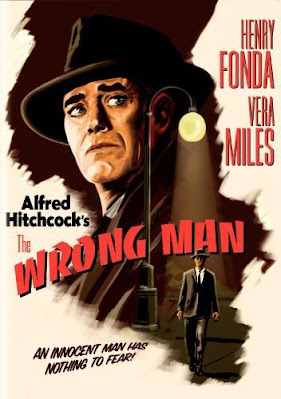
Hitchcock's "The Wrong Man": Realism versus Drama

Alfred Hitchcock made no secret of the fact that he was fond of stories based on the “wrong man” motif. Most famously he used it in the 1959 comic thriller North by Northwest, in which a bland businessman (Cary Grant, of course) is mistaken for someone else, a man who poses a serious threat to a cadre of evildoers. While desperately insisting he knows nothing about the nefarious plot that’s afoot, he is drugged, chased, shot at, and otherwise harassed by the baddies, right up until the ultimate happy ending. Hitchcock biographers have a field day discussing their subject in terms of his belief that human beings are just one small step away from being implicated for something they haven’t done.

 There is in fact a Hitchcock film titled The Wrong Man.  It was released in 1956, with Henry Fonda in the central role and Vera Miles as his wife. The expected Hitchcock cameo comes at the film’s very beginning, when the director himself appears in silhouette, explaining that this film is unique in his canon for being closely based on true events. So deliberately does the script follow the actual “wrong man” story of Christopher Emmanuel "Manny" Balestrero that the film is sometimes referred to as a docudrama. The question is: does this adherence to literal truth enhance or detract from Hitchcock’s particular cinematic gifts?

 Fonda plays a jazz bass player with a steady gig at Manhattan’s then-famous Stork Club. He’s also a devoted family man who loves his wife and is a hero to his two sons. When his loving spouse reveals she’s going to need expensive dental work, he tries to cash in her life insurance policy, only to be fingered by several office workers convinced he’s the man who has twice robbed them at gunpoint. Poor Manny can’t seem to catch a break: storekeepers all over his Jackson Heights neighborhood identify him as the robber who’s been preying on them, and so  he’s dragged off to jail. Meanwhile, of course, the tension within his family accelerates, to the point where wife Rose suffers a serious mental breakdown and needs to be hospitalized. Even when a competent attorney comes to represent Manny,  there’s no relief: two of three witnesses who could clear him of the charges against him have died, and the third can’t be found. It’s only when the actual robber is fortuitously caught in the act that his nightmare (sort of) ends.

 Well, this was reality for one very unlucky man. Which doesn’t mean that his story holds much excitement for the moviegoer. As Manny’s plight got sadder and sadder, I started checking my watch. Fonda’s acting is highly credible, but watching someone suffer—with no wit, no poetry, no lesson learned—was not necessarily how I wanted to spend my evening. Filmgoers back in 1956 apparently felt the same way about this film, though a few intellectual types like Jean-Luc Godard have since given it high praise.

 By way of contrast, Hitchcock shot Saboteur in 1942. This story of an innocent man (Bob Cummings) suspected of bombing the defense plant in which he works plays nicely on the paranoia of the World War II era.  His flight from the law drives him from L.A. through the deserts of the Southwest to New York City, where the climax takes place at (and on) the Statue of Liberty. Romance of course creeps into the story. The bad guys are really bad, though it remains unclear exactly what they’re trying to accomplish, and why their ranks include society dowager types. Implausible, sure. But lots of fun.


Tuesday, August 17, 2021

When Mob Rule Prevails: The Ox-Bow Incident

 My parents, who had no love for westerns, made an exception for The Ox-Bow Incident. And no wonder! This 1943 drama, directed by William Wellman from a novel by Walter Van Tilburg Clark, is hardly a glorification of machismo on the range. Instead, it’s a sobering study of mob mentality, graphically revealing what happens when a community is overcome by bloodlust.

 Anyone watching The Ox-Bow Incident today will be struck by the fact that its settings  (supposedly high in the mountains of Nevada) don’t seem entirely convincing. Much of the action looks like it was filmed on a studio lot, and indeed it was.  Because Ox-Bow was made in wartime, location shooting was an expensive luxury that mostly couldn’t be justified. But I’m struck now by how this film, by implication, has something to say about why men go to war in the first place. The movie begins as news arrives in a small western town that a well-respected rancher has been shot in the head and his cattle stolen. Immediately a mob forms in front of the local saloon, and there are loud cries for vengeance. Among those clamoring to form a posse to catch and lynch the culprits are many with their own agendas. One dour man in black is convinced that the arm of the law moves too slowly for true justice to be done. Another, the town drunk, is excited by all the talk of bloody vengeance. In the absence of the local sheriff, his newly-appointed deputy is determined to show off his own authority. A Civil War veteran who has a fancy uniform but a questionable war record takes on a leadership role, partly as a way of trying to force his gentle son to man up. Among all these blood-thirsty men is one woman (Jane Darwell), who enjoys being even more tough-minded that her male counterparts.

 It’s a surprise to see Darwell talk tough here, when we remember her so vividly as the gentle, noble Ma Joad in 1940’s The Grapes of Wrath. In that great film, Henry Fonda played her loyal son. Here, by contrast, he’s dead-set against her as she clamors for vengeance against three men who are fast asleep when found by the mob. Circumstantial evidence makes them seem guilty of the crimes, though the well-spoken Donald Martin (a fine performance by Dana Andrews) tries hard to explain why he and the other two (including a shady Mexican played by the young Anthony Quinn) are by no means culpable. There’s a haunting scene in which, facing death at sunrise, Martin pens a farewell letter to his wife back home while the posse celebrates with liquor and raucous song.

 Andrews’ performance is powerful, but the focal point of the picture remains Fonda, as a drifter with local ties. He may have a chip on his shoulder (for one thing, he’s just been dumped by the woman he loves), but he’s still got that fundamentally noble streak that’s embedded in so many Fonda characters: he rides out with the posse partly in the name of self-preservation, but he can’t bring himself to accept mob rule as a form of justice. By the time he made this film, Fonda was a Hollywood star, one whose best roles were low-key but fundamentally heroic. His personal politics—involving respect for the common man—always shone through on the screen. When he was a boy in Omaha, his father took him to the  site of the lynching of a Black man. The object lesson was clear: this was what happened when people forgot about their essential humanity.