Showing posts with label Boris Karloff. Show all posts

Friday, January 9, 2026

Not-So-Young Frankenstein

I’m afraid the Frankenstein story doesn’t really resonate with me. Circa 1990, when I worked for Roger Corman  at Concorde-New Horizons Pictures, a successful Hollywood producer named Thom Mount approached Roger with an offer he couldn’t refuse. Mount had been a Corman underling years before, and felt that his mentor should set aside his production company  obligations and return to directing. So he came to Roger with a deal: a cool million dollars to write and direct a film based on Mary Shelley’s 1818 gothic novel, Frankenstein, or, The Modern Prometheus, about a scientist who creates and animates a monstrous creature, only to live to regret his own folly.

 As Roger’s story editor, I was charged with overseeing the film’s script, which would ultimately be based on Frankenstein Unbound, a Brian Aldiss novel with a time-travel element: a man from our own era finds himself back in the early nineteenth century, interacting with Dr. Frankenstein, a sensuous Mary Shelley, and of course the monster. Naturally I read both the Aldiss novel and Mary Shelley’s original—and I can barely remember either one. But a few oddball things remain in my memory banks from the completed film. One is Roger’s decision to cast his fourteen-year-old daughter Catherine as a servant girl wrongly accused of murder. Young Catherine Corman played the role credibly, but it’s not every day that a film director hangs his own child on camera. (Today, Catherine, none the worse for wear, is a writer, photographer, and indie filmmaker.)

 I have two other memories of a film that most critics and most audiences have scorned. One is an awkward sex scene between Mary Shelley (played by the very young Bridget Fonda) and John Hurt as a very middle-aged visitor from the 20th century. The other is the moment when the Frankenstein monster finally finds a mate—and the two inexplicably lapse into a romantic pas de deux. This was in the version of the movie I saw at an advance screening, but apparently the audience reaction was so negative that the moment was cut from the released film. 

 Of course there are other cinematic versions of Mary Shelley’s work. Most of us know the classic 1931 James Whale film, featuring Boris Karloff as an ungainly but oddly likable monster who accidentally drowns a little girl because he doesn’t fully understand the game they’re playing. Karloff’s monster has become iconic, inspiring generations of Halloween costumes and a delicious Mel Brooks spoof. But Spanish director Guillermo del Toro had long wanted to try his hand at creating an intelligent, sympathetic Frankenstein monster. His new approach (with Oscar Isaac as the scientist and the very tall Jacob Elordi as the monster)  is visually exciting, But it also seems endless and, frankly, more than a bit sappy, leaning heavily on ultimate recognition by man and monster that they’re in many ways father and son . . . and that it’s not nice to fool with Mother Nature.

 There’s much philosophical meat in the Frankenstein story, and we in the 21st century are well advised to be aware of the dangers of taking science too far. But I don’t think del Toro, for all his good intentions, has made a movie that’s philosophically worth our attention. Curiously, it was just two years ago that Yorgos Lanthimos directed a film that—while in no way based specifically on Shelley’s novel—approaches some of that book’s intellectual concerns. I’m talking about Poor Things, in which a female “monster” reminds us of the dangers of science, and what it might take to move beyond them. 


Tuesday, April 1, 2025

The Play’s the Thing: "Arsenic and Old Lace"

Once upon a time, hit movies got their start as Broadway plays. This was long true of blockbuster musicals, of course: think of the stage-to-screen metamorphosis of (for example) Oklahoma!, My Fair Lady, The Sound of Music, and Fiddler on the Roof. (Today, though musical theatre is a much harder sell than it once was, the current box-office success of the screen’s Wicked reminds us how a beloved stage play can translate into a motion picture bonanza.)  But stage comedies without musical underpinnings have also been the source of screen success. Think back to 1936, and the Kaufman and Hart screwball stage hit, You Can’t Take It With You, about a family of lovable eccentrics whose daughter falls in love with the son of a stodgy banker.  Two years later, the play was filmed with an all-star cast led by Jean Arthur, James Stewart, and Lionel Barrymore, winning Oscars for Best Picture and for Frank Capra’s direction.  

The awards racked up by You Can’t Take It With You may have been somewhat unique (it’s rare for light comedies to take home top prizes), but there was a time when many a Broadway comedy enjoyed additional kudos for its screen iteration. Clearly loads of people who lived far from Broadway were eager to see shows they’d only heard about, especially if their favorite Hollywood stars appeared in the movie version. Here’s one example: a little farce called The Solid Gold Cadillac, a big Broadway hit of the 1954-55 season, was filmed in 1956. The little old lady of the stage version—someone who upends the business world with her unexpected financial savvy—became in the film the much-younger, much-cuter Judy Holliday, who won critical praise and a Golden Globe nomination. 

Which leads me to mention that the little-old-lady star of the original stage version of The Solid Gold Cadillac was Josephine Hull, who was almost 80 when she created the role. Though she lost that part to the thirty-something Holliday, she did appear on screen in several classic stage-to-screen transfers, including Harvey (that’s the one with the invisible rabbit) and Arsenic and Old Lace. For the latter, released on screen in 1944, Frank Capra was again involved. This time the laughs came from a macabre set-up involving a Brooklyn theatre critic whose two sweet elderly aunts have a surprising habit of bumping off lonely old men with glasses of elderberry wine, delicately laced with arsenic, strychnine, and cyanide.

 In the film version, Mortimer Brewster (a newlywed after a lifetime of disparaging marriage) is played by none other than Cary Grant. I’ve enjoyed Grant’s appearances in many film comedies (from Bringing Up Baby to Charade), but this may be his most physical role of all. His job is chiefly to react with astonishment to all the zany, grisly doings occurring around him, and Grant is definitely up to the challenge: watching him drop his jaw, bug out his eyes, and do elaborate double-takes is a masterclass in comedic acting. But there are lots of other talented farceurs involved. Chief among them are Jack Carson as a cop with dramatic ambitions, Edward Everett Horton as the proprietor of a lunatic asylum, Jean Adair as Josephine Hull’s lovably addled sister, and the inimitable Peter Lorre as a surgeon with a serious drinking problem. The stage version had featured Boris Karloff as Mortimer’s disfigured (and very scary) brother. As the biggest name in the cast (as well as the play’s chief investor), Karloff couldn’t leave the play to perform in the film version, so Raymond Massey (in Frankenstein-adjacent Karloff makeup) does the honors. 


Saturday, May 14, 2011

Lord Willing and the Creek Don't Rise


It’s tough to hear about flooding in the Mississippi Delta. First tornados, then floods: the weather reports sound like something out of a Biblical prophecy. Of what does the old Negro spiritual warn us? No more water; fire next time. That haunting phrase, based on the Book of Noah, can certainly make you stop and think.

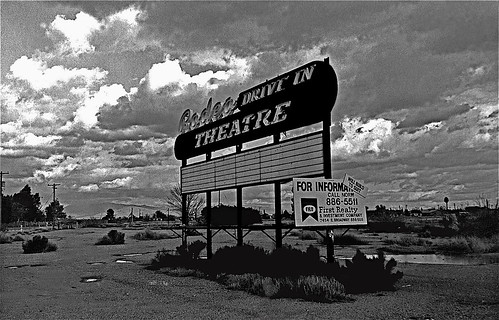
But when I heard an NPR reporter mention Yazoo City, Mississippi, my mind wandered from the current crisis to my early days at Roger Corman’s New World Pictures. Though my chief duties were in story department (heck, along with Frances Doel I WAS the story department), I was also asked by Roger to help out with graphing the distribution of such classics as Night Call Nurses and Angels Hard as They Come. More often than not, our movies were booked into drive-ins in out-of-the-way burgs I wouldn’t much care to visit. But they had such wonderful names! I distinctly remember that Yazoo City was a popular venue for New World fare. My special favorite, though, was (as I remember it) the Dogwood Drive-In in Palestine, Texas.

The drive-ins were fading away even then, as the land they sat on became too valuable to devote to teenagers in parked cars. In their heyday, however, they set the scene for an unbeatably American combo: the romance of the automobile plus the romantic urges of horny young people, who could barely be bothered to look at the screen. But drive-ins were also frequented by large family groups on small budgets. Jody Armour is now a USC professor of law, but he recalls that in the Sixties, when money was tight, turning off the TV set and going on a family outing to a drive-in was a very big deal: “We’d think about it days ahead of time . . . . If you saw Planet of the Apes, one of the early movies I remember, that really lived with you. You went home and you dreamed about those huge apes that were 25 feet tall on that silver screen in the drive-in.”

In 1968, Roger Corman gave young Peter Bogdanovich a chance to direct a movie that would meld two days of work by horror star Boris Karloff with footage from Karloff’s vintage Corman film, The Terror. Bogdanovich and his multitalented wife Polly Platt dreamed up the notion of casting Karloff as an aging movie actor who is menaced by a sniper at a drive-in theater. It was a brilliant concept for a contemporary horror film, and Targets ended up launching both Bogdanovich and Platt on impressive careers. Three years later, the pair made The Last Picture Show. Apparently the Lord was willing, and both of their lives were changed forever.