Showing posts with label Charles Laughton. Show all posts

Thursday, June 23, 2022

Playing With Time in “The Big Clock”

Alfred Hitchcock, it is said, was far more interested in suspense than in mystery. Rather than making Agatha Christie-type whodunits, in which we struggle to figure out the identity of the murderer, he focused on the tension surrounding the apprehension of the guilty party.  A particular favorite Hitchcock device was that of the “wrong man,” the innocent who’s wrongly accused of a serious crime and must spend the rest of the film trying to shake off those determined to apprehend and convict him.

 A 1946 novel proved much sought-after by the motion picture industry because of its elaborate twist on the “wrong man” genre. The Big Clock, by Kenneth Fearing, ultimately became (after several plot changes) a 1976 French crime drama starring Yves Montand, as well as a 1987 political thriller, No Way Out, with Kevin Costner in the leading role. But the film adaptation closest to the original material retained the book’s title, The Big Clock, and cast Hollywood stalwarts Ray Milland, Charles Laughton, and Maureen O’Sullivan as its leads. It was directed by John Farrow (yes, Mia’s father), and overseen by Richard Maibaum, a longtime producer and screenwriter best known today for his work on 13 James Bond screenplays.

 Like many a noir-type feature, the screen version of The Big Clock begins near its climax, with Ray Milland’s George Stroud hiding from the law inside an office tower distinguished by an enormous set of international clock faces. Time, as he notes in a voiceover, is not on his side. He’s wanted for murder, and the police are hot on his trail.

 Then we flip back a few hours to how it all began. Stroud is editor-in-chief of Crimeways Magazine, part of the Janoth publishing empire headquartered in the skyscraper that boasts the huge clock. So valuable is he to the imperious Earl Janoth (played with his usual outsized presence by Charles Laughton) that Stroud and his wife have never had a proper honeymoon. Now he’s determined to change all that, defying Janoth’s insistence that he give up a sweet little West Virginia getaway to follow up on some true-crime leads that have come his way.

 In sticking up for his personal freedoms, Stroud gets sacked, then finds himself in a barroom commiserating with Janoth’s unhappy mistress (Rita Johnson as Pauline York). It won’t be long before she turns up dead, and someone has glimpsed him stealing away from her apartment not long before the discovery of her murder with a blunt object that had recently been in his possession.

 The twist is that Janoth, much less interested in Pauline’s death than in the potential for covering an exciting manhunt in his magazines and tabloids, enlists Stroud to track down the killer. We know Stroud didn’t do it; we also know who did. But every clue he uncovers in the line of duty points back to himself as the guilty party. Before poetic justice is finally served in the film’s last few minutes, we see a man unraveling as he comes closer and closer to being apprehended for a crime he didn’t commit. Though there’s a morose take on corporate culture in The Big Clock, ultimately the wicked are punished and the righteous man finds his reward. Which is how the world should work, right?

 As always, Milland makes a good hero and Laughton steals the show as his avaricious boss. And, as is so often true, the women are basically just along for the ride. One exception is Laughton’s real-life wife, Elsa Lanchester, as a dotty artist who provides some much needed comic relief.

 

Thursday, March 10, 2022

It’s Not Nice to Fool (With) Mother Nature: “Island of Lost Souls”

Those with long memories may recall a TV commercial for a brand of margarine, featuring a daintily costumed celestial figure who discovers to her surprise that she’s not eating real butter, then snarls, “It’s not nice to fool Mother Nature.” (Cue the lightning strike.) This of course is the subliminal message of the scores of science-fiction and horror films in which a scientist, overloaded with brains and hubris, seeks to move outside the natural order to create something brand-new . . . and inevitably horrible.

 Where would Hollywood be without this basic plotline? Certainly I came across it time and time again when working for Roger Corman. One example is 1993’s Carnosaur, which we at Concorde-New Horizons made—fast and cheap—for one very specific reason: to beat Steven Spielberg’s Jurassic Park into theatres. Jurassic Park and its sequels are, as all film fans know, modern classics in the upend-the-natural-order genre, setting up a world in which a crazed visionary has installed cloned dinosaurs in a modern-day theme park.  (Naturally they escape and run amok.) Our Carnosaur, inventively devised by writer/director Adam Simon, changes things up by introducing a FEMALE mad scientist (Diane Ladd), one who bioengineers a Tyrannosaurus Rex while working on genetically modified chickens. (Or something like that.)

 The film in which Roger Corman made his return to directing after nearly twenty years, Frankenstein Unbound (1990) of course draws from one of the world’s most famous mad-scientist stories. Mary Shelley, the very young wife of English poet Percy Bysshe Shelley, created the character of Frankenstein as part of an around-the-hearth competition of literary types vying to come up with the best ghost story. Shelley’s novel, Frankenstein; or, The Modern Prometheus, was published in 1818, when she was 20 years old. Its title character is not the monster, but rather the bright young doctor who assembles a creature out of scavenged body parts, then finds a way to bring it to life. Needless to say, the consequences are horrific—and the movies based on them, starting with James Whale’s (and Boris Karloff’s) Frankenstein  in 1931, continue to titillate us today.

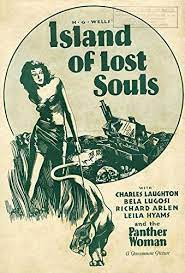
 Like the Frankenstein films, Island of Lost Souls is based on a nineteenth-century English novel. Its source material is The Island of Dr. Moreau, written by pioneering science-fiction author H.G. Wells, who clearly saw the dangers as well as the promise of scientific research into the origins of man. This story about a crazed vivisectionist, living on a distant Pacific island, who labors to turn wild beasts into humans, has spawned a dozen film versions, starting back in the silent era. In a 1996 movie, Marlon Brando played the mad doctor. But Island of Lost Souls, a pre-code flick from 1932, has the always-mesmerizing Charles Laughton in the role. Naturally, the film is stiff and creaky. But I was particularly fond of the young actress, Kathleen Burke, who is named in the film’s opening credits solely as The Panther Woman. Despite her supposed genetic inheritance from the animal kingdom, she’s a sweet, lovely creature desperate to find human love. Bela Lugosi is also around in a small role, giving the story an additional frisson.

 I’ve learned that the subject matter of Island of Lost Souls did not go unchallenged Many national film boards opposed the lines containing Moreau’s boast that he was playing God. Cruelty to animals was a big issue for some, and eventually there were bans in places like Sweden and the UK. If you were a white Australian, you could see the movie unchallenged, but Aboriginals were barred. Today, of course, anything goes.

.


Tuesday, February 22, 2022

Oh, O'Henry!

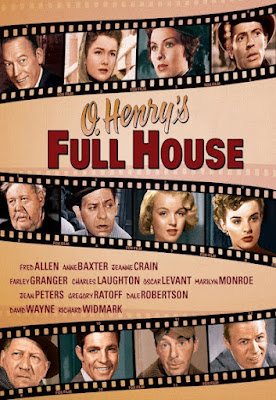
They don’t make ‘em like that anymore:  compilation films based on sentimental stories from a single author. But in 1952, Twentieth-Century Fox assembled its most experienced directors and its brightest box-office stars to bring to the screen five stories by O’Henry, he of the famous twist endings. To give their film added cachet, Fox creatives chose as their narrator the great American novelist, John Steinbeck. Backed by a book-lined study, Steinbeck—in his sonorous baritone—praises William Sydney Porter’s literary skills, the ones that made his literary alter ego famous throughout the world, and sets the scene for each tale. The whole mishmash is given its own title: O’Henry’s Full House.

 Needless to say, the stories are a mixed bag, depending on the varied contributions of writers, directors, and actors.  Henry Koster may not have the best track record of the directors represented here, but since his “The Cop and the Anthem” stars the great Charles Laughton at his finest, the opening segment is definitely the best. Laughton plays Soapy, a jovial n’er-do-well with no visible means of support. His usual M.O., when the city is too cold for sleeping on park benches, is to break a few laws and  then enjoy three months in a comfortable jail cell. Only problem: though he steals an umbrella, throws a brick through a store window, and eats a sumptuous meal for which he has no money to pay, he can’t manage to get himself arrested. When he is at his lowest ebb, clutching at the hope of a better life . . . that’s when O’Henry’s brand of irony kicks in. (I’ve got to mention a small but memorable role by Marilyn Monroe, whose short scene with Laughton has a poignance that’s truly impressive.)

 “The Clarion Call,” about a crime reporter who meets up with a childhood-friend-turned-criminal, is most interesting for the outsized performance of Richard Widmark. As the maniacal crook with the bizarre laugh, Widmark was borrowing from his own Oscar-nominated performance in 1947’s noir classic, Kiss of Death, also directed by Henry Hathaway. I’m told that Widmark’s inspiration for both roles came from his love of the Joker character in Batman comics. And his portrayal, in turn, influenced Frank Gorshin’s Riddler and other screen Batman villains.

 O’Henry had a special sympathy for the joys and (particularly) the woes of common folk, especially those who led luckless lives in city tenements. “The Last Leaf” is a prime example of the author at his most sentimental. It’s the story of a young woman (Jean Peters) jilted by her wealthy lover, who returns to her humble flat and succumbs to pneumonia. Winter is coming on: as her sister (Anne Baxter) worries over her, she becomes obsessed with the idea that she’ll die when the last leaf falls from the vine she can see from her window. Gregory Ratoff plays a down-at-the-heels old artist who wants to help her regain her will to live.

 Two of O’Henry’s most famous stories come last. Writer Ben Hecht and director Howard Hawks were involved with the comic tale of “The Ransom of Red Chief,” with Fred Allen and Oscar Levant as two inept conmen who plan to kidnap a local boy and hold him for ransom. As a pop culture fan in the Fifties might have said, “Taint funny, McGee.”

 The schmaltz reaches its peak with “The Gift of the Magi,” in which Jeanne Crain and Farley Granger—impoverished young marrieds—sell their most prized possessions to buy one another the Christmas gifts of their dreams. We end with Christmas carols and happily-ever-after. Aw shucks! 

 Dedicated to Jack Neworth, fellow Laughton admirer, for introducing me to this obscure title.