
Happy birthday to Ron Howard, 68 years old today.
Early in this century, while researching my Ron Howard: From Mayberry to the Moon . . . and Beyond, I wrote a polite letter to my subject, requesting his cooperation on the project. The note he sent back to me was a polite turn-down: Howard explained that he wasn’t yet ready to step back and assess his own life story. Someday he hoped to be able to write his own memoir. Expecting no less, I continued on with my own book, one that was published in 2003 and turned into an audiobook just last year.
(A much less polite turn-down came from the head of Howard’s company, Imagine Entertainment. When I got this pompous man on the phone, he fumed, “How dare you? What right do you have?” As an honest journalist researching a major public figure, I had every right, but that’s another story.)
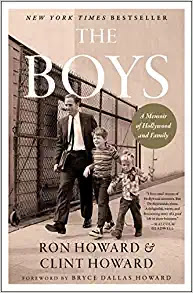
A few months back, Ron Howard made good on his dream of writing up his memories himself. Along with brother Clint, he has published The Boys: A Memoir of Hollywood and Family. The Howards have dedicated the book to their now-deceased parents, Rance and Jean Howard. If their musings sound potentially saccharine and self-serving, believe me that they’re not. One thing the two brothers clearly learned from their salt-of-the-earth parents is the value of truth-telling. Rance Howard, from all accounts, always wanted to be straight with his sons when they asked awkward questions, even in their tender years. That’s why, when Jean was expecting Clint, Rance drew crude stick figures to explain to little Ronny how babies get conceived, And on the set of The Andy Griffith Show, Rance was at pains to explain to young Clint the meaning of the drawings on the men’s room walls, even while warning Clint never to take up the practice.
So “the boys,” paying tribute to their parents, are frank about the joys and woes of growing up as child actors. They recognize the unparalleled opportunities to which their careers gave them access, as well as the awkward fact that by being TV celebrities attending a middle-class public school they were doomed to struggle to fit in. They are both candid and colloquial in their narration of what it was like to be “different” during their school years. And they freely acknowledge that in some ways their youthful success (particularly that of Ron, featured in The Music Man as well as TV’s Andy Griffith Show and later Happy Days) was tough on their actor-father who never moved beyond being a journeyman thespian, mostly cast in modest roles in his sons’ projects.
Alternating as narrators, Ron and Clint present their own take on the life they’ve led. Ron details his adolescent angst when his career seemed to be drying up, as well as the way he finally was able to switch from acting to directing, thanks to Roger Corman’s penchant for giving “name” actors a shot at the director’s chair, so long as they were comfortable with sex, violence, and low-budget production values. The rambunctious Clint, meanwhile, is frank about the struggles with drug and alcohol addiction that began in high school. Because the book ends as Ron, in his twenties, is launching his directing career and Clint is making the shift from juvenile roles into character acting (with a specialty in outrageous performances), we aren’t treated to an in-depth look at the Howards’ adult years.
I’m thrilled that Ron picks up one of my own themes, explaining his passion for stories about bold leaps in terms of his parents’ audacious runaway wedding. I, for one, say “More, please.”


