Showing posts with label Donald Sutherland. Show all posts

Tuesday, June 25, 2024

An Ode to the Elastic, Electric Donald Sutherland

I first knowingly encountered the late Donald Sutherland in 1968, in an odd little British film called Joanna. Then and now, I’ve been unsure if Joanna was intended as an ode to Swinging London (the miniskirts! the casual sex!) or a morality tale or a spoof. It did have a very pretty leading lady, a score by Sixties fave Rod McKuen, and several hunky young men. It also had Sutherland as the wealthy but terminally ill Lord Peter Sanderson, who hosts Joanna and her groovy friends at his sumptuous home in Morocco. When he came on screen, I thought I had never seen such a weird-looking person. There was a fey quality to him that had me completely baffled: was there some sort of comment being made about his sexuality? I didn’t know, but I didn’t much care. Joanna was a movie that didn’t invite hard thinking.

 It took a while to realize I’d seen Sutherland a year earlier in a vastly different role, that of a not-too-bright Southerner named Vernon Pinkley who hilariously steps in to impersonate a general in a World War II action drama, The Dirty Dozen. That was the thing about Sutherland: you couldn’t pin him down. Even his nationality seemed flexible: the Canada-born Sutherland played British and American roles with equal conviction.

 It was in 1970 that Sutherland had his big Hollywood breakthrough. Though for fans of the long-running TV series, Alan Alda will always be the REAL star of M*A*S*H, Robert Altman’s original film starred Sutherland as Hawkeye Pierce. He and Elliott Gould as best buddy Trapper John McIntyre found stardom as two young battlefield surgeons who cope with the horrors of the Korean War by way of outrageous antics. One year later he played the title role in Klute, a neo-noir thriller best remembered for Jane Fonda’s Oscar-winning role as a prostitute being stalked by a killer. Sutherland’s role is that of a detective who becomes Fonda’s protector and then her lover. The powerful connection between Fonda and Sutherland,  which allegedly spilled over into their personal lives, led to Sutherland’s deep involvement in Fonda’s crusade against the Vietnam War.

 Another intensely dramatic role for Sutherland was opposite Julie Christie in 1973’s psychological thriller, Don’t Look Now. The eerie Venice-set drama, brilliantly directed by Nicolas Roeg, focuses on young parents trying to get past the accidental death of their young daughter. In the midst of their all-consuming grief,  there’s a sex scene that raised many eyebrows for its convincing eroticism, leaving some viewers certain that the intimacy on screen was genuine.  (Sutherland has staunchly denied this.) He was also a grieving father in Robert Redford’s Oscar-winning Ordinary People (1980), though most of the film’s accolades went to Mary Tyler Moore and young Timothy Hutton, who played his wife and his surviving son. But none of this should imply that Sutherland only took on somber roles. He played everyone from heroes to goofballs, like the pot-smoking professor in National Lampoon’s Animal House. He was even a stuffy British patriarch (and Keira Knightley’s father) in Joe Wright’s 2005 version of the Jane Austen classic, Pride and Prejudice, as well as the chief villain in The Hunger Games. Though Oscar nominations eluded him, the Academy in 2017 granted him an honorary Oscar “for a lifetime of indelible characters, rendered with unwavering truthfulness."

Today son Kiefer (named after Donald Sutherland’s very first director) carries on the family commitment to screen acting. But it’s unlikely he’ll ever top his father’s long and varied list of achievements. 


Tuesday, April 18, 2023

Four Degrees of Kevin Bacon


Six Degrees of Separation is a 1993 film, based on a hit Broadway play, in which a wealthy, cultured, and liberal-minded couple (Stockard Channing and Donald Sutherland) welcome a personable Black man (the young Will Smith) into their posh Manhattan condo. He’s articulate but bedraggled, claiming to be the victim of a Central Park mugging. After some coy evasions, he admits he’s the son of superstar Sidney Poitier. Of course they urge him to spend the night.

 It all smacks of a con—especially after they find him in bed, in the nude, with a second young man—but Smith’s Paul is not your average grifter. The film, which also stars Ian McKellen and a starry cast under the direction of Fred Schepisi, is fundamentally about the human need for connection, and about what human beings will do to create bonds with one another. It’s the source of the idea that (to quote Channing’s dialogue at one point) “everybody on this planet is separated by only six other people. Six degrees of separation between us and everyone else on this planet.”  

The stage version of Six Degrees of Separation, from 1990, was nominated for multiple awards. The  film garnered fewer accolades, although Channing (repeating her stage triumph) was in the running for a Best Actress Oscar. Part of the problem was that the movie version, despite some creative directorial choices, still felt like a filmed play.  Also, the complex nuances of these characters and situations probably didn’t come across to moviegoers.

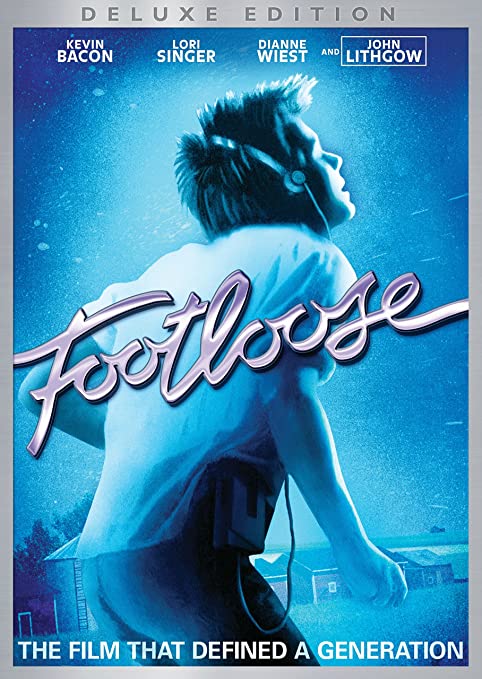
 The same can NOT be said of a 1984 film called Footloose, in which Kevin Bacon plays a teen from Chicago who teaches some small-town Texans about the joys of dancing. Here’s a musical that’s simple, straightforward, and just made for toe-tapping, starting with all those pairs of quick-stepping feet we see under the opening credits, grooving to the catchy beat of the title tune. Catching up with Footloose years after its screen debut, my movie companion and I marveled at Bacon’s skill-set: aside from his personal charm and acting chops, he was apparently a terrific dancer and also a gymnast who could effortlessly twirl on the high bar. That’s when I read that Bacon—whose movie fame was ensured by this role—had no fewer than four doubles on the set. These included a stunt double for fight scenes, a dance double, and two gymnastics experts. So the parlor game about “Six Degrees of Kevin Bacon” (a cheeky variant on the Six Degrees of Separation meme reflecting how the busy Bacon seemed to have worked with nearly everyone in Hollywood) could be adapted to indicate how, in this film, Bacon was everywhere, doing everything (with a little help from his friends).

 Though Footloose is easy enough to follow (and easy enough to love), it is not totally lacking in complexity. School dances are banned in this small town because of the efforts of the highly influential local pastor. But, as played by John Lithgow, he is not merely a zealot or a prude. Instead he’s a man who has turned his sorrow over  a family tragedy into a crusade against the elements he believes led to his son’s death. By contrast, his sexy young daughter (Lori Singer) has found her own dubious way of dealing with grief. Naturally, she and Bacon’s character (not to mention his dancing and gymnastic clones) end up connecting, and you can count on an ending in which pretty much everyone finds happiness.

 Which is certainly more than you can say for the ambiguous fadeout of Six Degrees of Separation.