Showing posts with label Hamilton. Show all posts

Tuesday, February 1, 2022

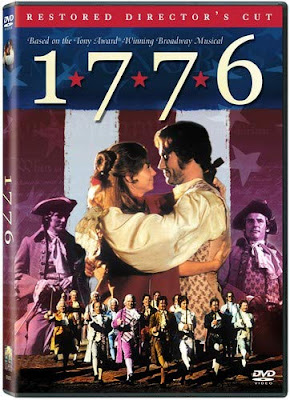
Doing a Number on “1776”

 Today if I mention a musical set in colonial America and reflecting the lives of the Founding Fathers, you’ll naturally think of Lin-Manuel Miranda’s magnum opus, Hamilton. That show, of course, has earned raves (and raised some hackles) for casting performers of color in the central roles, thus playing up the revolutionary side of the fight for a new republic, while also reminding us that (unlike the Dead White Men depicted in our high school history books) the founders were complex figures with complex, often-clashing views on race and everything else.

 But back in 1969, there was another hit Broadway musical about the Founding Fathers, one in which the Dead White Men of the history books were played by white men who were very much alive. The show won four Tony Awards, including Best Musical, for depicting in some detail a key moment in American history. Almost the entirety of 1776 plays out in and around Independence Hall, Philadelphia, where delegates from the 13 colonies are hotly debating declaring independence from Britain. Among the show’s unusual aspects: in the entire cast there are only two female roles (Abigail Adams and Martha Jefferson – no Sally Hemings here).  And there’s a thirty-minute stretch in the first act, as the delegates bicker over policies and procedures, without any musical numbers at all.

 Elsewhere there are songs aplenty, everything from a rollicking frontier ballad sung by a Virginian proud of his ancestry (“The Lees of Virginia”) to a stark lament about a young soldier lost on the field of battle. A delegate who after long months stuck in Philadelphia is deeply missing his beloved wife sings long-distance duets with her. But there are also ricky-tick comic ditties in which delegates insult one another, particularly heaping scorn on the much-disliked John Adams.

 I don’t know how all this played out on stage. But in 1972, ramping up for the nation’s bicentennial year, Jack Warner brought the stage production to the screen, keeping intact most of the original cast.  This meant moviegoers got to see as the “obnoxious, unpopular” though ultimately right-thinking John Adams an actor named William Daniels, best remembered as Benjamin Braddock’s jolly but domineering dad in The Graduate. His is the leading role, though I got much more enjoyment from Howard Da Silva as a sly and colorful Benjamin Franklin, Adam’s frequent (though frequently napping) sidekick.  

 Scholars agree that the story played out in 1776 takes some liberties with what actually happened. They insist, though, that it remains true to the gist of the basic arguments for and against declaring independence from the Motherland. Of course, the original delegates were not apt to burst into song,  nor to participate in quaint little dance routines. This may have worked well on the stage, where we expect a certain level of artificiality. The show’s creators felt their story was enlivened by music, and that songs served to humanize those historical figures who too often strike us as colorless, even stodgy. On screen, however, it’s jarring to watch Founding Fathers musically insulting each other. There’s a music-hall-style number in which Adams, Franklin, Jefferson, and some others—all trying to get out of writing the Declaration of Independence—toss back and forth the quill pen that is meant to be used on the document. This silly, obvious piffle is mirrored by a later (supposedly) comic number in which delegates hotly debate whether the national bird should be a turkey, an eagle, or a dove. (Adams wins on that one.)

 Verdict: fascinating material (including a tough debate on slavery) marred by trivializing musical turns. 


Friday, July 16, 2021

Going Wide-Screen with “In the Heights”

Lin-Manuel Miranda seems one of those rare Americans who can do no wrong. He’s charming! He’s funny! He’s personally gracious and politically “woke”! Miranda took a serious political biography about one of our country’s founding fathers and turned it into a megahit Broadway musical, with himself in the leading role. (Now the video version of Hamilton – basically a well-crafted filmed play – is up for a remarkable 12 Emmy awards.) Naturally, Hollywood has taken an interest. Miranda has played a variety of roles and raked in an Oscar nomination for his anthem, “How Far I’ll Go,” which plays a key role in Disney’s Moana. And he’s turned to film directing as well, with the upcoming tick, tick . . . Boom! It’s a tribute of sorts to Broadway’s Jonathan Larson, who wrote an autographical play about a struggling young musical-theatre composer, then died on the eve of the triumphant debut of his 1996 play, Rent. So one apparent genius (yes, Miranda owns one of those MacArthur “genius” grants) pays homage to another.

 In 2008. seven years before Hamilton, Broadway playgoers saw another Miranda opus, In the Heights, one that reflected his own upbringing in Manhattan’s heavily Latino Washington Heights. The show, again with Miranda in a key role, won the Tony Award for Best Musical, in what admittedly was a sparse year for musical hits. (Ever hear of Passing Strange? Cry Baby? Xanadu?) I happened to see the original cast in action. While I loved the show’s Latin rhythms and couldn’t fault the performers, I found the story lackluster at best. Yes, it was interesting to see ethnic Dominican and Puerto Rican immigrants to New York City reveal their challenges and their longings, but the specific characters on whom the plot focused seemed thinly drawn. In the stage version, In the Heights concentrates mostly on a Romeo and Juliet romance between the academically successful Nina and a young African-American named Benny, who works for Nina’s father’s car-service company. This schmaltzy clash of cultures as well as education-levels is complicated by Nina’s struggles as a homesick freshman at faraway dream-school Stanford.

 When it came time to make the movie,  Miranda and company smartly shifted the story’s chief focus from Nina and Benny’s forbidden (and not all that convincing) love to another of the play’s couples. On stage, Usnavi— the owner of a local bodega but one who longs to return to his native land -- was played by Miranda himself, mostly as a rap-happy narrator for the proceedings. Now, in his forties, he’s given himself a much smaller but still colorful role as a seller of piragua (shaved ice) who’s caught in a quiet battle with the local Mr. Softee vendor. (Don’t miss the Easter Egg at the very end of the credits, showing who is the victor in their long-term rivalry.) Meanwhile Usnavi, now played by the fresh-faced Anthony Ramos, becomes one of the film’s romantic leads, as he yearns for the affection of the ambitious, artistic Vanessa.

 It’s a smart re-think of the story, though the still-present Stanford subplot strikes me as sloppy and bogus once more. (Here’s a great take-down by an actual Stanford graduate from a background similar to Nina’s.) But I chose this film for my return to the cineplex because I wanted to see its musical numbers in all their glory. They are indeed glorious, if perhaps overwhelming after a while. Everyone sings and dances – young kids, abuelas – on the streets, in the public swimming pool, up and down the sides of tenement buildings. Perhaps this feel-good film is just what we need right now.


Tuesday, July 7, 2020

Unmasking Alexander Hamilton in the (Living) Room Where It Happens


 It’s an ill wind, they say, that blows no one any good. As we all live through the enforced boredom of the COVID-19 pandemic, Lin-Manuel Miranda’s Hamilton is making a mighty comeback in living rooms everywhere. Would-be theatregoers like me had our expensive tickets refunded at the start of quarantine. But in a great trade-off, we can now see the original cast in the filmed version of the stage production, by committing to a month of Disney+.

Normally a filmed play is not something to get excited about. The thrill of live theatre lies in its spontaneity: the fact that drama blossoms right before your eyes. The audience, fundamentally, is part of the show. Some productions capitalize on this fact by staging the action in such a way that the onlookers are personally drawn in. Back in the 1930s, Clifford Odets’ Waiting for Lefty, which culminates in a labor uprising, planted strikers in the audience, the better to shake up the crowd. In 1967, Hair sealed its connection with the young people in their theatre seats by inviting them on stage to dance with the cast, while their parents awkwardly stayed put. The stage version of The Lion King mesmerizes audience members by opening with a animal parade up the theatre aisles.

Hamilton is not the kind of show that relies on such (let’s face it) gimmickry: the actors stay on the stage and the audience stays in its seats. Still, this very pointed re-telling of the birth of the U.S.A. uses such innovations as rap music and the Founding Fathers played by actors of color, all to drive home a point about the revolutionary nature of the great American experiment. Individual performances have generated electric excitement, particularly just after the 2016 election when Vice-President-elect Mike Pence was in the house. Since then, Hamilton has continued to be a hot ticket, particularly among those new to the theatre-going experience. The show’s reach has been so great that when John Bolton, former National Security Advisor in the Trump administration, put forth his tell-all book, he apparently borrowed its title, The Room Where It Happened, from Hamilton’s jazziest tune.

Because Hamilton, in its Broadway staging, has become such a cultural phenomenon, the always shrewd Disney company saw fit to back the filming of the play, planning to release it at cineplexes next year. COVID changed those plans: with all of us currently addicted to TV viewing, it made sense to release the film NOW, as a splashy way to kick off Disney’s new subscription service.

Years ago I graduated from (really!) Alexander Hamilton High School. There was a statue of Alex in our main building, but few of us had much interest in the man himself. In his knee britches and pigtail, he looked singularly boring: all we knew is that he was Secretary of the Treasury (big whoop!) and had the bad taste to die in a duel. Too bad, we all thought, he wasn’t someone exciting, like, say, Thomas Jefferson. In Lin-Manuel Miranda’s rendition, Jefferson is a real sparkplug, though not perhaps someone worth admiring. Hamilton, by contrast is a bastard, an orphan, and an immigrant—who knew? Also brilliant and occasionally very much mistaken.

I saw a road company of Hamilton in Chicago, in the third balcony of an enormous old theatre. I enjoyed it, but felt I was missing the nuances enjoyed by those in orchestra seats. Thanks to a film version artfully photographed (with ten cameras) and edited, I could finally truly see what the historic hoo-ha was all about.