Showing posts with label James Baldwin. Show all posts

Tuesday, January 11, 2022

The Importance of Being Sidney (Poitier)

How well I remember the evening in 1964 when Sidney Poitier became Hollywood’s first African American winner of the Oscar for Best Actor. The film was Lilies of the Field, in which he played a wanderer in the parched American Southwest who is persuaded by some feisty German nuns to build a chapel for the glory of God. It’s a charming movie, one that could raise few hackles among those who were made uneasy as the Civil Rights Movement built up steam. My parents and I were thrilled that the film industry had gotten it right, giving its highest honor to someone who so clearly symbolized social progress.

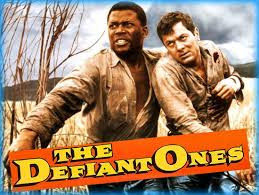
 It wasn’t Sidney Poitier’s fault that he was the right man at the right time. Starting in the late 1950s, Hollywood was realizing that African Americans should be seen as more than Pullman porters, shoeshine boys, and lazy household retainers in the Stepin Fetchit mold. Tall, handsome, and ebony-skinned, Poitier fit naturally into hero roles, and had neither opportunity nor inclination to try for a broader range of parts, such as those that later Black actors like Denzel Washington have enjoyed. Even while playing an escaped convict in Stanley Kramer’s The Defiant Ones (1958), Poitier displayed a natural nobility that inspired white audiences while sometimes annoying Black intellectuals. James Baldwin noted in The Devil Makes Work how “liberal white audiences applauded when Sidney, at the end of the film, jumped off the train in order not to abandon his white buddy. The Harlem audience was outraged, and yelled, ‘Get back on the train, you fool!’”

 Karen Kramer, who became close to Poitier through her director-husband, admits that, off-camera, Poitier “didn’t know where he belonged. He was not completely accepted by the white community, and he was stepping out of bounds with the black community. So he was in limbo there.” Rod Steiger, Poitier’s In the Heat of the Night co-star, later revealed how Poitier chafed at being designated the Prince of his People: “They put this image on him, for chrissake. He couldn’t yell, couldn’t swear, couldn’t do anything, ‘cause he was the prince of the black race.” This awkward label made Poitier jealously guard his private hours, and contributed to his hypersensitivity about his reputation with the moviegoing public.

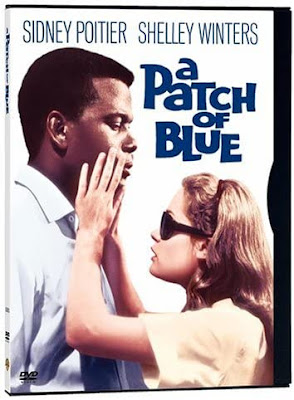
 By the mid-Sixties, Poitier’s roles invariably showcased a man alone, set apart from society by the color of his skin. Never was he allowed such basic things as romance or even sexual urges. In 1965 he twice starred opposite gifted white actresses: Elizabeth Hartman as a needy blind girl in A Patch of Blue; Anne Bancroft as a suicidal matron at the other end of a telephone hotline in The Slender Thread. In both films he shows compassion, but also physical detachment. In the Heat of the Night makes it clear, in a key scene, that he’s a loner, a cop married to his job.

 In the banner year 1967, when Poitier was Hollywood’s biggest box office draw, Guess Who’s Coming to Dinner fomented even more ire among Black viewers, because it celebrated their Sidney as the unexpected fiancé of a (rather vapid) white woman. The film prompted a young Black playwright, Clifford Mason, to publish in the New York Times a scathing take-down titled “Why Does White America Love Sidney Poitier So?”  Recently Mason explained to me his vitriol toward Poitier as an outgrowth of dashed expectations. He’d hoped for a leading Black actor who could truly tackle the hard issues. Mason now phrases his disappointment in movie terms: “I wanted Bogart, but all I got was Cary Grant.”


Tuesday, January 8, 2019

Trying Not to Yawn on Beale Street


Well, the Golden Globes have just been handed out. In the drama category, all three of the BLACK films have come up empty. I’m talking about Black Panther, BlacKkkKlansman, and If Beale Street Could Talk, all of which tackle the African-American experience in somber terms. Among the musical and comedy nominees, the statuette was won by Green Book, which presents black-white relations in a far more positive light. Perhaps it’s true that the small cadre of Golden Globe voters, those sometimes eccentric members of the Hollywood Foreign Press, prefer their race-based stories to be uplifting. Or perhaps those three black films cancelled each other out, paving the way for the surprise victory of (huh?) Bohemian Rhapsody.

No matter. I was eager to see Beale Street for several reasons. First, it’s based on a James Baldwin novel I’ve never read. Baldwin, a masterful writer, loved movies. During a brutally unhappy childhood, he went to movie matinees for solace and inspiration. But he was hardly above criticizing films he felt demeaned the African-American experience. (His feisty book-length essay from 1976, The Devil Finds Work, contains a critique of Stanley Kramer’s The Defiant Ones that is just plain hilarious.) Baldwin’s lack of faith in Hollywood probably helps explain why his other novels have not been filmed. I noticed in the end-credits of Beale Street a heartfelt thank-you to the James Baldwin Estate. I’m guessing he did NOT want Tinseltown monkeying around with his work.

 Which brings me to reason #2. If Beale Street Could Talk was adapted as well as directed by Barry Jenkins, the young African-American who brought the Oscar-winning Moonlight to the screen in 2016. As someone who admired Moonlight (though not finding it entirely gripping as a drama), I wanted to see what Jenkins would do next. He didn’t disappoint. Beale Street revels in his trademark lushness of color, sound, and texture, particularly in its swoony interaction between two young (and very attractive) lovers, played by newcomers KiKi Layne and Stephan James. Tender family scenes, especially those involving the young heroine’s supportive mother, lively father, and high-spirited sister, also made their mark. And no one who sees this film will soon forget the outrageousness of justice denied: as a kind of antidote to the good-hearted cops of BlacKkkKlansman, Beale Street showcases how a policeman with a grudge can callously destroy an innocent young life. 


The word is that Jenkins had been working on the script for Beale Street since back when he was turning an unpublished play into Moonlight. But here’s the tricky thing about adaptation: novels, in particular, are much longer than movies. So they tend to contain far more material than any movie can handle. The challenge is to know what subplots to cut; otherwise, the resulting film will be full of loose threads, leaving us to wonder just how we got from point A to point B. I could list at length some of the frustrations presented by Beale Street. For example, what happens to the hero’s God-fearing, evil-minded mother later in the story? She certainly makes her presence felt early on, when the full implications of young Tish’s and Stephan’s plight are presented to her. So where does she go thereafter? And when the heroine’s loving mom, played by the justly-celebrated Regina King, flies off to Puerto Rico in a desperate bid to save her daughter’s lover, what is the plot logic behind her behavior? Yes, her trip sparks a dramatic confrontation, but the journey itself never makes much sense. All this clutter of detail ultimately bogs down the action, leaving me annoyed instead of inspired.