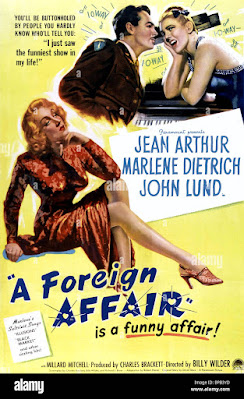
My Billy Wilder journey
continues, as I work my way through Joe McBride's comprehensive Billy Wilder: Dancing on the Edge. This week I saw one of Wilder’s more
unheralded triumphs, the 1948 A Foreign Affair. This dark romantic
comedy stands out partly because of where it was filmed: in the rubble of
Berlin, following the end of World War II. (At the close of his wartime service
in the U.S. Army, Wilder was promised government assistance if he shot a movie
in occupied Deutschland, thus giving a boost to the ruined German economy as
well as to the revival of the German film industry.) A Foreign Affair
deals, sometimes sardonically, with the Allies’ efforts to rebuild the
devastated German capital. But its primary subject is, as always with Wilder,
the vagaries of the human heart. Though Nazis, and their collaborators, are
hardly looked on with favor in the course of the film, the occupying American
army does not escape unscathed. And a visiting American congressional
delegation on a fact-finding tour is treated with all the satirical thrust that
Wilder can muster.
Jean Arthur came out of
retirement to play Phoebe Frost, a strait-laced Iowa congresswoman bent on
improving the morale of the occupying U.S. troops. When she strays from the
official tour, she’s alarmed to find that young American servicemen, mistaking
her for a blonde fraulein, are eager to canoodle. She’s also appalled
when she observes that locals (especially attractive young women) are more than
happy to bestow their favors on Americans who can provide them with chocolate
bars and nylon stockings. Pretending to be a giggly German maedchen, she
goes along with two G.I. Joes to a seedy local club. That’s where she frowns
with disapproval on a nightclub singer, Erika von Schlütow, played by Marlene
Dietrich with her usual potent mix of glamour and irony.
Though Dietrich herself was
known for her unrelenting opposition to Hitler and his thugs, her character in
this film represents the German citizens who will do whatever it takes to get
by. That’s why, although she’s embroiled in a powerful (and possibly
sado-masochistic) relationship with an American officer, John Lund’s Captain
Pringle, there’s also a Nazi higher-up lurking in her past. The film’s most
striking moments involve her encounters with Congresswoman Frost, who in an
ironic turnabout must look to Erika to save her from public humiliation, not to
mention legal jeopardy. Connecting the
two women is Captain Pringle, who is not above taking on romance as part of his
military duties.
Looking back on Wilder’s
life, as McBride does so effectively, it’s rather startling to see him focusing
on the post-war neediness of the German populace. Wilder, a Jewish man who grew
up in Vienna and began his filmmaking career in Berlin, was never able to save
his own mother and other relatives from the Nazi death camps. Needless to say,
he had no great love for the German hierarchy that led the country into war.
And his life in the United States, from 1933 onward, paved the way for fame and
fortune in his adopted land. Still, unlike Congresswoman Phoebe Frost, he
cannot view the German people as undeserving of sympathy. Scrounging for food and small luxury items
(as well as the occasional moment of fun) in their bombed-out city, they awaken
his compassion. And it’s in keeping with his mordant temperament that he
resists simple delineations of right and wrong. So A Foreign Affair offers
up not (as per its poster) hilarious comedy, but rather food for
thought, which is far more nourishing than a chocolate bar.
Joe McBride, the man himself, adds to this post with some important info for cinéastes:"Did
you know I did the audio commentary on
the recent Kino Lorber Blu-ray edition?For
a long time the film was MIA in home video." He adds the all-important Amazon link: https://www.amazon.com/Foreign-Affair-Blu-ray-Jean-Arthur/dp/B07SNNNMQ7


