Showing posts with label Olivia Colman. Show all posts

Tuesday, September 16, 2025

Couples Therapy: “The Roses”

Someone out there is spending tons of money publicizing the new British film, The Roses. It was the feature attraction, over Labor Day weekend, at the very popular Century City Mall, and I’ve spotted  elaborate merchandising attempts at my supermarket. Here’s the question: is the film worth all that attention? It’s gorgeous to look at, with Australia’s dramatic sea coast filling in (alas) for Northern California. There’s a opening credit sequence that’s a delight. And the film stars two of Britain’s finest, Benedict Cumberbatch and Olivia Colman, as loving spouses who can’t quite adjust to a change in their marital circumstances. Both are lively presences who have a talent for dishing out nasty quips at one another’s expense.

 Moviegoers with long memories (or subscriptions to Amazon Prime) might recall that The War of the Roses, a cleverly-titled novel by Warren Adler, was made into a 1989 battle-of-the-sexes film starring Michael Douglas and Kathleen Turner as marital sparring partners. The highly popular black comedy was cleverly directed by Danny DeVito, who also cast himself as a chain-smoking divorce attorney. Serving as narrator, DeVito takes the viewer back to the meeting of Douglas (as Oliver) and Turner (as Barbara) at an auction for high-end collectibles. Both have a passion for home design (and a special yen for English ceramics), so when they marry and nest in a mansion, décor is very much on their minds. Ultimately, alas, the bloom is off the Roses, and Barbara demands a divorce. Moreover, she demands full custody of their dream house, something Oliver would never willingly grant. Soon nothing—and no one—is safe, including the household pets and Oliver’s prized sportscar. It all builds to a grim conclusion that is a hoot if you enjoy seeing things go smash.

 I’m not sure The War of the Roses has much of a point to make (outside of this: never run over your spouse’s cat). But it’s an uproarious exploration of people at their worst, and we can all use a good bitter laugh from time to time. By contrast, the new British film, The Roses, seems determined to be about something. More precisely, it seems to want to put its finger on how marriages go sour, and when precisely this happens. Theo and Ivy Rose are an English couple who share a snarky sensibility. They’ve moved to Northern California to pursue their creative passions. Theo is a trained architect with a taste for the ultra-modern. Ivy is a chef who has put her professional aspirations aside while raising two children, until Theo buys her a hole-in-the-wall diner she promptly renames “We’ve Got Crabs.” As it turns out, the same natural disaster that scuttles his newest and most innovative design proves to be a boon to her little café. So she’s suddenly famous, and he’s out of work.

 The film then becomes a study of what happens to a marriage in which one partner is thriving professionally while the other is put out to pasture. (I’m certain matters are all the worse because it’s the formerly stay-at-home wife who’s suddenly the Next Big Thing.) The topic is definitely a pertinent one, but this film seems determined to cover lots of territory by bringing in additional plot strands. There are many new characters (the rather baffling children, the horny best friend, the doofus buddy, the sinister attorney) to distract from the central his-and-hers conflict. The irony of the conclusion is well handled, with a nice jab at the “smart house” Theo has designed, but well before that point I was tired indeed of the couple’s overblown spat. 


Friday, January 14, 2022

Finding The Lost Daughter (or "Leda and the Swain")

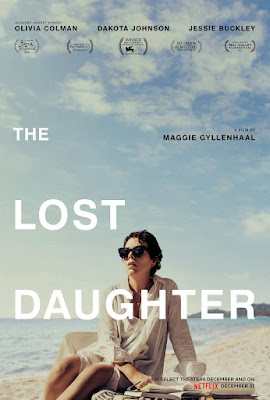
The slyness of The Lost Daughter is part of its attraction. This film, based on a novel of the same name by Italy’s mysterious Elena Ferrante, does contain as an important plot strand a little girl  who strays from the Greek beach where her parents are enjoying sun and sand. But mostly this is the story of a mother who feels lost.  Or, at least, a mother who is continually questioning her own behavior, past and present.

 The film, effectively helmed by Maggie Gyllenhaal in her directorial debut, shifts artfully between past and present. The Leda of the past (her name is a nod to Greek mythology and the poetry of Yeats) is a frazzled young wife and mother who resents the intrusions of her two rambunctious young daughters as she struggles to translate English verse into Italian. The Leda of the present—the one who occupies the central position in the film—is a highly placed professor of comparative literature. Loaded down with heavy books, she arrives at an oceanside resort town in Greece, for what she terms a working holiday.

 This older Leda, on the cusp of middle-age, is sometimes hard to fathom. As played by the always watchable Olivia Colman, she sometimes seems to be joyously drinking in the spirit of her new surroundings. The beach is enticing, the caretakers who work in the area are friendly, and she responds with amiable politeness to everyone she meets. But there’s another side to her too: she can throw us off balance with a sudden rude remark, and there’s something about the big noisy family group that encamps near “her” spot on the beach that is clearly setting her off. Some reviewers, seemingly determined to make the film into a suspense thriller, emphasize the mysteries of Leda’s behavior as though this were an episode of Murder, She Wrote. No, it’s actually more of an in-depth character study of a woman who recoils from others partly because she’s recoiling—unsuccessfully—from herself.

 The most baffling aspects of Leda’s behavior involve a child’s doll, a rather scruffy plaything beloved by the little girl whose brief disappearance gives the story its title. While being the one to locate the missing child, Leda secretly holds onto her doll, even as the girl’s family desperately searches for its whereabouts. Why? Many smart people I know are debating this question. But I believe the answer is hidden in those flashbacks, in which another well-loved doll, essentially a family heirloom, makes an appearance. The contradictory things Leda does in the present are inextricably linked to her behavior in the past, as a young mother (well played by Jessie Buckley) torn between her various responsibilities and her flagging sense of self.

 Because the true identity of the pseudonymous Elena Ferrante remains a mystery among literary types, some have speculated that “she” is actually a male author. I have no way of knowing, but based on the contents of this film I’d say that Ferrante, like Maggie Gyllenhaal, knows at first hand what it’s like to go through life as a female. Women who’ve raised children have a special insight into the tug-of-war between motherhood and self-preservation. Leda, it seems clear, loved (and still loves) her daughters, but has also spent her life fighting to hold onto a personal identity that doesn’t always have room for their daily demands. An intellectual woman, one whose ambitions stretch far beyond hearth and home, is not always satisfied with playing the familial caretaker role. No wonder the younger Leda fell so catastrophically for someone who admired her for her mind.  


Friday, May 1, 2020

“The Crown”: It’s (Not So) Good to Be the Queen


If you have to commit to social isolation, Buckingham Palace might be the place to do it. After all, it’s very well decorated, there are plenty of loyal retainers on hand to attend to your every need, and if you are inclined to mope, you have many comfy corners to choose from. Running out of toilet paper is doubtless not a problem.  I trust Queen Elizabeth II, now  94 years old, is being duly cautious, sheltering herself from threats of COVID-19 either at Buck House or at one of her several other homes in England and Scotland. But she did emerge on April 5 (see below) to speak to the  people of the British commonwealth from Windsor Castle, urging Britons to stay strong in the face of global pandemic. Her warm, calm, sympathetic tone—far different from the bombast of various politicians familiar to us all—was widely praised. It seemed that in her sixty-seven years on the throne she has learned to bridge the gap between her royal self and her subjects., at least when the chips are down.

As I suffer through my own isolation right now, I’m binge-watching all three seasons of The Crown, the Netflix series that is astoundingly frank about the comings and goings of the British royal family. I have no way of knowing if all the scandalous details of this regal soap opera are portrayed accurately, if the love affairs, emotional kinks, and threatened coup d’états really happened in the ways they show up on screen. Still, I’m old enough to remember some of this from contemporary news reports,, like the Profumo scandal and all the sturm und drang involving Princess Margaret falling more than once for exactly the wrong guy.

The series also allows us to see the queen (Claire Foy in the early years, Olivia Colman later) slowly and sometimes painfully learning the tricks of her very particular trade.  If Queen Elizabeth has now mastered how to speak to her subjects, we’ve seen her (particularly in a long-ago address to striking Welsh miners) so detached from the lives of the working class that she rouses their hostility against her. And slightly later, when there’s an unspeakable tragedy involving children in another Welsh village, we’ve watched her struggling to appear sympathetic when her eyes are dry. As TV drama, it’s absolutely irresistible.

One detail that fascinates me about The Crown is the fact that in some ways it’s a TV drama about the impact of television on British royalty. It seems that when Elizabeth, then age 26, was crowned Queen in Westminster Abbey, she appointed her husband, Prince Philip, to the head of the committee working out the details of the coronation. For her this selection was mostly made to appease a restless spouse whose ego was suffering from all the veneration surrounding his wife. But Philip, bucking centuries of tradition, came up with some useful modern ideas. Prime among them was the concept of including Elizabeth’s subjects in the ceremony by putting the whole event on live television. This attempt at slightly democratizing the royal pomp and circumstance turned out to be a major p.r.. success story. But Philip’s later insistence (inspired in part by Jacqueline Kennedy’s televised White House tour) on a day-in-the-life documentary look at the royals at work would became a major embarrassment for all concerned. In any case, it’s clear that the whole royal family relies heavily on TV for their view of the outside world. Amid Buckingham Palace’s elegant sofas and tapestries, they gather around the box to watch Parliamentary election results and astronauts walking on the moon.