Showing posts with label Benedict Cumberbatch. Show all posts

Tuesday, September 16, 2025

Couples Therapy: “The Roses”

Someone out there is spending tons of money publicizing the new British film, The Roses. It was the feature attraction, over Labor Day weekend, at the very popular Century City Mall, and I’ve spotted  elaborate merchandising attempts at my supermarket. Here’s the question: is the film worth all that attention? It’s gorgeous to look at, with Australia’s dramatic sea coast filling in (alas) for Northern California. There’s a opening credit sequence that’s a delight. And the film stars two of Britain’s finest, Benedict Cumberbatch and Olivia Colman, as loving spouses who can’t quite adjust to a change in their marital circumstances. Both are lively presences who have a talent for dishing out nasty quips at one another’s expense.

 Moviegoers with long memories (or subscriptions to Amazon Prime) might recall that The War of the Roses, a cleverly-titled novel by Warren Adler, was made into a 1989 battle-of-the-sexes film starring Michael Douglas and Kathleen Turner as marital sparring partners. The highly popular black comedy was cleverly directed by Danny DeVito, who also cast himself as a chain-smoking divorce attorney. Serving as narrator, DeVito takes the viewer back to the meeting of Douglas (as Oliver) and Turner (as Barbara) at an auction for high-end collectibles. Both have a passion for home design (and a special yen for English ceramics), so when they marry and nest in a mansion, décor is very much on their minds. Ultimately, alas, the bloom is off the Roses, and Barbara demands a divorce. Moreover, she demands full custody of their dream house, something Oliver would never willingly grant. Soon nothing—and no one—is safe, including the household pets and Oliver’s prized sportscar. It all builds to a grim conclusion that is a hoot if you enjoy seeing things go smash.

 I’m not sure The War of the Roses has much of a point to make (outside of this: never run over your spouse’s cat). But it’s an uproarious exploration of people at their worst, and we can all use a good bitter laugh from time to time. By contrast, the new British film, The Roses, seems determined to be about something. More precisely, it seems to want to put its finger on how marriages go sour, and when precisely this happens. Theo and Ivy Rose are an English couple who share a snarky sensibility. They’ve moved to Northern California to pursue their creative passions. Theo is a trained architect with a taste for the ultra-modern. Ivy is a chef who has put her professional aspirations aside while raising two children, until Theo buys her a hole-in-the-wall diner she promptly renames “We’ve Got Crabs.” As it turns out, the same natural disaster that scuttles his newest and most innovative design proves to be a boon to her little café. So she’s suddenly famous, and he’s out of work.

 The film then becomes a study of what happens to a marriage in which one partner is thriving professionally while the other is put out to pasture. (I’m certain matters are all the worse because it’s the formerly stay-at-home wife who’s suddenly the Next Big Thing.) The topic is definitely a pertinent one, but this film seems determined to cover lots of territory by bringing in additional plot strands. There are many new characters (the rather baffling children, the horny best friend, the doofus buddy, the sinister attorney) to distract from the central his-and-hers conflict. The irony of the conclusion is well handled, with a nice jab at the “smart house” Theo has designed, but well before that point I was tired indeed of the couple’s overblown spat. 


Friday, March 8, 2024

“The Wonderful Story of Henry Sugar . . . and Wes Anderson”

I seem to be having a bit of a private Wes Anderson festival lately. Some cinematic research led me to re-watch Moonrise Kingdom, The French Dispatch, and his latest, Asteroid City. As always, I was charmed by Anderson’s enchanting visuals, and by his use of some of the world’s best actors in quirky and unexpected ways. And yet I could never shake the notion that most of Anderson’s work is much ado about nothing: that he lacks the story sense to make something that actually has meaning. With Oscar night coming up so soon, it’s appropriate to mention that Anderson’s films have never lacked for Academy love. Over the years, there have been 16 nominations in various categories,  most of them technical. The Grand Budapest Hotel (2014—perhaps the Anderson work with the most to say) actually collected 9 nominations, including Best Picture, Best Director, and Best Original Screenplay. And it won statuettes for its costume design, hair and makeup, production design, and original score. Still, the big prizes have eluded Anderson himself, maybe because many Academy voters see Anderson’s works as charming stunts, rather than as truly meaningful creations.

 Perhaps this will be the year when Anderson finally wins his own Oscar. He’s on the short list not for Asteroid City (which got shut out of all categories) but for his forty-minute adaptation of a Roald Dahl tale, “The Wonderful Story of Henry Sugar.” Dah’s whimsical though sometimes macabre way of looking at the world seems to beautifully suit Anderson’s stylistics, allowing him to romp visually while giving some spine to his storytelling. Clearly Anderson is on a Roald Dahl kick: for Netflix he has applied  his cinematic skills to a whole 1976 volume of Dahl stories, of which “Henry Sugar” is the first and best.

 For “Henry Sugar,” Anderson enjoys the services of some of England’s finest, including Benedict Cumberbatch (as the title character), along with Dev Patel, Ben Kingsley, and (playing a version of Dahl himself) Ralph Fiennes. All seem to have been directed to play straight to the camera, delivering their lines at a speedy deadpan clip as though they were reading straight from the Dahl text. And what a text it is, comprising an exotic tale within a tale. Fiennes as Dahl introduces us to Henry, a wealthy Englishman whose only goal is increasing his substantial fortune by playing cards for money. In his countryman’s well-furnished library he happens upon the account of an Indian mystic who learned after years of strenuous concentration to read with his eyes securely bandaged. To Henry, the knowledge of this possibility leads immediately to thoughts of how he can best his card-playing cronies by being able to read the cards in a deck though only seeing their backsides. He applies himself to this effort, and succeeds magnificently, coming away with a brick-sized packet of cold, hard cash. But of course things don’t work out as planned, and Dahl’s neat twist of an ending shows us the surprising ways that greed can work on the human psyche.

 Dahl has supplied the story line: Anderson contributes his own magic, mostly of the visual variety. His locations—whether they represent Dahl’s cozy writing cottage, a baronial stately home, an Indian guru’s jungle hut, or a hospital lounge—all seem as artificial as stage sets, and they come apart and re-form (with the help, at times, of stagehands) with dazzling speed. What Anderson has achieved is a short film that gives us the immediacy, and the aesthetic pleasure, of live theatre. Which makes me wonder: why doesn’t Anderson give stage work a try?  


Tuesday, December 14, 2021

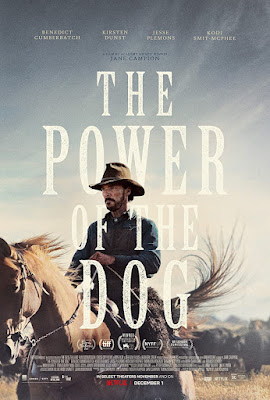
A Powerful “Power of the Dog”

Jane Campion’s new The Power of the Dog, can fairly be described as a mystery. Which by no means suggests that it’s a classic whodunit, with dark deeds committed early on and the perpetrator unmasked just before the lights come up. There’s certainly darkness in this movie, but emphasis in The Power of the Dog is squarely on the mystery of the human soul. As in Campion’s long-ago 1993 triumph, The Piano, the new film is peopled by characters who act in ways we don’t always understand. Two moviegoers can come away from it with entirely different perspectives on what just happened on screen. My filmgoing companion turned to me afterwards and said, “Well, I didn’t see that coming.” And I admit that my own first thoughts were quite different from the well-reasoned conclusion he’d reached. There’s no shame in needing to watch The Power of the Dog more than once. This is a film that offers huge rewards to those paying close attention.

 Partly that’s because Campion is such a visual stylist. Without ever becoming heavy-handed, she draws our attention to places and objects that have their own quiet significance in the tale being told. As in The Piano, the landscape is definitely part of the story. In the earlier film it was the wild New Zealand coastline. Here it’s New Zealand again, standing in for the chilly plains and rocky hills of Montana, circa 1920. The realistic close-ups of cowboys going about their daily work move the film squarely into the Western genre, but there’s an effective juxtaposition with the film’s traces of modernity, including the rare automobile and flapper-length skirts. The clash between past and present is essential to the story being told, somewhat as in Kirk Douglas’s fascinating Lonely are the Brave.

 But things, as well as places and time-frames, also have their significance. I don’t believe an at-home viewing on a television screen can fully introduce us to inanimate objects that, through dramatic closeups, play a key part in the unfolding drama. Hand-made paper flowers, a braided leather rope, a monogramed scarf, gleaming white tennis sneakers—these mundane items become hugely important over the course of the story. Equally important is the mysterious title that only makes its meaning felt at the film’s very end. Its source is a Biblical passage (Psalm 22:20 --“Rescue my soul from the sword, my essence from the grip of the dog”) that at first seems unrelated to the matters at hand. Certainly, this is not a dog story.  It’s only in the context of all that’s gone before that we can find a shred of meaning in these mysterious but evocative words.

 I’ve stalled in mentioning the film’s chief actors, all of whom make an indelible impression. The protean Benedict Cumberbatch is front and center, playing Phil Burbank, a roughneck type we don’t know whether to hate or pity. Jesse Plemons (so ominous in Breaking Bad) here conveys a very different type, the gentle, civilized brother who becomes the object of Phil’s ongoing scorn. The always welcome Kirsten Dunst sinks her teeth into the role of the new wife, fragile but ultimately sturdy. If all of the above sounds like something from Steinbeck (East of Eden) or maybe Tennessee Williams, Campion has a few surprises up her sleeve. I also need to mention a relative newcomer to American films, Australian Kodi Smit-McPhee, as Dunst’s gawky, introspective son. In a L.A. Times interview, Smit-McPhee gives his own clearcut view of the film’s ambiguous ending. If you read it prior to seeing this mesmerizing movie, you’ll be sorry.