Showing posts with label Kirsten Dunst. Show all posts

Tuesday, December 14, 2021

A Powerful “Power of the Dog”

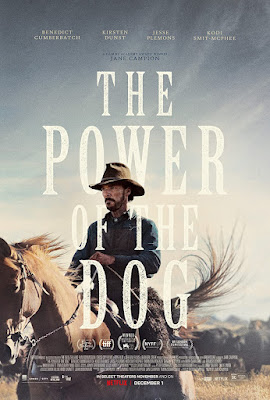
Jane Campion’s new The Power of the Dog, can fairly be described as a mystery. Which by no means suggests that it’s a classic whodunit, with dark deeds committed early on and the perpetrator unmasked just before the lights come up. There’s certainly darkness in this movie, but emphasis in The Power of the Dog is squarely on the mystery of the human soul. As in Campion’s long-ago 1993 triumph, The Piano, the new film is peopled by characters who act in ways we don’t always understand. Two moviegoers can come away from it with entirely different perspectives on what just happened on screen. My filmgoing companion turned to me afterwards and said, “Well, I didn’t see that coming.” And I admit that my own first thoughts were quite different from the well-reasoned conclusion he’d reached. There’s no shame in needing to watch The Power of the Dog more than once. This is a film that offers huge rewards to those paying close attention.

 Partly that’s because Campion is such a visual stylist. Without ever becoming heavy-handed, she draws our attention to places and objects that have their own quiet significance in the tale being told. As in The Piano, the landscape is definitely part of the story. In the earlier film it was the wild New Zealand coastline. Here it’s New Zealand again, standing in for the chilly plains and rocky hills of Montana, circa 1920. The realistic close-ups of cowboys going about their daily work move the film squarely into the Western genre, but there’s an effective juxtaposition with the film’s traces of modernity, including the rare automobile and flapper-length skirts. The clash between past and present is essential to the story being told, somewhat as in Kirk Douglas’s fascinating Lonely are the Brave.

 But things, as well as places and time-frames, also have their significance. I don’t believe an at-home viewing on a television screen can fully introduce us to inanimate objects that, through dramatic closeups, play a key part in the unfolding drama. Hand-made paper flowers, a braided leather rope, a monogramed scarf, gleaming white tennis sneakers—these mundane items become hugely important over the course of the story. Equally important is the mysterious title that only makes its meaning felt at the film’s very end. Its source is a Biblical passage (Psalm 22:20 --“Rescue my soul from the sword, my essence from the grip of the dog”) that at first seems unrelated to the matters at hand. Certainly, this is not a dog story.  It’s only in the context of all that’s gone before that we can find a shred of meaning in these mysterious but evocative words.

 I’ve stalled in mentioning the film’s chief actors, all of whom make an indelible impression. The protean Benedict Cumberbatch is front and center, playing Phil Burbank, a roughneck type we don’t know whether to hate or pity. Jesse Plemons (so ominous in Breaking Bad) here conveys a very different type, the gentle, civilized brother who becomes the object of Phil’s ongoing scorn. The always welcome Kirsten Dunst sinks her teeth into the role of the new wife, fragile but ultimately sturdy. If all of the above sounds like something from Steinbeck (East of Eden) or maybe Tennessee Williams, Campion has a few surprises up her sleeve. I also need to mention a relative newcomer to American films, Australian Kodi Smit-McPhee, as Dunst’s gawky, introspective son. In a L.A. Times interview, Smit-McPhee gives his own clearcut view of the film’s ambiguous ending. If you read it prior to seeing this mesmerizing movie, you’ll be sorry.


Tuesday, October 2, 2018

The Virgin Suicides of Five Little Women


I’ve just watched the beautiful and talented Kirsten Dunst, at 12, play snippy little Amy March—a schoolgirl obsessed with fashion, popularity, and nice noses—in the 1994 screen version of Little Women. What a shock to jump five years and see Dunst as a very different young woman in Sofia Coppola’s debut film, The Virgin Suicides.

The Virgin Suicides, based on a sensational 1999 novel by Jeffrey Eugenides, was the then-twenty-eight-year-old Coppola’s debut as a film director. She has said that prior to reading the novel, she had no clear artistic path. It was her intense enthusiasm for this book that led her to adapt it for the screen, and then to find her calling as a director. She loved this novel because—grim as it was—it seemed to capture her sense of young womanhood as a time of transition, a tumultuous passage from innocent girlishness into the powers (and fears) of an adult female life. Eugenides is the rare author who wholeheartedly praises the film made from his novel. He notes, though, that in his mind the tale had chiefly focused on the young suburban boys who obsessed from a distance over the macabre doings of the five gorgeous Lisbon sisters. The film version, he notes, necessarily puts the five beautiful blondes at the visual center of the action, giving us clues to their surprising choices, though by no means putting their mysteries to rest.

Yes, this is a film about suicide, beginning with that of the youngest Lisbon, Cecilia. She had previously explained her nihilistic mindset to an emergency room doctor who gently chided, “What are you doing here, honey? You're not even old enough to know how bad life gets.” Her matter-of-fact response: “Obviously, Doctor, you've never been a 13-year-old girl.”

The young teenaged sisters so vividly depicted in Louisa May Alcott’s Little Women were facing real problems: poverty, serious illness, an absent father wounded on the field of battle, the rigidly circumscribed role of a young lady in 19th century America. Yet, blessed with lively minds, strong moral fiber, and a sublimely understanding mother, they all coped—and even managed to truly enjoy the innocent frolics of their girlhood. It’s startling to move from the world of Little Women to late twentieth-century suburbia, where the Lisbon family sends its daughters to a tony local school. The Lisbons seem to have no health issues and no particular money woes. True, Mom (Kathleen Turner) and Dad (James Woods, as the school’s math teacher) are intense both in their Catholic devotions and in their household rules of conduct. They don’t seem the sort of parents you’d come to with your personal woes. Maybe that’s why Cecilia, at thirteen, is so determined to end it all. And maybe it’s also why fourteen-year-old Lux (played Dunst) finds her own ways to rebel against the family’s rigid standards of behavior. Hardly virginal, Lux seems committed to giving herself to any boy who’s tempted by her beauty. 

Commenting on The Virgin Suicides years after the film was made, Dunst has noted that her role required her to explore the rawer emotions of the adult world she was personally poised to enter.  Though she’d been acting professionally since age 7, this was her first offbeat independent production, as well as perhaps her first chance to delve into her own sexuality on screen. That’s something Amy March and her older sisters never seem to do. Which makes the world of Little Women, for all its hardships, a friendlier place than the one the Lisbon girls so uneasily inhabit.