Showing posts with label Jesse Plemons. Show all posts

Friday, November 21, 2025

Hairless in the Basement: “Bugonia”

Greek filmmaker Yorgos Lanthimos is not one to play it safe. Neither, apparently, is Emma Stone. The Internet tells me that Lanthimos is a part of the so-called “Greek Weird Wave.” Unlike such earlier Greek filmmakers as the great Michael Cacoyannis—who dramatized classical tragedies like Electra (1962) and The Trojan Women (1971) while also bringing a full range of dramatic colors to 1964’s modern-day Zorba the Greek—Lanthimos is not interested in ennobling his characters. He seems to have real affection for the grotesque. I haven’t seen all of his English-language films. But The Lobster, in which single adults are given 45 days to find a mate or risk being turned into the animal of their choice, is both bizarre and extremely entertaining. And I loved Lanthimos’s first collaboration with Emma Stone, in 2018’s The Favourite, which made me regard the 18th century British monarchy in a whole new light. None of this, though, prepared me for Poor Things (2023), a kind of berserk Frankenstein story in which Stone’s young adult character starts out with a small child’s brain, then develops a teenager’s libido, before finally reaching a kind of mental and emotional maturity. (The Oscar Stone won for this role was definitely well-deserved.)

 In this year’s Bugonia (the title refers to an ancient Greek folk ritual involving bees and cow dung), Lanthimos and Stone are together once again. And once again he seems to enjoy systematically destroying her wide-eyed beauty in the name of grim humor. In the film, Stone plays a soignée big pharma exec who works out of a hypermodern building set in the rural American countryside. She’s a powerhouse at work, but this doesn’t stop her from being kidnapped by two scruffy locals and imprisoned in their basement. The older one, Teddy, is played by the recently ubiquitous Jesse Plemons, who—with his always disheveled red hair—is looking more and more like Opie gone to seed. He’s the idea guy: the one who is absolutely convinced that Stone’s Michelle is really a dangerous space alien sent to threaten Planet Earth. The younger, Don, is Teddy’s always-loyal cousin. (He’s played by young Alban Delbis, who is genuinely afflicted with autism. A star of his SoCal high school’s drama class, Delbis gives an impressively moving performance.)

 The notion that a successful entrepreneur in a business suit and heels would  be accused by a doofus or two of actually coming from outer space sounds like it could make for fun at the movies. That’s what I thought my evening would be like, but the film’s poster should really have disabused me of that notion. Though a few of my fellow filmgoers managed to guffaw a time or two, Bugonia is hard to classify as a comedy, even a very dark one. Yes, there are some unexpected plot twists that encourage us to smirk, but I defy anyone to chuckle at the film’s gut-punching ending.

 Most critical reviews of Bugonia have been positive, I’m told, My hometown newspaper, The Los Angeles Times, titles its strong review “It’s Emma Stone’s planet now as the alien comedy ‘Bugonia’ proves.” The focus by the Times critic is on how cleverly Stone plays with our emotions, and how much she endures for her art, up to and including having the hair on her head brutally shaved off on camera. To promote the film’s opening, a Culver City theatre staged a promo performance exclusively for bald people, or those who were willing to lose their locks on-site. But despite the resulting hoopla, I’m sensing that audiences—with or without hair—are staying away.

Tuesday, December 14, 2021

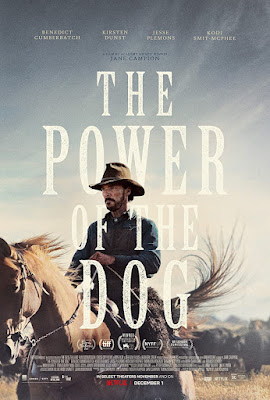
A Powerful “Power of the Dog”

Jane Campion’s new The Power of the Dog, can fairly be described as a mystery. Which by no means suggests that it’s a classic whodunit, with dark deeds committed early on and the perpetrator unmasked just before the lights come up. There’s certainly darkness in this movie, but emphasis in The Power of the Dog is squarely on the mystery of the human soul. As in Campion’s long-ago 1993 triumph, The Piano, the new film is peopled by characters who act in ways we don’t always understand. Two moviegoers can come away from it with entirely different perspectives on what just happened on screen. My filmgoing companion turned to me afterwards and said, “Well, I didn’t see that coming.” And I admit that my own first thoughts were quite different from the well-reasoned conclusion he’d reached. There’s no shame in needing to watch The Power of the Dog more than once. This is a film that offers huge rewards to those paying close attention.

 Partly that’s because Campion is such a visual stylist. Without ever becoming heavy-handed, she draws our attention to places and objects that have their own quiet significance in the tale being told. As in The Piano, the landscape is definitely part of the story. In the earlier film it was the wild New Zealand coastline. Here it’s New Zealand again, standing in for the chilly plains and rocky hills of Montana, circa 1920. The realistic close-ups of cowboys going about their daily work move the film squarely into the Western genre, but there’s an effective juxtaposition with the film’s traces of modernity, including the rare automobile and flapper-length skirts. The clash between past and present is essential to the story being told, somewhat as in Kirk Douglas’s fascinating Lonely are the Brave.

 But things, as well as places and time-frames, also have their significance. I don’t believe an at-home viewing on a television screen can fully introduce us to inanimate objects that, through dramatic closeups, play a key part in the unfolding drama. Hand-made paper flowers, a braided leather rope, a monogramed scarf, gleaming white tennis sneakers—these mundane items become hugely important over the course of the story. Equally important is the mysterious title that only makes its meaning felt at the film’s very end. Its source is a Biblical passage (Psalm 22:20 --“Rescue my soul from the sword, my essence from the grip of the dog”) that at first seems unrelated to the matters at hand. Certainly, this is not a dog story.  It’s only in the context of all that’s gone before that we can find a shred of meaning in these mysterious but evocative words.

 I’ve stalled in mentioning the film’s chief actors, all of whom make an indelible impression. The protean Benedict Cumberbatch is front and center, playing Phil Burbank, a roughneck type we don’t know whether to hate or pity. Jesse Plemons (so ominous in Breaking Bad) here conveys a very different type, the gentle, civilized brother who becomes the object of Phil’s ongoing scorn. The always welcome Kirsten Dunst sinks her teeth into the role of the new wife, fragile but ultimately sturdy. If all of the above sounds like something from Steinbeck (East of Eden) or maybe Tennessee Williams, Campion has a few surprises up her sleeve. I also need to mention a relative newcomer to American films, Australian Kodi Smit-McPhee, as Dunst’s gawky, introspective son. In a L.A. Times interview, Smit-McPhee gives his own clearcut view of the film’s ambiguous ending. If you read it prior to seeing this mesmerizing movie, you’ll be sorry.