Showing posts with label Jane Campion. Show all posts

Tuesday, December 14, 2021

A Powerful “Power of the Dog”

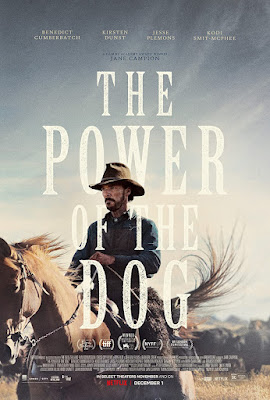
Jane Campion’s new The Power of the Dog, can fairly be described as a mystery. Which by no means suggests that it’s a classic whodunit, with dark deeds committed early on and the perpetrator unmasked just before the lights come up. There’s certainly darkness in this movie, but emphasis in The Power of the Dog is squarely on the mystery of the human soul. As in Campion’s long-ago 1993 triumph, The Piano, the new film is peopled by characters who act in ways we don’t always understand. Two moviegoers can come away from it with entirely different perspectives on what just happened on screen. My filmgoing companion turned to me afterwards and said, “Well, I didn’t see that coming.” And I admit that my own first thoughts were quite different from the well-reasoned conclusion he’d reached. There’s no shame in needing to watch The Power of the Dog more than once. This is a film that offers huge rewards to those paying close attention.

 Partly that’s because Campion is such a visual stylist. Without ever becoming heavy-handed, she draws our attention to places and objects that have their own quiet significance in the tale being told. As in The Piano, the landscape is definitely part of the story. In the earlier film it was the wild New Zealand coastline. Here it’s New Zealand again, standing in for the chilly plains and rocky hills of Montana, circa 1920. The realistic close-ups of cowboys going about their daily work move the film squarely into the Western genre, but there’s an effective juxtaposition with the film’s traces of modernity, including the rare automobile and flapper-length skirts. The clash between past and present is essential to the story being told, somewhat as in Kirk Douglas’s fascinating Lonely are the Brave.

 But things, as well as places and time-frames, also have their significance. I don’t believe an at-home viewing on a television screen can fully introduce us to inanimate objects that, through dramatic closeups, play a key part in the unfolding drama. Hand-made paper flowers, a braided leather rope, a monogramed scarf, gleaming white tennis sneakers—these mundane items become hugely important over the course of the story. Equally important is the mysterious title that only makes its meaning felt at the film’s very end. Its source is a Biblical passage (Psalm 22:20 --“Rescue my soul from the sword, my essence from the grip of the dog”) that at first seems unrelated to the matters at hand. Certainly, this is not a dog story.  It’s only in the context of all that’s gone before that we can find a shred of meaning in these mysterious but evocative words.

 I’ve stalled in mentioning the film’s chief actors, all of whom make an indelible impression. The protean Benedict Cumberbatch is front and center, playing Phil Burbank, a roughneck type we don’t know whether to hate or pity. Jesse Plemons (so ominous in Breaking Bad) here conveys a very different type, the gentle, civilized brother who becomes the object of Phil’s ongoing scorn. The always welcome Kirsten Dunst sinks her teeth into the role of the new wife, fragile but ultimately sturdy. If all of the above sounds like something from Steinbeck (East of Eden) or maybe Tennessee Williams, Campion has a few surprises up her sleeve. I also need to mention a relative newcomer to American films, Australian Kodi Smit-McPhee, as Dunst’s gawky, introspective son. In a L.A. Times interview, Smit-McPhee gives his own clearcut view of the film’s ambiguous ending. If you read it prior to seeing this mesmerizing movie, you’ll be sorry.


Friday, January 3, 2020

The Director Was a Woman


The theory is that Little Women has been largely snubbed by the Golden Globe and SAG folks because few of the men who run those organizations want to see a movie that’s all about GIRLS. The members of the Hollywood Foreign Press, a small and exclusive group, didn’t include a single woman among their Golden Globe nominees for best director and best screenplay. This despite the contributions of, among others, Greta Gerwig (Little Women), Marielle Heller (A Beautiful Day in the Neighborhood), Kasi Lemmons (Harriet), and Lulu Wang (The Farewell).

Meanwhile, BBC Culture has just presented the results of its latest polling. After surveying 368 experts from 84 countries, they’ve compiled a list of the 100 greatest films directed by women. Why choose this topic? It came out of the BBC’s realization that after several years of polling on various film-related subjects (greatest foreign-language films, greatest film comedies, greatest American films, and so on), they rarely found women’s achievements represented. I’m sure there are PhD dissertations being written at this very moment as to why it’s so rare for women to helm movies. But it’s fascinating to look back and see the names of women who did something wonderful. Too bad so many of them were working in foreign language cinema. French-speaking women, in particular, seem to prevail. On the list we find six films by the late, beloved Agnès Varda,, three by Claire Denis, several by the  Belgium-born Chantal Akerman, and a very recent entry, Portrait de la jeune fille en feu (aka Portrait of a Lady on Fire) by Céline Sciamma. There’s no surprise that Italy is represented on the list by Lina Wertmūller, whose Seven Beauties made her the first woman ever to be nominated for a Best Director Oscar. Nor that Poland’s Agnieska Holland is recognized for the poignant Europa, Europa. It’s hard to accept the name of German filmmaker Leni Riefenstahl, whose filmmaking talent here outweighs her use of cinema to glorify Adolf Hitler in documentaries like Triumph of the Will. (Women, like men, are not always as wise as they are talented.)

Though I haven’t seen every one of these films, I can hardly argue with the list’s #1 slot, which goes to New Zealand’s Jane Campion for her haunting feature, The Piano. Like Wertmūller, Campion was given a Best Director nod by the Academy of Motion Picture Arts and Sciences. She was not to nab an Oscar for directing, but won instead for her screenplay. There have been only three other female Oscar nominees for Best Director: Sofia Coppola for Lost in Translation, Kathryn Bigelow for The Hurt Locker (she actually won, possibly because her film had an intensely male focus), and Greta Gerwig for Lady Bird. All three are still active filmmakers, so maybe there’s hope that Coppola and Gerwig too will someday be among the chosen few. I also liked seeing on the  BBC list names like that of Lisa Chodolenko, whose The Kids Are All Right was one of the standouts of 2010, Amy Heckerling (Fast Times at Ridgemont High), Kasi Lemmons (Eve’s Bayou).and Kimberley Peirce (Boys Don’t Cry). But I don’t know how the experts could have left out such talents as Nicole Holofcener (for the delightful Enough Said) and Allison Anders (Mi Vida Loca).

Then there’s an entry that continues to trouble me: Lana and Lilly Wachowski for 1999’s The Matrix. The Wachowskis, both transgender, were considered male when they shot this big-budget film. Did that fact help them get past the barriers that stop so many female directors in their tracks?