Showing posts with label Pixar. Show all posts

Wednesday, November 26, 2025

Food, Glorious Food: “Big Night”

I’ve always enjoyed movies about cooking. Given that we all have to eat, I guess it’s not remarkable that food preparation can be used in so many ways to comment on the human condition. In the 1987 Danish film Babette’s Feast, a French refugee introduces an austere Scandinavian family to the joys of good food . . . and by extension the earthy pleasures of life.  Taiwan-born director Ang Lee, in his 1994 Eat Drink Man Woman, uses a retired chef cooking for his adult daughters as a way to explore Chinese  tradition as well as the relationship between generations. In 2023’s The Taste of Things, starring the luminous Juliette Binoche, a pairing involving love and loss unfolds through the relationship of a gourmet and his loyal cook. And we can’t forget the Pixar animated film, Ratatouille, which proves that you’re never too small to be very good in the kitchen.

 Earlier this year, Netflix presented Nonnas, a star-studded TV movie based on the real-life story of a New York man. He paid tribute to his late mother’s talents as a home cook by launching a popular Staten Island restaurant in which the kitchen is staffed by a clutch of Italian mamas. This slight but charming film is notable for casting veteran actresses of Italian descent (like Lorraine Bracco, Brenda Vaccaro, and Talia Shire), and having them fight epic stove-top battles over cooking techniques and regional specialties.

 Then there’s Big Night, a 1996 labor of love co-written and co-directed by Stanley Tucci. Tucci, a hyper-versatile character actor who was Oscar-nominated for playing an ominous neighbor in 2009’s The Lovely Bones, is most fondly remembered (by me, at least) as a sympathetic gay art director in 2006’s The Devil Wears Prada. He also made an impressively down-to-earth Roman Catholic cardinal in last year’s Conclave.

 Throughout his career, Tucci has not been shy about proclaiming his love for good cooking, especially of the Italian variety. In 2021 he hosted  Stanley Tucci: Searching for Italy, a CNN series that followed him through the land of his ancestors. That same year he published Taste: My Life Through Food, a memoir that spent sixteen weeks on the New York Times bestseller list. Other Tucci publications include What I Ate in One Year and several cookbooks.

 So it’s no surprise that when Tucci set about to make an original film, he put food preparation at its center. Big Night casts Tucci and Tony Shalhoub (of Lebanese descent but comfortable playing a wide range of nationalities) as Italian-born brothers determined to create a fine-dining restaurant near the New Jersey shore. In the film, Primo (Shalhoub) is the older brother, an artist in the kitchen who’s intolerant of shortcuts and trendy gimmicks. Tucci himself plays Secundo, the would-be practical brother who’s determined to see the business succeed, but has his own lapses into fantasyland. While locals cram into a livelier but far less authentic Italian-American bistro nearby, the brothers are desperate to stay afloat. That’s when, for reasons the film makes clear, the duo decide to risk everything on an elaborate gourmet banquet that’s spectacular but in many ways poorly conceived. This is a story about the restaurant business—yes!—but even more about the push-and-pull relationship between two brothers with very different visions of what they want to achieve in life.

 Big Night is not an Oscar-winning kind of movie. But it nabbed several writing awards, including an Independent Spirit nod for Best First Screenplay. Clearly, Tucci’s got talent in areas other than acting, and I can’t help wondering what he’ll serve us next. 

 (Here's a fascinationg addendum, provided by Hillel Schwartz, a friend and loyal reader:)  Stanley Tucci played Paul Child (Julia Child's husband) in the 2009 movie Julie & Julia. Tucci wrote about his deep admiration for Julia Child in his Taste and in an article for TIME Magazine: https://time.com/6103409/stanley-tucci-taste-julia-child/.  Ironically, Tucci was diagnosed in 2017 with a tumor at the base of his tongue, and lost his sense of taste and smell, but this was successfully treated with chemotherapy and radiation, although he had to have a feeding tube for six months. And now his co-star in Big Night, Tony Shalhoub, has his own tv series, where he goes around tasting versions of bread in different ethnic cuisines.

Friday, July 23, 2021

The Never-Ending (Toy) Story

 I generally avoid movies whose titles end with a number, like Jaws 2 or The Fast and the Furious 5. As I have good reason to know (having worked on Corman franchises like Bloodfist and Slumber Party Massacre), each movie that follows the original is a bit less clever, a bit more predictable. But the good folks at Pixar were not about to let their Toy Story sequels disappoint their loyal fan base. Remarkably, 2010’s Toy Story 3, which I just rewatched, may be the best of the lot. Sure, it still contains familiar characters like valiant Sheriff Woody, spacey Buzz Lightyear, the Potato Head pair, and a fearful Tyrannosaurus Rex, all of them loyal to “their” kid, Andy. But the thing is—Andy is now almost eighteen, and on his way to college. The toys haven’t changed over time, but Andy has. And time becomes film’s big (if hidden) subject.

 This makes it quite a different story from the previous two Toy Story films. The original dealt with such child-appropriate topics as jealousy and friendship. In that 1995 film, the arrival of Buzz—who becomes Andy’s new favorite—rocks Woody to the core. But when the chips are down, Woody and Buzz learn to work together and forge a solid friendship, as underscored by Randy Newman’s Oscar-nominated song, “You’ve Got a Friend in Me.” Their relationship continues in Toy Story 2 (1999), in which Buzz needs to come to the rescue of Woody, who’s been kidnapped (toynapped?) by a dastardly collector with plans to send him to Japan.

 But by 2010, the original film’s target audience was on the brink of adulthood, and largely leaving all things Disney behind. In a way, Toy Story 3 is directed at their parents, who have deeply mixed emotions about seeing their offspring fly away from the nest. Yes, Andy’s mom is eager to see him clear out his childhood toys before he goes off to college, but she is still feeling the loss of the little boy she once knew and loved. What happens to the toys that may be headed for the attic—or scrapped—is what this story is about.

 Since the Pixar team understands that young viewers prefer excitement to philosophy, there’s plenty of derring-do here, like some heroic flights from a garbage truck and from a childcare center that seems a paradise but is ruled over by a menacing pink stuffed bear who smells like strawberries (the late Ned Beatty, full of Southern charm and menace). A sequence at the city dump has an Inferno quality, but – of course – ends in a breathless escape. And I defy parents not to be moved when Andy decides what best to do with well-loved toys he’s outgrown.

 Pixar is good, too, at finding ways to tickle adult funny-bones. At the childcare center where the discarded toys briefly find a home, a vapid Barbie (in Jane Fonda-style leotard and leggings) finds the Ken of her dreams, then later tricks him into modeling his elaborate Sixties wardrobe (tie-dye! an astronaut suit!) when he needs to be distracted from the big escape attempt. And I suspect we Boomers remember many of the vintage toys in the film, like the Slinky-dog, the GI Joe action figures, and that talking telephone. The film has more serious matters on its mind, too, like our throwaway culture that decrees that anything out of date should simply be tossed, and that most of our once-cherished possessions ultimately belong in a landfill.

 All in all, it’s a beautiful film with a perfect ending. But then they made Toy Story 4.


Tuesday, June 4, 2019

We Like Short Shorts (The Academy’s Nominees for Best Animated Short)


Long airline flights can introduce you to the unexpected. Flying to New York City last month, I discovered via  my seatback videoscreen the five Oscar-nominated short animated films of 2018. Animated shorts—those that are not attached to a Pixar blockbuster—are generally overlooked by the moviegoing public. That’s a shame, because the best of them are clever and artful, doing a lot with a little. While cruising at 30,000 feet, and waiting for the snack mix to arrive,  I discovered what I had been missing at my local cineplex.

Here are a few things I learned from the class of 2018: Despite the advent of computer-generated animation, hand-drawn cartooning is not dead. Canada is the home of some very creative animators. Asian motifs and connections often prevail. The relationship between parent and child is a popular subject for animated shorts, as is the whole notion of the passage of time. And though several of these films are voiced by actors, a cartoon can convey a good deal without saying a word.

In alphabetical order, the first film up is Canada’s “Animal Behaviour,” a deliriously wacky hand-drawn saga set in a therapy session. The shrink is a dog, and the patients are all members of the animal kingdom, like a pig with an eating disorder and a praying mantis who understandably has relationship issues. Things move along predictably until a gorilla lumbers in, at which point chaos erupts.

Next comes “Bao,” a Chinese-Canadian entry with Pixar connections. Silently showing an amiable little woman who (yes, really!) adopts one of her homemade dumplings as a baby, then watches it evolve into the teen years and young manhood, this film has much to say about the joys and heartbreak of being a mom.. I saw “Bao” as a prelude to Disney and Pixar’s Incredibles 2. For me this eight-minute masterpiece was far better and certainly far more touching than the highly-touted feature film. Though I doubt Pixar’s target kid-audience would grasp the point, their parents certainly should . No wonder “Bao” took home the statuette on Oscar night.

Probably my least favorite of the films was “Late Afternoon,” a lovely-to-look-at story of an elderly lady moving back and forth through her memories as she’s served cookies and tea. Predictable? I should say so. Lugubrious? That too.

Almost as touching  as “Bao” is “One Small Step,” about a Chinese American girl who yearns to become an astronaut and walk on the moon. Helping her along her path is her father, a humble shoemaker, who keeps her appropriately shod as she grows, matures, and moves toward the faraway surface of her dreams. The use of shoes as a motif works beautifully in giving new meaning to Neil Armstrong’s famous words. At the ending, you may shed a tear or two. I did, anyway.

Finally, there’s another poignant and aesthetically challenging Canadian film, “Weekends,” about a young Toronto boy shuttling between the very different homes of his divorced mom and dad.  This film draws on the boy’s perspective, at times showing the parents’ new love interests in a  grotesquely surrealistic light. Once again the animation is hand-drawn; once again no words are spoken out loud, so that we’re forced to supply our own subtext for the story. But “Weekends” is by no means  completely silent (as I first thought because my headset plug had detached from its socket.) The film is scored to the evocative strains of Gymnopédies, No. 1 by Erik Satie. At fifteen minutes in length, “Weekends” eventually outwears its welcome, but its artistry still lingered as I moved through the clouds.

Friday, February 23, 2018

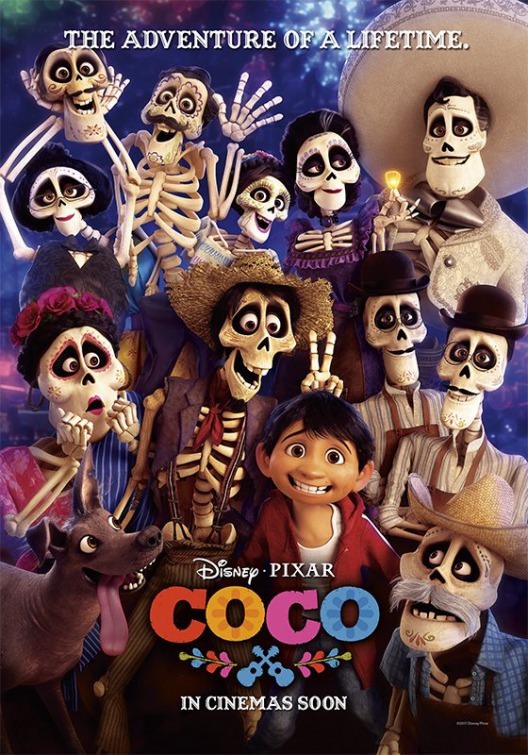
Remembering “Coco”: It’s a Scary World, After All?


Little kids, I’ve discovered, like things that are scary . . . as long as they’re not TOO scary. But they’re not crazy about sitting quietly in the dark of a movie theatre for a long period of time. And they value entertainment that’s simple and straightforward. They understand about good guys and bad guys, but shades of grey are pretty much beyond them. These are some lessons I learned when I took two young family members (ages 6 and 3) on their first big movie outing, to see Pixar’s Coco.

Personally, I loved this film, the odds-on favorite to win the Oscar for best animated feature. It’s beautiful to look at, and does a splendid job of mirroring Mexican culture in a way that’s both respectful and fun. From the opening credits, spelled out in brightly-colored papel picado (paper-cut) banners, to the incorporation of Mexican Dia de los Muertos traditions, Coco is a visual treat. The music is terrific too, and the film’s message about family solidarity and respect for one’s past certainly resonates.

That being said, Norteamericano children six and under can be forgiven for not appreciating the charms of Coco. After all, it’s almost two hours long, which makes for a lengthy sit. And it’s complicated: not every kid can quickly grasp why the plucky young hero has to journey to the realm of the dead and (worse yet!) risk not being able to return. And Coco is—let’s face it—a wee bit scary. Hundreds of animated skeletons appear among the cast of character. Even though most of them are quite fanciful and lovable, their presence poses questions about the meaning of death that I suspect make most American kids uneasy. (Mexican culture is traditionally good at acknowledging death in ways both loving and humorous, so I’d enjoy  hearing how a six-year-old steeped in that heritage would feel about the movie.)

 Anyway, the two youngsters I took to see Coco have now survived their very first trip to Disneyland. The three-year-old, a girl who loves puppies and unicorns, enjoyed her dizzy ride in those whirling Alice in Wonderland teacups (every adult’s least-favorite Disney attraction), but later proclaimed that what she liked best was prancing on a white wooden horse on the King Arthur Carousel. Her big brother, newly six, was definitely in the market for scares. He survived the Haunted Mansion, then graduated to the thrills of Star Tours, the Indiana Jones ride, a Matterhorn bobsled, and the bone-rattling Wild West rollercoaster called Big Thunder Railroad. Each of these he found scary, but not too scary to be fun. I’m certain he’d go back at a moment’s notice.

Why was he put off by Coco, even though he couldn’t get enough of these thrill-rides? Well, first of all, the rides are short, so there’s precious little time to get anxious or confused. And though they may be full of physical jolts, you can’t call them mentally taxing.  True, they simulate danger, but rescue always comes very quickly. Though he wouldn’t want to see Coco again, this six-year-old can be mesmerized by early Disney cartoon shorts, like one where an obvious bad guy (Pistol Pete?) is foiled by spunky hero Mickey Mouse, who deftly removes consecutive rungs of a ladder Pete is climbing. In comic shorts like this, everyone gets a bit battered, but the humor is so broad that we know there’s no harm done, and that everyone is going to live forever without anything much changing. In Coco, lives change forever—and that’s a lot to grasp when you’re sitting in the dark.