Showing posts with label Roman Polanski. Show all posts

Tuesday, July 9, 2024

L.A. Weather and “Chinatown”

As a longtime volunteer with the Santa Monic Public Library system, I’m reading a new best-seller called L.A. Weather, by María Amparo Escandón. It concerns a family with Mexican and Old California roots, ambitiously folding in almost every touchstone 21st century concern you can think of: sexuality, gender demarcations, surrogate pregnancy, gentrification, religious practices, divorce, and complex family dynamics. (Somehow the question of politics only briefly rears its ugly head). But the key issue that gives the book its title has to do with the complexities of Southern California weather. The book’s central patriarch figure, Oscar, becomes increasingly estranged from his wife and three daughters as he obsesses over climate change and its potential impact on his secret almond grove.

 I appreciate the novel’s insider grasp of L.A. geography, and of the ethnic enclaves it chronicles. A movie based on the book would be an enjoyable tour of Malibu beach houses, east L.A. barrio bungalows, and orchards set deep in the San Fernando Valley. I’ve never done a scientific study, but it’s been pointed out to me that most upbeat screen love stories are set in New York (see, for instance, You’ve Got Mail), while L.A. in the preferred backdrop for dysfunctional futuristic landscapes (Bladerunner, I’m looking at you!)  It seems as though film execs, mostly from the east, come to SoCal to pursue their careers, then score with movies that either romanticize the coast they left behind or turn their new west-coast home into a horror show.

 Escandón’s family saga contains a genuine affection for her adopted hometown, but also seems prophetic in that it worries about a climate crisis that threatens to uproot the Alvarado family’s sense of well-being. What strikes me, to my surprise, is how the novel’s key plot strand is the same one that resonates in the late Robert Towne’s script for Chinatown. This 1974 thriller, brilliantly directed by ultimate outsider Roman Polanski, is set in the L.A. of the 1930s, the era of such famous page and screen detectives as Philip Marlowe. There have been ten or more screen adaptations of Marlowe-related stories, including Humphrey Bogart’s 1946 The Big Sleep and Elliott Gould’s 1973 The Long Goodbye. Marlowe films always focus on moral decay and a private-eye hero who tries desperately (and sometimes messily) to create order out of chaos. But in Chinatown the hero (Jack Nicholson’s Jake Gittes) is less heroic and the ending is far less tidy than in the Marlowe-related flicks. As a crony memorably tells Gittes after the unthinkable has happened, “Forget it, Jake, it’s Chinatown.” This climactic line threw me when I first saw the film, but of course I’ve come to accept it as a metaphor for all that’s chaotic and obscene about L.A. life. (Really, if you’ve seen this and Bonnie and Clyde, you know that Faye Dunaway should definitely stay out of moving cars when thugs and cops are around.)

 The moral story in Chinatown may be the one that stays with the viewer, but the plot hinges on a still-resonant L.A. topic: the drought. A key character in the film, L.A. water tsar Hollis Mulwray, is loosely based on a legendary L.A. figure, dam-builder William Mulholland. And we clearly see the tension between San Fernando Valley farmers who demand irrigation for their cash crops and City of L.A. residents worried about their source of drinking water. Those issues still remain, exacerbated by climate change, and we who prefer garden living to making our homes in a desert appreciate books and films that point out where we’re going wrong. 


Thursday, February 10, 2022

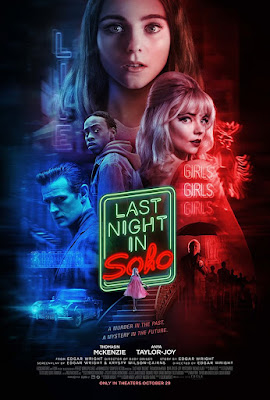
Dreaming of Last Night in Soho

It’s clear that Edgar Wright has genre films in his blood. He first gained attention with the zombie comedy Shaun of the Dead (I admit I haven’t seen it, but you’ve got to love that title). Since then he’s worked with much bigger budgets on movies I’ve enjoyed, including the screen version of a wacky graphic novel (Scott Pilgrim vs. the World) and a slam-bang car-crash movie (Baby Driver). I just saw his latest, Last Night in Soho, and couldn’t help thinking of it as a Roger Corman release, though without the T&A. In my book, the Corman comparison is far from an insult. Last Night in Soho was doubtless much costlier than the Corman flicks of my era, and it has a far more polished look, not to mention the appearance of such classic British actors as Rita Tushingham, Terrence Stamp, and the late Diana Rigg in key roles. But like Corman movies of the Stripped to Kill variety, Last Night in Soho has wild audacity and just enough kinkiness to make it mesmerizing.  

 The classier comparison, I admit, would be to Roman Polanski’s Repulsion. Like that memorable psychological horror film from 1965, Last Night in Soho exists largely in the head of a deeply troubled young woman. Eloise (Thomasin McKenzie of Jojo Rabbit) leaves her loving grannie behind in Cornwall to attend a prestigious fashion institute located in a seedy part of London. Her mother had died tragically many years before, but now Ellie is filled with joy—at least at first—at the thought of making her way as a fashion designer. It’s not long, though, before she’s having disorienting visions of nighttime London in the Swinging Sixties. In these visions she herself, in all her country mousiness, seems to merge with a glamorous young nightclub singer named Sandie (Anya Taylor-Joy), a captivating vision in flowing hot-pink minidress and bouffant blonde hair. 

 Things get stranger and stranger as the two young women’s identities continue to intertwine. (The film’s brilliant cinematography, which makes elaborate use of reflective surfaces, establishes that the one character is literally the mirror image of the other.) Eventually, as the viewer scrambles to figure out the identity of the mysterious Sandie, it becomes clear that there will be blood. More than that I’d rather not say, except to note that an unexpected story twist is in the offing. You might call it cheesy, but in dramatic terms it strikes me as highly effective. Not everyone agrees, though: I note that something called the Women Film Critics Circle voted Wright into its Hall of Shame for a third-act plot element they feel is demeaning to women.  

 It's time to tip my imaginary hat to the movie’s cinematographer. Chung-hoon Chung. He is used regularly by a giant of Korean cinema, Park Chan-wook, in such masterworks as The Handmaiden, and I hope we’ll soon see more of his dazzling visuals in English-language films. Thanks to his accomplishments, the film critic of the Los Angeles Times calls Last Night in Soho “without a doubt, the best-looking film of Wright’s career.”  There are also some admirable performances, led by the two young female leads. The brunette McKenzie, with her big blue eyes, is the very picture of youthful innocence, and it’s jarring to see her evolve (via a dye job and a new hairdo) into an aspiring Sixties go-go girl. As for Taylor-Joy, who first sprang into my consciousness via TV’s The Queen’s Gambit, she seems capable of any dramatic task that’s set for her however outrageous it might be. The same goes, of course, for Edgar Wright.


Tuesday, October 12, 2021

Virginia is for Lovers; Los Angeles is for Filmmakers: “L.A. Confidential” and “L.A. Story”

It’s not exactly “Virginia is for Lovers” or “I ♥ New York,” but a longtime slogan for my hometown has been “L.A.’s the Place.” It’s a catchy reminder that there’s a lot going on here: glamour, intrigue, possibility. And of course movies.

 One reason Southern California attracted moviemakers early on was because it could look like many other places. Though today location shooting is the norm, even some quintessential NYC movies were shot in L.A. Like, for instance, Martin Scorsese’s breakout film, Mean Streets. Still, L.A. over the years has sometimes had the chance to play itself. Particularly in the film noir era (1940s-1950s), L.A. sunshine was transmuted into a view of the city emphasizing dark shadows and darker morals.

 In the 1990s we saw two major films with L.A. in their titles. One, picking up on the mood (though not the look) of film noir, focused on the City of the Angels as a place of rampant corruption. The other, an outrageous comedy, focused on L.A.’s sexual hedonism before climaxing in a candy-coated embrace.

 L.A. Confidential (1997) is a worthy follow-up to Roman Polanski’s L.A. masterpiece, Chinatown. Based on a twisty 1990 novel by native son James Elroy, it uses the year 1953 as a springboard to a world where policemen, pimps, and politicians run roughshod over ordinary folks. Perhaps the film’s number-one victim is the lovely Lynn Bracken, who has slipped from showbiz aspirations into the life of a call-girl outfitted (or, in the movie’s parlance, “cut”) to resemble Veronica Lake. Filling out the cast is a cop with a hair-trigger temper (newcomer Russell Crowe), a devious chief of police (James Cromwell), a detective who’s gone Hollywood (Kevin Spacey), and a sleazy gossip columnist (Danny DeVito) who narrates the sordid goings-on “off the record, on the QT, and very hush hush.”

 Though much admired in its day, L.A. Confidential didn’t take home the big prizes. Yes, Kim Basinger won a supporting actress Oscar for playing vulnerable but clear-eyed Lynn, and the film was also honored for its adapted screenplay. But this was the year Titanic picked up most of the marbles (11 Oscars), so L.A. Confidential was very much an also-ran.  I want to salute the late Curtis Hanson, the film’s director, producer, and co-scriptwriter, for a job very well done. Hanson, who provides thoughtful commentary on the film’s DVD, is yet another Roger Corman alumnus who made good. Debuting as a director with a cheapie Corman thriller, Sweet Kill (1972), Hanson went on to showcase his skills as a maker of genre hits like The Hand that Rocks the Cradle and The River Wild before L.A. Confidential thrust him into the spotlight. Alas, he could never quite repeat the film’s success.

 At the start of L.A. Confidential there are quick shots of the city at work and at play in 1953. There we glimpse the grand opening of an L.A. freeway. By 1991, the year of L.A. Story, freeways are a given. So are backyard swimming pools, complicated espresso drinks, the Hard Rock Café, and of course earthquakes. SoCal native Steve Martin and company have fun smirking at Angelenos’ social peculiarities, like driving to a friend’s house instead of simply walking down the block. It’s an uneven film, with some brilliant moments. Two of the best: an opening that parodies the start of Fellini’s La Dolce Vita, with a giant hot dog (and not a statue of Jesus) being transported through the air. And of course Martin blithely roller-skating past the abstract expressionist canvases at the county art museum. (In real life he’s a trustee.)

 By the way, my colleague Michael Coate, whose Digital Bits site explores film history, has just posted a nifty tribute to Raiders of the Lost Ark on the occasion of its 40th anniversary. I'm quoted in chapter 10 on Deborah Nadoolman's iconic costume design for the film.


Tuesday, September 14, 2021

Heading into a Cul-de-Sac

Roman Polanski and the American film industry have had an unusual relationship. Polanski has been a Hollywood hero (for directing such major hits as Rosemary’s Baby and Chinatown), and a Hollywood victim (for losing wife Sharon Tate and their unborn child to the Manson murder ring). In 1977 he evolved into a Hollywood fugitive, the result of a lurid sexual escapade with a thirteen-year-old girl at Jack Nicholson’s Bel-Air home. Though he continues to win acclaim, even in Hollywood, for such deeply moving films as The Pianist (2002), he is still today considered a fugitive from the U.S. justice system. It’s not my place here to either condemn or excuse Polanski’s behavior. Suffice it to say that he’s an extremely talented director, and one whose childhood traumas probably influenced his distinctive taste for the perverse. After all, as a six-year-old Jewish child in Krakow, he witnessed his parents being hustled off to Nazi death camps, then lived for years in foster homes, pretending to be part of the Roman Catholic majority.

 Before Polanski arrived in Hollywood, he shot much-acclaimed films both in Poland (Knife in the Water) and the United Kingdom. The psychological horror of Rosemary’s Baby was preceded by Repulsion, a British film starring Catherine Deneuve as a beautiful but sexually stunted young woman obsessed with a fear of men’s desire for her. Repulsion was Polanski’s first film in English. A year later, he made another film he had co-scripted. Called Cul-de-Sac, it was something he once declared was one of his proudest achievements.

 Cul-de-Sac is both very simple and very odd. Set in and around a centuries-old castle-like structure on a Northumberland island, it is in some ways a tone-poem that focuses on ancient stones and the lapping of the sea.  In this stark setting, we come to know three people. One is a middle-aged man, apparently retired from a successful business career, who has retreated to this castle to paint, raise chickens, and enjoy the good life. He’s played by Donald Pleasence, the bald-headed British actor often cast in sinister roles. (See, for instance, his portrayal of a villain in a James Bond flick, You Only Live Twice; he also played the psychiatrist in Halloween) Here he’s not sinister so much as weak, a man physically and emotionally incapable of defending hearth and home. That home includes his second wife, the young and beautiful Françoise Dorléac (Deneuve’s sister in real life), who seems to like stripping off her clothing in the presence of other men. 

This oddly-coupled pair hardly expects the arrival of a two-bit gangster hiding out after a botched robbery. He’s played by Lionel Stander, a refugee from Hollywood in the blacklist era, after years of playing sidekicks in films like  Mr. Deeds Goes to Town and A Star is Born. Stander was a big man, broad of shoulder and deep of chest, whose trademark was a distinctively gravelly speaking voice. In his presence the diminutive Pleasence shrinks to nothing, and the interplay of the trio (punctuated when a few more unexpected guests turn up) is sometimes funny but always ominous.

 Cul-de-Sac, which won top prize at the Berlin Film Festival, will not be to everyone’s taste. Though one trailer I saw promised that it would be “fun” for moviegoers, I doubt that most Americans looking for a good time at the cineplex would find this their cup of tea. It reflects the era’s nihilistic sense of alienation, as seen in the work of playwrights like Samuel Beckett and Harold Pinter. But if you like the macabre, this one’s for you.

A good friend of mine, Bella Stander, is one of Lionel Stander's 5 daughters, and has been chronicling her dad's career for many years. She enjoyed this post, but has added her own commentary regarding Cul-de-Sac:

  • The film was shot on Holy Island, the site of Lindisfarne.
  • It was my dad’s biggest film role (though his name isn’t on the poster you show), and he got a hernia from pushing the car in the opening scene.
  • It was Jacqueline Bisset’s first film credit (as Jackie Bisset)—and she was sleeping with Polanski.
  • People who see it are divided into two groups: those who think it’s hilarious (me, my son) and those who say WTF? in utter bewilderment (my husband and most of my friends).
  • Most important: It’s in the new “Home Invasion” collection on Criterion Channel.

 Thanks, Bella1