Showing posts with label Anthony Hopkins. Show all posts

Tuesday, June 18, 2024

Good Housekeeping: “The Remains of the Day”

The lineage of The Remains of the Day is unusual. It began as a 1989 novel by Kazuo Ishigoro, a native Japanese who was raised in England. Though Ishigoro’s first two novels deal with the nation he had left at age 5, The Remains of the Day marked his turn toward strictly British subject matter. Following the massive success of this novel, he has explored science-fiction material (Never Let Me Go), dabbled in screenwriting (for the Oscar-nominated Living) and won the 2017 Nobel Prize in Literature, among other major honors.

 The screen version of The Remains of the Day, released in 1993, started out (to my surprise) as a Mike Nichols project with a screenplay by Harold Pinter. When the film passed into the hands of the Merchant-Ivory team, Pinter severed ties, though apparently some of his work was used, while Nichols stayed involved as a producer. The resulting film benefits from Ismail Merchant’s, James Ivory’s and Ruth Prawer Jhabvala’s comfort with literary adaptations, as well as their impressive visual sense. A film about a head butler and a housekeeper numbering their days in service to Lord Darlington requires a functioning manor house as its setting. The Merchant-Ivory reputation was such (after the artistic success of films like A Room with a View and Howard’s End)  that the filmmakers were able to persuade previously reluctant property owners to open their doors to cast and crew. Clearly, the resulting film is a triumph of logistics. Several country homes were used in combination, including Dyrham Park for the house’s exterior and driveway; Powderham Castle for some gracious public rooms and a spectacular turquoise stairway; Badminton House for servants’ quarters and a conservatory. On screen it all looks like one impressive stately mansion.

 Though Ishigoro wrote his novel in the first person, from the perspective of a starchy and deeply traditional butler, the screenplay’s basically third-person point of view hardly detracts. In Anthony Hopkins’ performance we well understand how much Mr. Stevens is bound by his own past, as well as by an unrelenting sense of duty to those he sees as his betters. Playing opposite him is the always convincing Emma Thompson, as a housekeeper who would like to be braver than she is. These two would make for a natural pairing, except that their basic timidity holds them back. This is best acknowledged in what the filmmakers call “the book scene,” in which Miss Kenyon briefly sets aside her usual decorum to playfully wrestle away from Stevens the mysterious book he is reading in his rare off-hours. The fact that he rebuffs her, for no very good reason, is a wonderful indicator of his habitual strait-laced outlook (is he deeply repressed, or just shy?).

 I first saw this film when it was in theatres, and best remembered it for that very English sense of stiff-upper-lip self-denial. What I’d forgotten completely is how much the film has to say about the politics of the pre-World War II era. Lord Darlington, it appears, has a sentimental affection for German culture. Though at base he’s a well-meaning man, his money and social position help him prop up the reputation of the Nazi party within his own country. What’s deeply disturbing is that Stevens, as his loyal retainer, will not permit himself to think independently of the master of the house, even when the lives of others (like two Jewish immigrant girls in his kitchen) are at stake. So he loses not only a chance at love but also, ultimately, his self-respect. A sad ending for one who puts duty before all else.

 

Tuesday, January 31, 2023

Does Father Know Best?: “Aftersun” and “Armageddon Time”

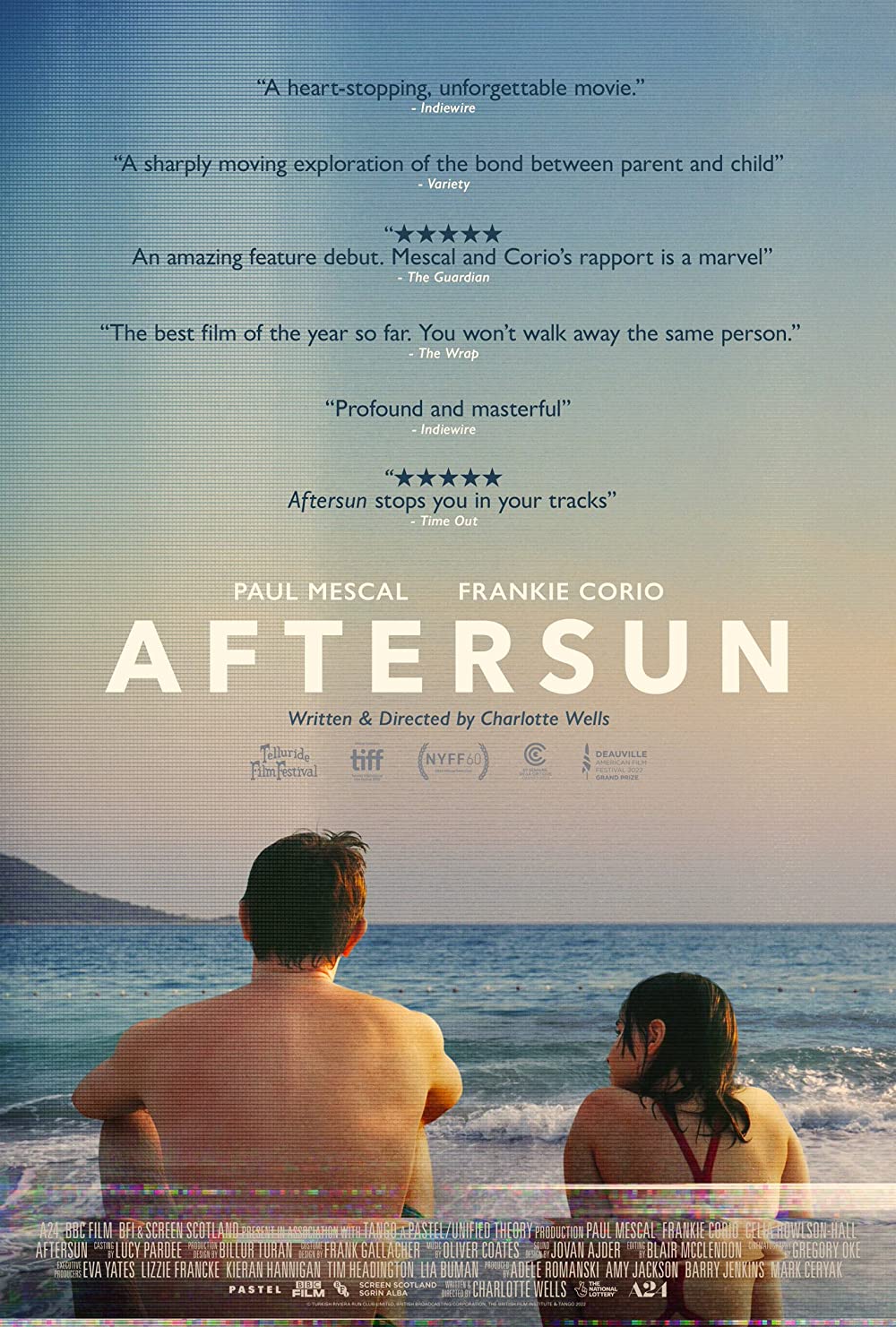
Aftersun? I admit I felt an after-shock, once I checked the rave reviews for an art-house film full of weird camera angles, scratchy footage, and little to no plot. Yes, it can be interesting to pan through someone’s vacation videos, looking for clues about relationships and impending traumas. But Aftershock just didn’t seem as fascinating to me as it did to my favorite serious critics, who pronounced it a work of genius by a bright new filmmaker, Charlotte Wells. 

 Maybe it’s all a matter of watching an ambitious film on a theatre-sized screen. Maybe you need to be in the right place (and not on your living-room couch) to appreciate idiosyncratic artistic choices and stories that hide the characters’ motivations beneath scads of mundane details.

 Yes, I was sympathetic to a film about the relationship between a lively 11-year-old girl and her 30-year-old father making up for lost time at a vacation resort. I could see the inherent tensions between them: the dad’s efforts to shield his daughter from his cigarette cravings, his tentative inquiries about her mother back home, the daughter’s budding fascination with the teen-age canoodling going on around her. But the critics’ glib explanation that this is a memory piece, with the now-grown daughter trying to sort through her recollections of a father who has come to a bad end, led me to wonder how they’d sorted out the film’s few clues and come to such a definitive explanation. (Question: was it all laid out for them in the film’s press packet?)  I like sleuthing  beneath the surface as much as the next moviegoer, but my main feeling here was one of frustration.

 Speaking of fathers, I’ve also just watched James Gray’s semi-autobiographical Armageddon Time, in which a middle-class New York kid discovers that life is not always fair, that when it comes to trouble his African-American buddy will always be getting the short end of the stick. Most reviews I’ve seen have focused on the story’s racial elements, as well as the kid’s deep emotional connection with an old-world  Jewish grandfather who knows from discrimination. That grandfather is played by Anthony Hopkins, in an unlikely but surprisingly convincing piece of casting. But Gray’s well-realized story also draws sharp portraits of young Paul Graff’s parents.

 It is striking to see Anne Hathaway, so often a perky ingenue, play (very nicely) a mom, one who’s trying awfully hard to hold together a family group whose values sometime conflict with one another. But I found myself particularly interested in Jeremy Strong, an actor whose name is new to me, despite his impressive stage and screen credits. (He won an Emmy for Succession And, with a lot more hair, he was Jerry Rubin in 2020’s The Trail of the Chicago 7.)  Strong plays Paul’s father, a plumber who has married into an affluent family, but can never quite forget his own blue-collar roots. What makes him so fascinating—and so real—is that he’s a volatile man, who reveals different sides of his personality at different moments. Waking up his son for school on an ordinary morning, he's charmingly goofy. When there’s just been an overnight death in the family, he’s gentle. But when Paul is accused of serious wrongdoing at school, he responds with a towering fury that is just shy of dangerous. What we don’t quite realize immediately is that he feels himself a bit of an outcast in this family. He’s not comfortable with the burden of private school tuition for both of his sons. Here’s a father who’s complicated, but the clues aren’t hard to find.


Friday, July 22, 2022

What Goes Around Comes Around: “360”

One thing we’ve learned in the era of COVID is that we’re all in this together. Particularly as we return to international travel, we’re re-discovering (via transmitted infections that are now running rampant around the globe) that, in the famous words of John Donne, no man is an island. That’s one of many thoughts that came to me in the wake of watching Fernando Meirelles’ 2011 film, 360. This structurally ambitious drama (it’s not for nothing that Meirelles once studied to be an architect) was written by the eminent Peter Morgan, best known for such royal projects as The Queen, The Crown, and The Last King of Scotland. Critics and audiences were not charmed by 360, and I can understand how the film’s intricacies will seem to some overly calculated. But my late-night viewing of this unheralded film left me with much to mull over.

 In some obvious ways, 360 owes a debt to Arthur Schnitzler’s notorious 1897 play, La Ronde. Schnitzler broke international taboos by depicting diverse pairs of lovers (a soldier, a housemaid, a young gentleman, and so on) before or after coitus. One of the pair in each scene moves on to another tryst in the next, hinting that sexuality knows no boundaries of class and economic status Eventually we come full circle, with the prostitute-character from the very first scene bedding the nobleman introduced near the end.  (Schnitzler does not concern himself with relationships transcending conventional gender roles, but his play outraged audiences of his own day and led to attacks on his character and his ethnicity.)

 In 360, too, many of the interlocking relationships are based on sex, but characters are considerably more complicated. As in: the British familyman played by Jude Law, while on a business trip to Vienna,  has nervously set up an assignation with an ambitious would-be prostitute from Slovakia. By chance it doesn’t happen,  but she re-enters the film much later, making a killing (so to speak) as part of a scheme to rob a ruthless gangster-type. Obviously, part of the film’s point is that you never know what will happen when you intersect with other human beings. Sometimes, in fact, great things may come to pass, if you’re only brave enough to seize the day. (Says one newly-emboldened character, “If you see a fork in the road, take it.”) On the other hand, audacity can also lead to tragedy. One memorable strand involves a young Brazilian (Maria Flor) living in London. Fleeing her two-timing lover, she boards a plane to fly home, meeting on the way a  wistful old Brit (Anthony Hopkins) searching for his long-lost daughter. Their brief encounter is enlivening to both of them, but an unexpected weather delay in the Denver airport puts her in the path of a convicted sex offender (Ben Foster) who’s desperately trying to control his illicit desires, at the same time that she’s experimenting with carefree hedonism.

 The production leans hard on a stellar international cast speaking a babel of diverse tongues. (Several of the characters are tied together by their serious struggles to learn English.)  360 was shot on location in Britain, France, Austria, and elsewhere, suggesting the degree to which our world has shrunk due to airline travel. Stylistically, Meirelles does wonderful things with glass panels and reflecting surfaces. In diverging from Schnitzler’s La Ronde, it feels modern in both its story and in its film aesthetic. I could pick it apart, but why do that? Frankly, I do not want to spoil my memories of a splendid diversion from my own humdrum summer days.