Showing posts with label Anne Hathaway. Show all posts

Tuesday, August 25, 2026

Pretty in Black and White

I’ve been thinking a lot lately, after viewing several vintage Anne Hathaway films, about how often Hollywood has focused on stories of young women emerging to take over their lives. Obviously, such plot lines are meant to appeal to youthful female audiences, who hope that they too will burst like butterflies from the drab cocoons that have long been holding them in. Think Cinderella turning from a scullery maid to a princess. Think Eliza Doolittle casting aside her Cockney upbringing and her native speech patterns to go to the Embassy Ball and be mistaken for royalty. Think, more recently, of Pretty in Pink (representing other Eighties films of John Hughes) in which Molly Ringwald crosses from the wrong side of the tracks to wow her classmates at her high school prom.

 In many of these films, the focus is on the young protagonist discovering her physical beauty, or maybe demonstrating that she has learned the social skills that will help her navigate the adult world. But there’s a classic 1950 black-&-white comedy (somehow characterized by the often obtuse Golden Globes folks as a drama) in which the female protagonist blossoms, but not because of her improved looks or social manners. Instead, Born Yesterday is a comic paean to the way that political education can change a gal’s life.

 Born Yesterday, based on Garson Kanin’s hit Broadway play, stars the inimitable Judy Holliday as a former nightclub cutie with a New Yawk accent that won’t quit. Though basically a chorine with pretensions—she once spoke three lines on stage—she has long been the sidepiece of Harry Brock, a crude and very rich junkman with his eye on a shady deal involving a U.S. Congressman. (He’s played in the film by Broderick Crawford, who’d just nabbed an Oscar for his lead role as a Huey Long-type in All the King’s Men.) Harry loves Billie Dawn, when he isn’t busy abusing her, because she accepts her own ignorance and never pries into his sordid business affairs. But now that he’s arrived in Washington DC, he figures her uncouth social behavior may become a liability. So he recruits a straight-arrow local reporter named Paul (William Holden) to give Billie a smattering of education.

 Squiring Billie around the nation’s capital, Paul gives her some serious tutelage about American ideals and principles (something we could surely all use today). Though her vocabulary is limited and her shrill voice seems capable of shattering glass, she discovers in herself a thirst for knowledge, as well as a firm determination to no longer be anyone’s patsy. Needless to say, this change in attitude makes an ongoing relationship with Harry Brock untenable. And the smart, well-educated Paul (perhaps savoring his role as her Pygmalion) comes to love Billie’s oddball combination of budding idealism and street smarts.

 George Cukor was known, perhaps unfairly, as a women’s director. He certainly knew how to transfer Holliday’s acclaimed stage performance as Billie Dawn to the silver screen. The voice, the dimples, and the would-be haughty walk are all captured for moviegoers to enjoy. Holliday’s characterization is both funny and lovable, which is perhaps how she remarkably beat out Gloria Swanson (Sunset Boulevard) and both Bette Davis and Anne Baxter (All About Eve) for the Best Actress Oscar of 1951. It was the great triumph of a brilliant but sadly short career. Born in 1921, she died of breast cancer in 1960, just a decade after her greatest triumph. Her last role was a musical performance in another Broadway transfer, Bells are Ringing, in which she was once again irresistibly adorable.

 Dedicated to the memory of Dolly Parton, another adorable blonde who was smarter than she sometimes let on.


Tuesday, August 18, 2026

Anne Hathaway: Once Upon a Princess

A long airline flight always gives me a great excuse to check out movies old and new on my seat-back screen. Sometimes there are surprises: flying over the Atlantic in a plane full of sleeping passengers, I decided to watch an oldie: Astaire and Rogers in 1939’s The Story of Vernon and Irene Castle. It’s the true tale of a famous dance duo hugely popular just before World War I.  I hadn’t realized, until I saw the film, that the historical Vernon, who had patriotically joined the Royal Flying Corps, died in a plane crash. Uh oh—not a nice thing to think about while aloft in the middle of the night.

 A recent cross-country trip allowed me to watch the new sequel to a comedy favorite of mine, The Devil Wears Prada (2006). Now, twenty years later, filmmakers have gathered the original cast—Anne Hathaway, Meryl Streep, Emily Blunt, Stanley Tucci—to update the story of an ambitious young journalist who finds herself taking orders from the imperious editor of Runway magazine, played by Streep with memorable sangfroid. In the original film, Hathaway’s Andy Sachs was a smart but naïve young college grad who thought she could handle the complexities of a job in the fashion industry while dealing with the demands of the capricious editor-in-chief, Miranda Priestly. Ultimately Andy learned . . . and triumphed (mostly) on her own terms. I had heard that the 2026 sequel would take an updated look at the waning role of the print medium within today’s fashion industry, and so it does. Andy is now an award-winning journalist with a new, and much more impressive, job at Runway, and Miranda is now threatened by unexpected forces that want to push her out of her top-dog position. That being said, not a lot has changed in terms of the film’s central relationship. Miranda is still icy; Andy is still puppy-dog eager. (Actually, it’s supporting player Blunt who makes the most striking evolution in the course of the story.) 

Having mildly (but no more) enjoyed this return to the ladies of Runway, I decided to check out the film that first put Hathaway on the map. She was not yet 20 when she starred for director Garry Marshall in Disney’s The Princess Diaries (2001), a family-friendly tale of a girl who makes the most romantic of transformations. Mia, played by Hathaway, is a San Francisco kid with a bohemian mom and very few friends at her trendy prep school. When she first appears on screen she’s almost unrecognizable in her requisite uniform: her hair is a frizzy mop and she wears thick spectacles. Beyond this, she’s gangly and awkward, and  clearly not the greatest of students. But life has a surprise for her, which comes in the form of a soignée Julie Andrews, who turns out to be Mia’s long-absent paternal grandmother—and the reigning monarch of the tiny European kingdom of Genovia. Now Mia, because of her father’s recent death, is next in line for the throne . . . and therefore must learn to conform to royal standards of looks and behavior. Hilarity ensues, as the ugly duckling is (with her grandmother’s loving help) transformed into a swan. It’s the Disney Princess version of Andy Sacks discovering how to dress, how to behave, and how to thrive in the fashion industry.

 Come to think of it, movies are full of these Cinderella stories, in which the drab or gawky young girl metamorphoses into some sort of princess.  I’m thinking, for instance, of Gigi, but YOU may have other examples in mind.


Tuesday, June 16, 2026

“ANNE HATHAWAY IS ON BROADWAY”: The Overlap of Stage and Screen

Is Anne Hathaway, the Oscar-winning star of such beloved films as The Devil Wears Prada, really appearing in a current Broadway show? Well, not exactly. But this is the eye-catching headline on the back cover of a recent Playbill. It’s a clever ad campaign for a Broadway pop musical, & Juliet, in which Shakespeare’s much-neglected wife—also named Anne Hathaway—plays a featured role. The joke works because most theatregoers are also movie enthusiasts. And there’s frequent overlap between the two industries, as screen stars try on major Broadway roles, and the stage’s most beloved performers hope to immortalize their talents on film.

 Once upon a time, hit Broadway shows quickly wended their way to Hollywood. There they became even bigger hits because—by transferring their essence from stage to screen—they could draw upon much bigger audiences. Musicals enjoyed perhaps the biggest advantage from this stage-to-screen metamorphosis, partly because they could transport the viewer visually to a spectacular new place. Just think about the difference between The Sound of Music as play and film. I happen to be genuinely sorry that the Robert Wise/Julie Andrews movie adaptation of the Rogers and Hammerstein hit cut two important satirical songs that examine the Austrian mindset under the rise of Nazi ideology. Still, no stage version can possibly live up to the breathtaking grandeur of the Austrian Alps, as seen in the 1965 film. It of course was shot on location, all the better to show off the hills that are so fully alive in the hearts of our central characters.

 These days, though, a curious reversal is taking place. Original Broadway musicals are largely being supplanted by shows that have already proven their box-office potential by being based on hit films. (The idea, I suppose, is to add music, then stir.)  One of this year’s four Tony nominees for Best Original Musical was The Lost Boys, a musicalization of a kinky little 1987 film about young vampires on the prowl in Santa Cruz, California. On my recent trip to the Big Apple, I could not afford a pricey ticket for that apparent extravaganza. But I did manage to drop in on Death Becomes Her, now moving toward the end of a two-year run. The original Hollywood black comedy, about a magic potion that keeps vain women forever young and beautiful, was directed by Robert Zemeckis and headlined by Meryl Streep, Goldie Hawn, Bruce Willis, and Isabella Rossellini, It was a macabre triumph, thanks to its star power and some colorful special effects. And how was the stage musical? My fellow audience members seemed to love it, and it landed seven Tony nominations, including two for stars Megan Hilty and Jennifer Simard. To be sure, it took home only one statuette, richly deserved, for its wildly imaginative costumes. But I found the music forgettable and the cast mostly trying much too hard to amuse us with their audacity. It seemed, in short, something of a spoof of a spoof. My advice: stick to the movie.

 One curious sidenote: Flower Drum Song, one of Rogers and Hammerstein’s lesser hits, opened on Broadway in 1958, and was filmed three years later. Boasting an all-Asian cast, it is set in San Francisco’s Chinatown where different generations struggle to reconcile their ancient traditions and modern American ways. Long regarded as potentially offensive, the show’s book has always seemed in need of a rewrite. Now it has one, by Chinese-American playwright David Henry Hwang, and it was a joy for me to see this charming musical (staged by L.A.’s East West Players) on stage once again. 


Tuesday, January 31, 2023

Does Father Know Best?: “Aftersun” and “Armageddon Time”

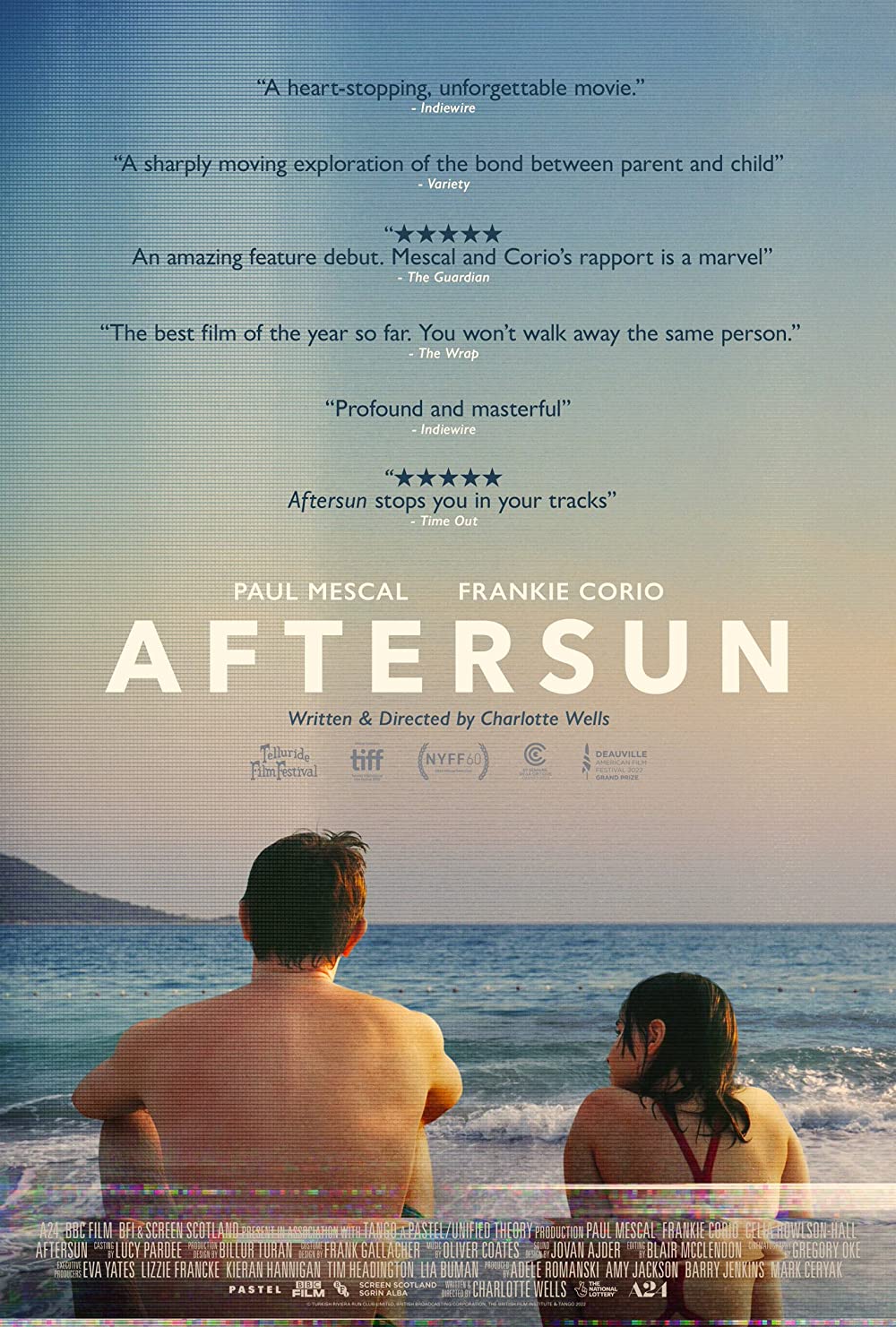
Aftersun? I admit I felt an after-shock, once I checked the rave reviews for an art-house film full of weird camera angles, scratchy footage, and little to no plot. Yes, it can be interesting to pan through someone’s vacation videos, looking for clues about relationships and impending traumas. But Aftershock just didn’t seem as fascinating to me as it did to my favorite serious critics, who pronounced it a work of genius by a bright new filmmaker, Charlotte Wells. 

 Maybe it’s all a matter of watching an ambitious film on a theatre-sized screen. Maybe you need to be in the right place (and not on your living-room couch) to appreciate idiosyncratic artistic choices and stories that hide the characters’ motivations beneath scads of mundane details.

 Yes, I was sympathetic to a film about the relationship between a lively 11-year-old girl and her 30-year-old father making up for lost time at a vacation resort. I could see the inherent tensions between them: the dad’s efforts to shield his daughter from his cigarette cravings, his tentative inquiries about her mother back home, the daughter’s budding fascination with the teen-age canoodling going on around her. But the critics’ glib explanation that this is a memory piece, with the now-grown daughter trying to sort through her recollections of a father who has come to a bad end, led me to wonder how they’d sorted out the film’s few clues and come to such a definitive explanation. (Question: was it all laid out for them in the film’s press packet?)  I like sleuthing  beneath the surface as much as the next moviegoer, but my main feeling here was one of frustration.

 Speaking of fathers, I’ve also just watched James Gray’s semi-autobiographical Armageddon Time, in which a middle-class New York kid discovers that life is not always fair, that when it comes to trouble his African-American buddy will always be getting the short end of the stick. Most reviews I’ve seen have focused on the story’s racial elements, as well as the kid’s deep emotional connection with an old-world  Jewish grandfather who knows from discrimination. That grandfather is played by Anthony Hopkins, in an unlikely but surprisingly convincing piece of casting. But Gray’s well-realized story also draws sharp portraits of young Paul Graff’s parents.

 It is striking to see Anne Hathaway, so often a perky ingenue, play (very nicely) a mom, one who’s trying awfully hard to hold together a family group whose values sometime conflict with one another. But I found myself particularly interested in Jeremy Strong, an actor whose name is new to me, despite his impressive stage and screen credits. (He won an Emmy for Succession And, with a lot more hair, he was Jerry Rubin in 2020’s The Trail of the Chicago 7.)  Strong plays Paul’s father, a plumber who has married into an affluent family, but can never quite forget his own blue-collar roots. What makes him so fascinating—and so real—is that he’s a volatile man, who reveals different sides of his personality at different moments. Waking up his son for school on an ordinary morning, he's charmingly goofy. When there’s just been an overnight death in the family, he’s gentle. But when Paul is accused of serious wrongdoing at school, he responds with a towering fury that is just shy of dangerous. What we don’t quite realize immediately is that he feels himself a bit of an outcast in this family. He’s not comfortable with the burden of private school tuition for both of his sons. Here’s a father who’s complicated, but the clues aren’t hard to find.