Showing posts with label Argo. Show all posts

Tuesday, January 10, 2023

Maryland Is For Movies (in Gene Meyer's new book)

Maryland is an oddly shaped state that coils around our nation’s capital. West Coasters tend to think of it as a series of bedroom communities that house the Washington elite in swanky suburbia. It also, has a Civil War connection, a booming tech industry, and a reputation for freshly caught shellfish. Remember the bumper stickers of some years back? If Virginia Is For Lovers, Maryland Is For Crabs.

 When thinking of Maryland, those of us with movie connections focus on Baltimore, birthplace of two writer/directors who’ve made their mark on film history. Barry Levinson set his first four films in Baltimore, reflecting aspects of his own growing-up years in Diner (1982), Tin Men (1987), Avalon (1990), and Liberty Heights (1999). Eventually Levinson moved on to other locales for such hit films as The Natural, the Oscar-winning Rain Man,  and the hilariously prescient Wag the Dog. Meanwhile, filmmaker John Waters has always stayed close to his Baltimore roots, in such strange and uproarious cult classics as Pink Flamingos (1972), Polyester (1981), and Hairspray (1988). The last of these was eventually transformed into a Tony-winning Broadway musical, which in turn became a hit film: its peppy opening number is “Good Morning, Baltimore.”

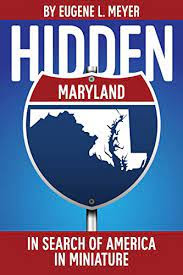
 My knowledge of Maryland may be limited, but not so my colleague Eugene L. Meyer, who for years has written about the delights of his home state in Maryland Life magazine and the Washington Post. His new book is Hidden Maryland: In Search of America in Miniature. Roaming the state, Gene uncovers all sorts of Maryland quirks and secrets. What I took away was that even in Maryland, you’re never too far from dreams of Hollywood. Gene warmly profiles the owner of Vera’s White Sands Restaurant, a “Kon Tiki tacky” Polynesian restaurant in Calvert County. Miss Vera (who, alas, recently passed on at age 92) loved to reminisce for her clientele about her glamour days in the Hollywood Hills, down the road from Humphrey Bogart and Lauren Bacall. Gene also writes about tiny Delmar, spanning the Delaware-Maryland border: it was the birthplace of William Alland, who played the reporter doing a post-mortem investigation of Orson Welles’ character in Citizen Kane.

Some genuine Hollywood figures still make their homes in Maryland. A blue-collar section of Montgomery County is the stomping ground of crime novelist George Pelecanos, who won multiple awards for his work as a writer and producer on TV’s The Wire. Pelecanos’s knowledge of the seedy underbelly of cities like Baltimore has led to his involvement with a number of other TV projects, including Tremé (about New Orleans), The Deuce (New York City), and D.C. Noir.

 One highlight of Gene’s book is a piece called “Everyman Tony Mendez Comes In From the Cold.”  It seems that Mendez, a soft-spoken guy now living in retirement in Washington County’s Pleasant Valley, was once a CIA spymaster so crafty that in 1980, at the height of the Iranian hostage crisis, he managed to extricate six American diplomats from the U.S. Embassy in Teheran. Posing as the production manager for a fake film company, he and his team arrived in Iran purporting to scout locations for a sci-fi flick, to be called Argo. (That title was based on a crude knock-knock joke then making the rounds of his office.) In the course of their “location scout,” Mendez and company managed to smuggle out the six frightened Americans who’d been in hiding for months.  

 If Argo sounds familiar, it’s because in 2012 an actual Hollywood film was made, chronicling Mendez’s exploits. He was played on screen by Ben Affleck, who also directed. Alas, Mendez himself passed on due to complications from Parkinson's in 2019.  Gene had interviewed him in 2012, and still treasures the autograph Mendez gave him, written with a shaky hand.  
 

Tuesday, February 12, 2013

And Then What? – The Oscars and the Power of Suspense


As I write this, the manhunt continues for Christopher Jordan Dorner, the vengeful ex-cop suspected of gunning down three innocents. Now, though Dorner seems to have vanished without a trace in the snowy mountains of Big Bear, tensions continue to rise. Where will he surface next? Who will be his target?

This kind of real-life suspense is something movies are always aiming to capture. Filmmakers know that viewers can be kept on the edge of their seats if they’re deeply invested in the fate of a film’s central characters. It helps if they find themselves surprised by plot twists and turns they didn’t anticipate. But what if the outcome is known in advance? Three of the nine films nominated for this year’s Best Picture Oscar -– Argo, Lincoln, and Zero Dark Thirty –- are based on actual historic incidents. In each case, when I walked into the theatre, I knew (at least in general terms) what would ultimately happen: that the beleaguered American Embassy personnel would safely escape from Tehran, that Lincoln and his allies would rally Congress to pass the 13th Amendment, that a squad of Navy SEALS would breach the Abbottabad compound and kill Osama Bin Laden. The success of these films lies in their ability to grip viewers like me, even when we know what’s coming.

Smart screenwriters dealing with historic episodes ratchet up suspense in several ways. Writers can create rich, complex charcters whose behavior is not always predictable. Tony Kushner’s script for Lincoln got me interested not only in the results of the Congressional vote but also in the diverse personalities who –- for their own reasons -- chose yea or nay. Writers can introduce heart-pounding chase scenes. Chris Terrio added to the climax of Argo a (doubtless exaggerated) pursuit on the airport tarmac that contributed hugely to the audience’s excitement level. Writers can flesh out an action sequence with so many real-seeming details that we can’t help but be caught up in the moment. All of us know the results of the Abbottabad raid, but it becomes much more powerful when Mark Boal’s script immerses us in its second-by-second chaos and confusion.

Back in 1995, Ron Howard and his screenwriting team faced a similar challenge when transforming the memoir of mission commander Jim Lovell into the film Apollo 13. The abortive Apollo 13 moon mission had blasted off in 1970, but in 1995 most moviegoers probably still remembered that it -- alone among America’s lunar missions -- hadn’t gone as planned. Due to crippling technical difficulties, the moon landing had to be scrubbed, and the astronauts barely made it back to earth. Because the astronauts’ survival was well known, screenwriters Willam Broyles Jr. and Al Reinert heightened their film’s suspense through character interaction. As the stakes grow higher, viewers shuttle between the apparently doomed astronauts in their capsule and the engineers at Houston’s manned space center, desperately relaying ideas to help fix the damaged spacecraft. Another key component of the film involves Jim Lovell’s wife, holding tight to her husband’s love as he yearns to return home to her and their family.

Apollo 13 was nominated for nine Oscars, including Best Picture. But there was no nomination for director Ron Howard. That fact seemed to doom the picture, even though it had won top honors from Hollywood’s acting, directing, and producing guilds several weeks earlier. On Oscar night, Braveheart was the big winner. Given the current Oscar snub for Argo’s director, Ben Affleck, is Argo fated to go the route of Apollo 13? That’s a question that will make for real suspense on February 23.

This post is dedicated to Roxanne Lane, a film industry veteran who’s one of Argo’s most loyal fans.

Note: Here’s a surprising editorial in today’s Los Angeles Times, pointing out Tony Kushner’s deliberate falsification of the voting record of four congressmen from Connecticut, in order to heighten the drama of the film Lincoln.

Tuesday, November 27, 2012

Argo Affleck Yourself! (Going Hollywood to Go Home)


What with the fallout from the Petraeus affair, not to mention the tragic attack in Benghazi, the CIA hasn’t been looking too good of late. That’s why it was a pleasant change to see Argo, in which – during the dark days of the 1979 Iranian revolution -- CIA operatives were crafty enough to spirit six Americans away from bloodthirsty Tehran mobs.

For those of us who survived the early Eighties, Argo provides flashbacks to some very bad times. Who can forget the period when 52 members of the American Embassy staff were held for 444 days by their Iranian captors? News broadcasts of that era signed off nightly with a reminder of how long our fellow citizens had been incarcerated, and it was hard to look past the fact that our country looked mighty helpless when faced with the strange new world of religious terrorism. Argo captures that era in masterful detail: the constant media barrage, Jimmy Carter looking grim, everyone’s really awful fashion sense.

Argo is the story of a small victory that occurred in the middle of a great disaster. Leave it to Hollywood to understand that the public likes true stories, but wants them to have happy endings. Kathryn Bigelow’s The Hurt Locker, an astonishingly real saga of a GI bomb disposal team in Iraq, may have won the 2008 Oscar, but few people bought tickets to see it. (The same might hold true for Bigelow’s latest, Zero Dark Thirty, which unsparingly chronicles the hunt for Osama bin Laden.) Argo, on the other hand, has been a certifiable hit. Partly that’s due to actor/director Ben Affleck’s sure hand at the helm. Partly, too, it reflects the audience’s fascination with tales of derring-do, subterfuge, and breathless escape – the ingredients that go into the best James Bond spy thrillers.

Ironically, one reason that Argo works so well as a Hollywood movie is that there’s a very Hollywood strand to its plot. It seems that CIA “extraction” expert Tony Mendez (a nicely low-key performance by Affleck) actually did smuggle the six Americans out of their hiding place by disguising them as a Canadian film production unit, visiting Tehran on a location scout for a sci-fi fantasy flick. To accomplish this, he partnered with Hollywood makeup artist John Chambers, best known (until now) as the greasepaint genius behind Planet of the Apes. In Argo, Chambers (deliciously played by John Goodman) joins forces with over-the-hill producer Lester Siegel (Alan Arkin at his most impish) to give an industry imprimatur to the bogus movie. Their banter adds an essential element of humor to the proceedings, providing an effective break in the mounting tension. (Says Lester to Mendez at one point, “You’re worried about the Ayatollah? Try the WGA.”)

Other Hollywood touches: At a reading of the script at the Beverly Hilton, intended to get the trade press talking about the non-existent film project, the always-bodacious Adrienne Barbeau takes the role of Serksi the Galactic Witch. And at Tehran’s airport some potentially hostile Iranian guards can’t disguise their child-like enthusiasm for the fake film’s gorgeously drawn storyboards.

Part of the point, it seems, is that everyone’s a sucker for Let’s Pretend. This fact helps save the six Americans, but it works conversely as well. In passing, we see a brief but horrifying incident that really happened: Iranian revolutionaries terrorizing American hostages by standing them up in front of what turns out to be a fake firing squad. It’s a heart-stopping moment. But ultimately this film about the NOT making of a film achieves what we’ve wanted all along: a Hollywood ending.