I don’t know what there is about Baltimore that makes it
such a funky film mecca. But Baltimore spawned Barry Levinson, whose first
film, Diner (1982), was an homage to his young adult years hanging out
in the city of this birth. Levinson quickly moved on to bigger and better
things, and won an Oscar for directing 1988’s Rain Man, primarily set against
the bright lights of Las Vegas. But he returned to his Baltimore roots for
1987’s Tin Men, 1990’s Avalon, and 1999’s Liberty Heights,
while also pursuing a major directorial career elsewhere.
Levinson may
have mostly traded his hometown for mainstream Hollywood, but John Waters never
left. Each of his deliberately trashy movies (which include such titles as PinkFlamingos, Polyester, and Cecil B. Demented) is set in
Baltimore, where he has assembled a loyal stock company of acolytes.
I bring up all of this because I’ve just seen an amiable new
indie called The Baltimorons, directed by Jay Duplass, and co-written by
Duplass with Michael Strassner, who also plays the overstuffed but totally
endearing lead. Strassner, a Baltimore native, portrays to perfection a sadsack
comedian and improv actor who—having finally achieved sobriety—is trying hard to
turn his life around. It all happens on Christmas Eve in Baltimore. When
Strassner’s Cliff breaks a tooth and needs an emergency dental appointment, he
has no idea that he and the one dentist who’ll meet his needs will soon be off
on an odyssey through Baltimore that becomes—surprise!—downright romantic.
The Baltimore we encounter in John Waters films and on TV’s The
Wire leans heavily toward the down-and-dirty side of the Charm City. Think
tacky trailer parks, and worse. But in The Baltimorons (named after
Cliff’s stage soubriquet), the city is filmed with loving eyes. Yes, the
Christmas lights on the rowhouses may look slightly tacky, but the Inner Harbor
at night gleams with promise. It’s enough to make us want to jump on a plane—or
better still a boat—and see that majestic bridge for ourselves. (Admittedly, I
believe it’s the bridge that collapsed after a container ship rammed it in
2024, so The Baltimorons allows us to turn back the clock. The disaster,
with its tragic loss of life, is addressed in the film’s credits.)
I’d be remiss if I didn’t hail the performance of Liz
Larsen, a veteran character actress who’s not usually in the spotlight. We
first meet her as a no-nonsense dental professional, then gradually come to
appreciate what life has done to her, and how badly she needs something
positive to happen, especially on Christmas Eve. Under Cliff’s tutelage, she
gradually reveals (via a trip to a comedy club followed by a late-night cruise
in her ex-husband’s fishing trawler) a madcap side we didn’t at first suspect. Is
love blooming? Well, sort of—though this may be the most unlikely pairing since
Harold and Maude.
This modest indie isn’t perfect. The whole relationship
between Cliff and his recent fiancée is never fully explained: why is she so exceedingly
loyal to a jobless loser like him? And comedies that kick off with a failed
suicide attempt are not exactly original. Still, it’s always a pleasure to see
a small film that tugs at the heartstrings. Jay Duplass, who often works with
younger brother Mark, is a former actor (TV’s Transparent). Both
brothers were inspired early on by the work of another pair of brothers, Ethan
and Joel Coen, especially their dark but exceedingly comic Raising Arizona. As
a Coen Brothers fan myself, I wish the Duplass duo long, happy creative lives.
Maryland is an oddly shaped
state that coils around our nation’s capital. West Coasters tend to think of it
as a series of bedroom communities that house the Washington elite in swanky
suburbia. It also, has a Civil War connection, a booming tech industry, and a
reputation for freshly caught shellfish. Remember the bumper stickers of some
years back? If Virginia Is For Lovers, Maryland Is For Crabs.
When thinking of Maryland,
those of us with movie connections focus on Baltimore, birthplace of two
writer/directors who’ve made their mark on film history. Barry Levinson set his
first four films in Baltimore, reflecting aspects of his own growing-up years
in Diner (1982), Tin Men (1987), Avalon (1990), and Liberty
Heights (1999). Eventually Levinson moved on to other locales for such hit
films as The Natural, the Oscar-winning Rain Man,and the hilariously prescient Wag the Dog.
Meanwhile, filmmaker John Waters has always stayed close to his Baltimore
roots, in such strange and uproarious cult classics as Pink Flamingos (1972),
Polyester (1981), and Hairspray (1988). The last of these was
eventually transformed into a Tony-winning Broadway musical, which in turn
became a hit film: its peppy opening number is “Good Morning, Baltimore.”
My knowledge of Maryland may
be limited, but not so my colleague Eugene L. Meyer, who for years has written
about the delights of his home state in Maryland Life magazine and the Washington
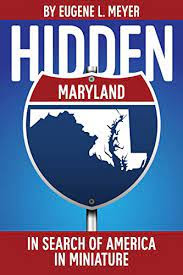
Post. His new book is Hidden Maryland: In Search of America in
Miniature. Roaming the state, Gene uncovers all sorts of Maryland quirks
and secrets. What I took away was that even in Maryland, you’re never too far
from dreams of Hollywood. Gene warmly profiles the owner of Vera’s White Sands
Restaurant, a “Kon Tiki tacky” Polynesian restaurant in Calvert County. Miss
Vera (who, alas, recently passed on at age 92) loved to reminisce for her clientele
about her glamour days in the Hollywood Hills, down the road from Humphrey
Bogart and Lauren Bacall. Gene also writes about tiny Delmar, spanning the
Delaware-Maryland border: it was the birthplace of William Alland, who played
the reporter doing a post-mortem investigation of Orson Welles’ character in Citizen
Kane.
Some genuine Hollywood
figures still make their homes in Maryland. A blue-collar section of Montgomery
County is the stomping ground of crime novelist George Pelecanos, who won
multiple awards for his work as a writer and producer on TV’s The Wire. Pelecanos’s
knowledge of the seedy underbelly of cities like Baltimore has led to his
involvement with a number of other TV projects, including Tremé (about
New Orleans), The Deuce (New York City), and D.C. Noir.
One highlight of Gene’s book
is a piece called “Everyman Tony Mendez Comes In From the Cold.”It seems that Mendez, a soft-spoken guy now
living in retirement in Washington County’s Pleasant Valley, was once a CIA
spymaster so crafty that in 1980, at the height of the Iranian hostage crisis, he
managed to extricate six American diplomats from the U.S. Embassy in Teheran.
Posing as the production manager for a fake film company, he and his team
arrived in Iran purporting to scout locations for a sci-fi flick, to be called Argo.
(That title was based on a crude knock-knock joke then making the rounds of
his office.) In the course of their “location scout,” Mendez and company
managed to smuggle out the six frightened Americans who’d been in hiding for
months.
If Argo sounds
familiar, it’s because in 2012 an actual Hollywood film was made, chronicling
Mendez’s exploits. He was played on screen by Ben Affleck, who also directed. Alas, Mendez himself passed on due to complications from Parkinson's in 2019. Gene had interviewed him in 2012, and still treasures the autograph Mendez gave him, written with a shaky hand.
Today—as California moves
toward an outrageous recall election and U.S. military spokesmen tapdance
around the situation on ground in Afghanistan—it’s not easy to keep politics
out of my head. Which is why I returned to one of my favorite Barry Levinson films,
Wag the Dog. Partially written by the always razor-sharp David Mamet,
and shot in a remarkable (for a star-studded Hollywood flick) 29 days, it is a
black-hearted look at how the political process can be manipulated to shape
public opinion.
You see, the President of the
United States has slipped off to the Oval Office with a young female Firefly
Scout. The press has gotten wind of it, and the election is less that two weeks
away.POTUS’s loyal staffers, desperate
to salvage his re-election campaign, call in top spin doctor Conrad Brean (Robert
De Niro), who knows that a big international distraction is what’s needed.
Like, maybe, a war with Albania? Such an undertaking needs some Hollywood
pizzazz, and Brean knows exactly who to call: producer Stanley Motss (Dustin
Hoffman). Motss, still miffed that he’s never won an Oscar, plunges eagerly
into this new project, even though he’s been warned he will never publicly be
able to claim credit. The heart of the film involves examples of Stanley’s
inventive handiwork, like a video clip of a bogus Albanian maiden – with kitten
inserted via CGI – telling the camera how badly she needs American intervention
to help save her homeland. (She’s played by Kirsten Dunst, looking particularly
fetching in her peasant rags.)
When the CIA, in league with
the President’s political rival, announces that the non-existent war is over,
Brean and his team come up with one final burst of inspiration, in the form of
an American soldier supposedly left behind on the field of battle. An Army
prison supplies them with the soldier, Sergeant William Schumann, around whom
they create an entire heroic mythology involving a nickname, The Old Shoe, and
a sentimental ballad theoretically dug out of the archives of the Library of
Congress. (Sung by none other than Willie Nelson, it launches a whole campaign
of old tennis sneakers being tossed onto telephone wires, in honor of the brave
lad.)
I won’t spoil the film’s
ending, except to note that Wag the Dog was released in theatres a scant
month before a certain U.S. President was making headlines for his Oval Office
frolics with a zoftig female intern. And not long thereafter, that administration
was bombing Sudan’s Al-Shifa pharmaceutical factory.
Life imitating art?
Barry Levinson, who’s still
very much an active Hollywood presence, started out as a screenwriter, then
made the leap into the director’s chair. His biggest moment as a director
probably came in 1989 when he won the Oscar for helming Rain Man. But
I’m partial to his 1982 debut film as a writer/director, one that helps capture
the Baltimore of his birth. When you’ve been watching classic Hollywood movies,
full of snappy dialogue and carefully choreographed movement, Diner seems
almost loosey-goosey. This tale of six buddies who hang out afterhours at the
local diner is basically a character study, one that conveys a sense of
improvisation by its young cast. They’re out of school and restless: even
sporting events and marriage pale before the pleasure of being in one another’s
company over a plate of fries. Kevin Bacon, Steve Guttenberg, Paul Reiser, Mickey
Rourke, Daniel Stern, and Tim Daly have all gone on to major Hollywood careers.
But they’ve never been better than in this warm-hearted ode to the American
boy-man who hasn’t figured out how to grow up.
Two weeks ago my travels took me to Baltimore, Maryland, where Roger Corman’s favorite author, Edgar Allan Poe, mysteriously died and was buried. More recently, Baltimore was the site of another mysterious death, that of Freddie Gray, a young African-American who fell into a coma after being transported in a police van. The fact that he was found to have died of spinal cord injuries was, to say the least, suspicious. Fortunately for me, I saw no sign of the civil disturbance that resulted from that episode, though the trials of the six police officers involved still continue.
What I saw instead of public anger was a city proud of its sports teams, its crab cakes, and itsdistinctive Inner Harbor. Not to mention a few branches of Pitango, which serves the best gelato I’ve ever tasted. (Yum!)Since my visit was brief, I didn’t get to see the famous National Aquarium. Nor did I get more than a glimpse of the spectacularly funky American Visionary Art Museum, with its mirrored exterior walls and oddball exhibits.
But I got to gander at the displays in Baltimore’s Museum of Industry, where the city shows off its role as an industrial pioneer. Baltimore, it turns out, is the home of such standard brands as Domino sugar, Black and Decker tools, Head skis and tennis racquets, and Bromo Seltzer. Way back when, this locale saw the invention (or the major refinement) of the linotype machine, the collapsible umbrella, and the crimped bottle cap.
Then, of course, there’s the role played by Baltimore in showbiz. The city’s quirky reputation has made it a good place to set a drama or a very black comedy. Today it’s best known as the setting of The Wire, the hard-hitting HBO crime drama that unfolded over a period of six years, from 2002 until 2008. Series creator David Simon had been a police reporter for the Baltimore Sun, so he was well acquainted with the city’s darker aspects.
The absolute king of quirk, John Waters, was born in a Baltimore suburb, and still makes the city his home. So did his muse Glenn Milstead, much better known as Divine, who starred in such Baltimore-based Waters flicks as Pink Flamingos. Divine died during an L.A. sojourn, but like Poe he is buried in the place that calls itself Charm City. Though Divine is gone now, Waters sashays on, though it’s been a decade since he’s released a new flick. Every one of the seventeen films he’s directed is set in Baltimore.
Barry Levinson too is a Baltimorean. Though his directing career has been more mainstream and has taken him farther afield,Levinson is responsible for four films set in the Baltimore of his own growing-up years. He made his screen debut with the semi-autobiographical Diner (1982), in which a circle of young males hang out just before one of them is to get married. I remember Diner for its low-key sense of reality, and for introducing me to the talents of Steve Guttenberg, Daniel Stern, Mickey Rourke, Kevin Bacon, Timothy Daly, and Ellen Barkin. Also Baltimore-based are Levinson’s Tin Men (1987), Avalon (1990), and Liberty Heights (1999). Avalon deals with the assimilation of a Jewish immigrant family, and Liberty Heights adds interracial tension into the mix.
A display at the Museum of Industry notes a number of other films shot in the picturesque city: The Accidental Tourist, Clara’s Heart, Broadcast News, and (unlikely though it may seem) Sleepless in Seattle. But I need to close with one of my favorite Audra McDonald songs. I can’t vouch for its message.
As someone who has always been passionate about language, I prefer good conversation to, well, just about anything. And for me chatting about movies is a special treat. I’m convinced that movies can shape lives. On this topic I’ve got some great stories to tell, and I invite YOU to share your own. But because I’m a show biz survivor, I will also sometimes pull back the curtain to show you the inner workings of the film industry. Read, and enjoy!