Showing posts with label Dustin Hoffman. Show all posts

Friday, October 3, 2025

Robert Redford Goes Downhill

There are those who will tell you that Robert Redford was the original choice to play Benjamin Braddock in the 1967 romantic classic, The Graduate. He was certainly in the running, and wanted the role badly. And, as my Seduced by Mrs. Robinson clarifies, he had just finished starring for director Mike Nichols in a Broadway hit comedy, Barefoot in the Park, so he seemed to be in a good position to headline Nichols’ planned first film. But, as the film’s producer, Larry Turman, spelled out to me, neither he nor Nichols was entirely sure that Redford was the right choice to play an awkward lover who was funny precisely because he was in over his head with a sexy older woman. Enter Dustin Hoffman, who turned in a performance that was a comedy gem.

 By 1969, Redford had made a half-dozen films, both amiable comedies and action thrillers. But lightning struck when he joined with Paul Newman for a true blockbuster, Butch Cassidy and the Sundance Kid. The two Hollywood hunks proved to have remarkable comic chemistry in a story less about the Old West than about the friendship of two rebellious buddies set against a rapidly changing world. Thinking back about the whole of Redford’s acting career, which includes some major thrillers and some films with strong political implications (see The Candidate and, of course, All the President’s Men), I’m convinced that as an actor Redford was at his best in roles that combined substance with comic flair. These include Butch Cassidy and The Sting, two brilliant pairings with Newman, as well as such more modest efforts as Sneakers (a caper comedy about hackers) and the late-in-life The Old Man & the Gun, shot when Redford was over 80.

 Which brings me to Downhill Racer, made in the same year as Butch Cassidy. Michael Ritchie’s first directorial effort, magnificently filmed on some of the world’s great ski slopes, is a gutsy look at the professional ski circuit, and grapples with the question of what it takes to be a winner. Redford plays an ambitious young racer, summoned by coach Gene Hackman to join the U.S. ski team after (in the film’s highly dramatic opening minutes) a talented skier suffers a bone-shattering fall. We know right away that Redford’s character, Dave Chappellet, is good—but also that he’s not particularly nice. He regards his new teammates as nuisances or rivals, and can’t be bothered to listen to his coach’s warnings. He’s willing to work hard on his own skills, but camaraderie is not for him.

 We understand something about Dave’s psychological makeup during the off-season, when he goes home to rural Colorado. His curmudgeonly dad, clearly a loner, greets him coldly, showing little interest in his son’s efforts to achieve Olympic gold on the way to fame and fortune. A local flame is thrilled to see him, but clearly it’s only sex he’s after.. The pattern repeats itself in Europe, where the sophisticated assistant (Camilla Sparv) to a manufacturer of ski equipment falls hard for him, only to learn that he’ll give her nothing beyond a roll in the hay.  He’s a loner and a user, that’s all.

 I won’t go into the end of the film, when his jest to the team’s #1 skier leads to an outcome he may or may not have anticipated. Is he a carefree hotdogger, or is there something more devious in the back of his mind? That’s an open question, one the film leaves us asking ourselves. I’d much rather watch Redford again in Butch Cassidy.


Tuesday, November 26, 2024

The Gregarious, Gorgeous Teri Garr

I once had the good fortune of seeing Teri Garr up close and personal. It was decades ago, long before the brilliant comic actress was diagnosed with multiple sclerosis, the cruel disease that recently ended her life at age 79. The place: the tiny, cramped locker room at Jane Fonda’s then-famous West Hollywood exercise studio. Both of us were changing out of exercise gear. She was among friends, clearly—and I saw her as a true life force, lively and exuberant.

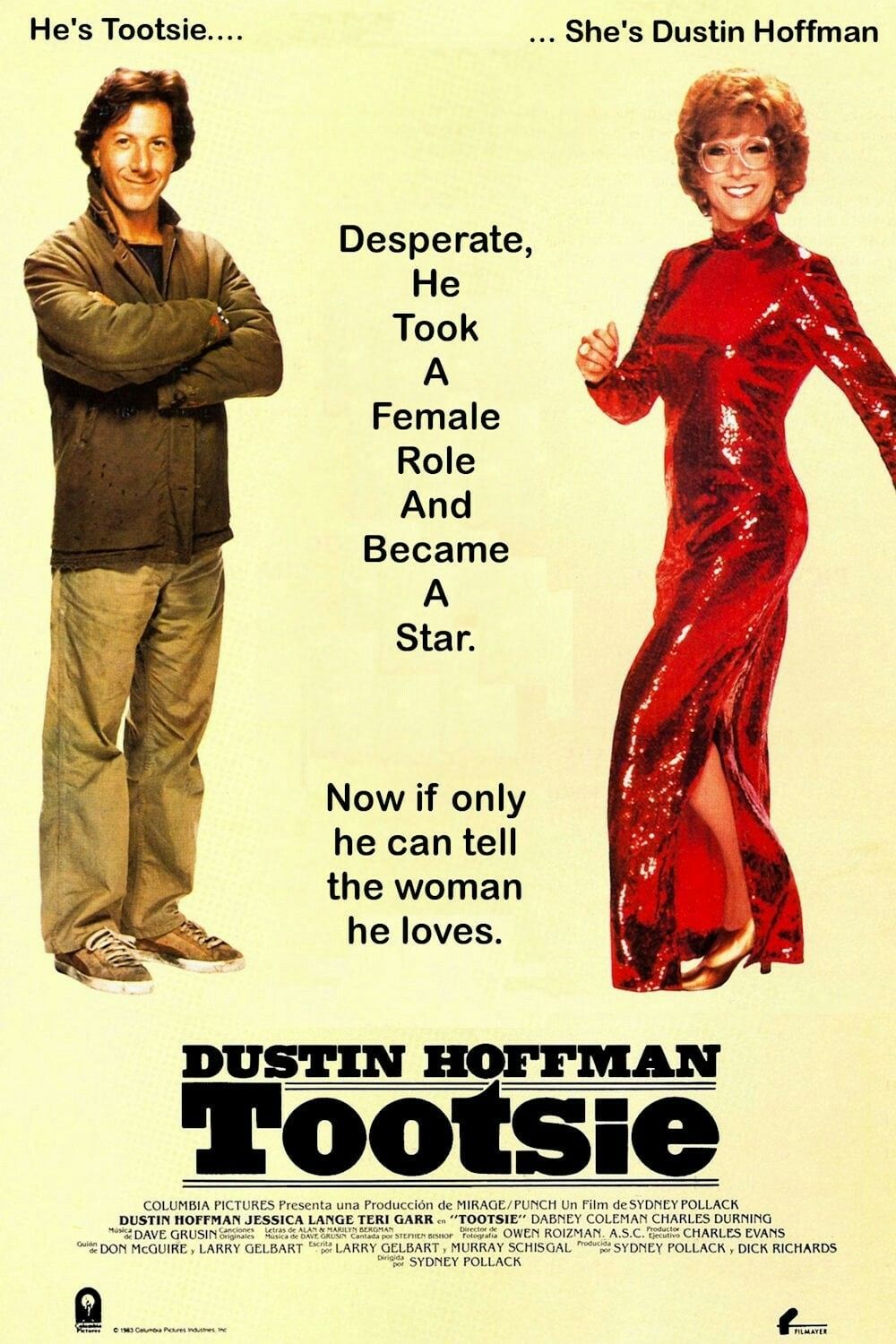
 She brought that same exuberance to her acting career, which included the wife role in Close Encounters of the Third Kind and the adorable mädchen who loved a roll in the hay in Mel Brooks’ Young Frankenstein. Her biggest screen success came in 1982, with the release of Tootsie, in which Dustin Hoffman stars as an out-of-work actor who disguises himself as a woman to win a soap opera role. The gender confusion that arises in this Sydney Pollack film is hilarious. But it also seems quite modern, given that there’s a move afoot to deny a newly-elected transgender U.S. congresswoman the right to use the women’s restroom in the Capitol. (So what, pray tell, is she supposed to do when the need arises?) 

 When Tootsie was being cast, Garr apparently hankered for the role of the female lead. Julie is depicted as a slightly damaged but sturdy soul who interacts with Hoffman’s Dorothy Michaels in a popular hospital-based soap opera. (She introduces herself to the new cast member as the “hospital slut.”) Julie treasures Dorothy’s friendship and is guided by her relationship wisdom, but has no inkling that this sassy older woman is actually a man—and that he’s in love with her. After losing the role of Julie to Jessica Lange, Garr was reluctant to take the smaller part of Sandy, the neurotic would-be actress who’s Michael’s protégée and at one point his accidental lover. (Don’t ask!) Luckily for us, Garr ultimately changed her mind about the role. Sandy’s uproarious neediness is a highlight of the film, and resulted in an Oscar nomination for Best Supporting Actress. Ironically, Jessica Lange was also nominated in this category, and took home the gold statuette: it was the only win for Tootsie that evening despite a whooping nine nominations. (This was the year of Gandhi—and the gender-bending Victor/Victoria). But if Lange won the Oscar, Teri Garr completely won my heart.

 Like all the greatest comedies, Tootsie has something to say, about the human condition. Its particular focus is on how women are treated in what often continues to feel like a man’s world. What Dustin Hoffman’s character discovers—in this beautifully directed, beautifully written, beautifully edited film—is that women benefit from being able to stand up for themselves. And, as a man, he comes to acknowledge that women need, and deserve, basic respect. Two prominent characters who have not learned this lesson are Dabney Coleman as an outrageously sexist TV director and George Gaynes as a preening actor who makes it his business to tongue-kiss every actress on camera. (By contrast, Julie’s father, as played by Charles Durning, is a manly but gentle widower who is smitten by “Dorothy” and complicates things by proposing marriage.)  Big kudos to screenwriter Larry Gelbart for finding the funny in the battle of the sexes while acknowledging that his characters all have something to learn. One of those characters of course is Garr’s Sandy. But she fights to hold onto her sense of humor. That of course also describes Garr, who considered titling her memoir, Does This Wheelchair Make Me Look Fat?  


Tuesday, August 1, 2023

The Perils of Papillon


I’ve always been curious about Papillon. This 1973 film, directed by Franklin J. Schaffner (Patton) derives from the purportedly true memoir of Henri Charrière, a low-level criminal who successfully escaped from the French penal colony of Devil’s Island, off the northeastern coast of South America. Grim survival stories are not especially favorites of mine, but circa 1985 I paid a visit to Guyane (aka French Guiana), where a family member was preparing for the launch of an American satellite on a European rocket based at the local space center. Not far from these high-tech surroundings was the Isle du Diable, and I was lucky to join a group of French journalists touring this infamous but now defunct site, which was the center of the French penal system from 1852 to 1952.

 I don’t remember much about the prison environment, except that it was a hot and brutal place, full of insects and other daunting obstacles. Schaffner’s film makes full use of these obstacles, both the natural and the man-made, in telling the story of a bloke with a butterfly tattooed on his chest (hence the nickname Papillon) and an indomitable will to survive. His leading man is Steve McQueen, known throughout his career as an escape artist par excellence. McQueen is an extraordinarily physical actor, blessed with a hard body and a stoic face that seems to accept danger as man’s natural lot. His job in this film is to survive, even when locked in a steel cage and deprived of any source of light. At times we see his agonized efforts to hold onto his humanity, despite it all. Many feel this is McQueen’s very best work.

 I began thinking about Papillon after I was interviewed by Kelsy Norman, a Canadian film buff (and ultimate McQueen fan) whose long-running podcast is called SPEEDING BULLITT: THE LIFE AND FILMS OF STEVE MCQUEEN. I hardly claim to be a McQueen expert, but Kelsy had read my Seduced by Mrs. Robinson: How The Graduate Becomes the Touchstone of a Generation, and was intrigued by my report of what McQueen had told his then-wife, now Neille Adams Toffel, after watching Dustin Hoffman in 1967’s The Graduate. Said he, “God, baby, I can’t believe this guy’s going to be a movie star, can you? I mean, he is one ugly cat. Good actor, yeah, but he sure is homely.” McQueen, always secretly insecure,  brooded mightily about the possibility that he and such classically handsome talents as Paul Newman might be shoved aside by the newcomer. Toffel writes in her memoir that “Steve would stare at his image in the mirror and say to me, ‘Look at that, baby, take a look at that face and that body and tell me the truth. Who would you pick, him or me?’ We would both laugh, although I knew he was serious.”

 As luck would have it, when McQueen began work on Papillon, he discovered he’d be playing against this very same Dustin Hoffman. Hoffman plays Louis Dega, a fellow prisoner who’s the polar opposite of Papillon in many ways. Dega is whip-smart, but also extremely cautious: there’s nothing of the escape artist about him. In time, against all odds, the two become friends. At perhaps Papillon’s lowest point, when he’s been thrown into solitary with his already bug-infested rations halved, Dega secretly comes to his aid. But the friendship between the two prisoners hardly extended to the two actors. McQueen, recognizing Hoffman’s talent, decided he needed to up his game on-screen. But a real-life friendship between the two was not in the cards.

Here's my interview with Kelsy Norman on his Speeding Bullitt podcast, which covers all things Steve McQueen. 


Tuesday, July 11, 2023

And Here’s to YOU, Larry Turman


The passing of Hollywood producer Lawrence Turman at age 96 has, I’m glad to say, not gone unnoticed. Turman produced 42 films, directed two, and spent the last three decades of his life teaching his trade to graduate students as the head of  the Peter Stark Producing Program at USC. I got to know him while researching Seduced by Mrs. Robinson, my 2017 book on the long-term impact of Turman’s best-known film, The Graduate. Released in 1967, The Graduate was a worldwide smash that briefly catapulted the then-41-year-old Turman into the top ranks of Hollywood players.  He enjoyed the notoriety, but hardly let it go to his head. The man I first met at his USC office in 2007 was both cordial and feisty. Above all, I quickly recognized him as a straight-shooter.

 This became clear  when our chat turned to the topic of Larry’s directorial debut. His goal was to bring to the screen another racy comedy by the original author of The Graduate, Charles Webb. But The Marriage of a Young Stockbroker (1971) turned out to be a disappointment, one for which he now blames himself.  Comparing Dustin Hoffman, whose career was launched with The Graduate,  to the young actor he cast in Stockbroker, Larry admitted, “There’s a reason Dustin Hoffman is a movie star and Richard Benjamin is not. Dustin is vulnerable and likable; Richard Benjamin, wonderful guy and a wonderful actor, he comes across on screen as brittle, cold, distant.” He now admits to having made, among many other errors, an unfortunate casting choice.

 While exploring the papers on the making of The Graduate in Larry Turman’s archives,  I was surprised to come across glossy photos of what looked to be a stag party. The men in the film’s cast and crew, perched on folding chairs, were being cozily entertained by two cuties wearing high heels, bikini bottoms, and nothing else. When I asked Larry about the circumstances, he sniffed, “If they had that party, they didn’t invite me, the producer.” That’s when I pulled out a photo, and he expressed surprise, “That’s me on Mike Nichols’ left.” An audition? I strongly doubt it.

 Larry’s 2005 book, So You Want to be a Producer, lays out in clear-cut terms what it takes to succeed in his field. But he cautions aspirants against being overly ego-driven. Case in point: some years back he saw an announcement of a Motion Picture Academy screening of The Graduate, with director Mike Nichols as the evening’s honored guest. Wrote Larry, “No mention of me whatsoever. If you’ve read this far, you know I think the world of Mike, but The Graduate exists as a film only because of me. So you want to be a producer?”

 Fortunately for me, I’d rather be a writer than a producer. And Larry was enormously helpful to me in clarifying why and how The Graduate was made. We did some jockeying over interpretations: I refused to accept that Katharine Ross’s character, the lovely Elaine Robinson, remains passive throughout. (After all, she comes to Ben’s Berkeley rooming house at midnight demanding to be kissed.) On the other hand, I learned something important: that although The Graduate seemed remarkably timely to college students in 1967, the thinking throughout the production was that the story took place circa 1963. (Hence, no Vietnam reference at all.)

When my book came out, I invited Larry to lunch as a thank-you, and afterwards received an email I cherish: “Lunch was very enjoyable and even enlightening.  Thank you again for initiating it.  You’re formidable.”

 So were you, Larry. So were you.


Tuesday, April 12, 2022

Clothes Make the Man?: “Some Like It Hot,” “Tootsie,” and “Mrs. Doubtfire”

It’s as old as Shakespeare: a man dressing up in women’s clothing. Of course in Shakespeare’s day there was an added complication. Because rules of public morality determined that it would be indecent to have a woman in a theatre troupe, young men put on dresses and wigs to play all the female roles. This helps explain why in so many Shakespearean comedies (like Twelfth Night and As You Like It) female characters spend much of their time in male disguise. The resulting gender confusion was explored by Tom Stoppard and company in one of my favorite romantic films, Shakespeare in Love. In that 1998 Best Picture winner, the theatre-mad Viola de Lesseps (Gwyneth Paltrow) disguises herself as a male—complete with a tiny mustache—so she can audition to join Shakespeare’s acting company. She ultimately originates the role of Juliet while having a doomed affair with the playwright himself.

 Usually, on stage and in movies, it’s men dressing up as women. Even long after actresses were accepted on stage, the British have continued to love the buffoonish spectacle of a well-padded man tricked out in a woman’s petticoat and bonnet. The so-called “dame show” has been a holiday staple for hundreds of years. Clearly it was this tradition that inspired Ray Bolger’s starring role in the hit musical version of a popular stage farce, Charley’s Aunt, in which a young man tries to further his romantic goals by disguising himself as a visiting dowager.  The British original, which debuted back in 1892, was ultimately filmed at least 13 times, in productions all over the world. No one, it seems, could get enough of a guy sporting a flouncy skirt.

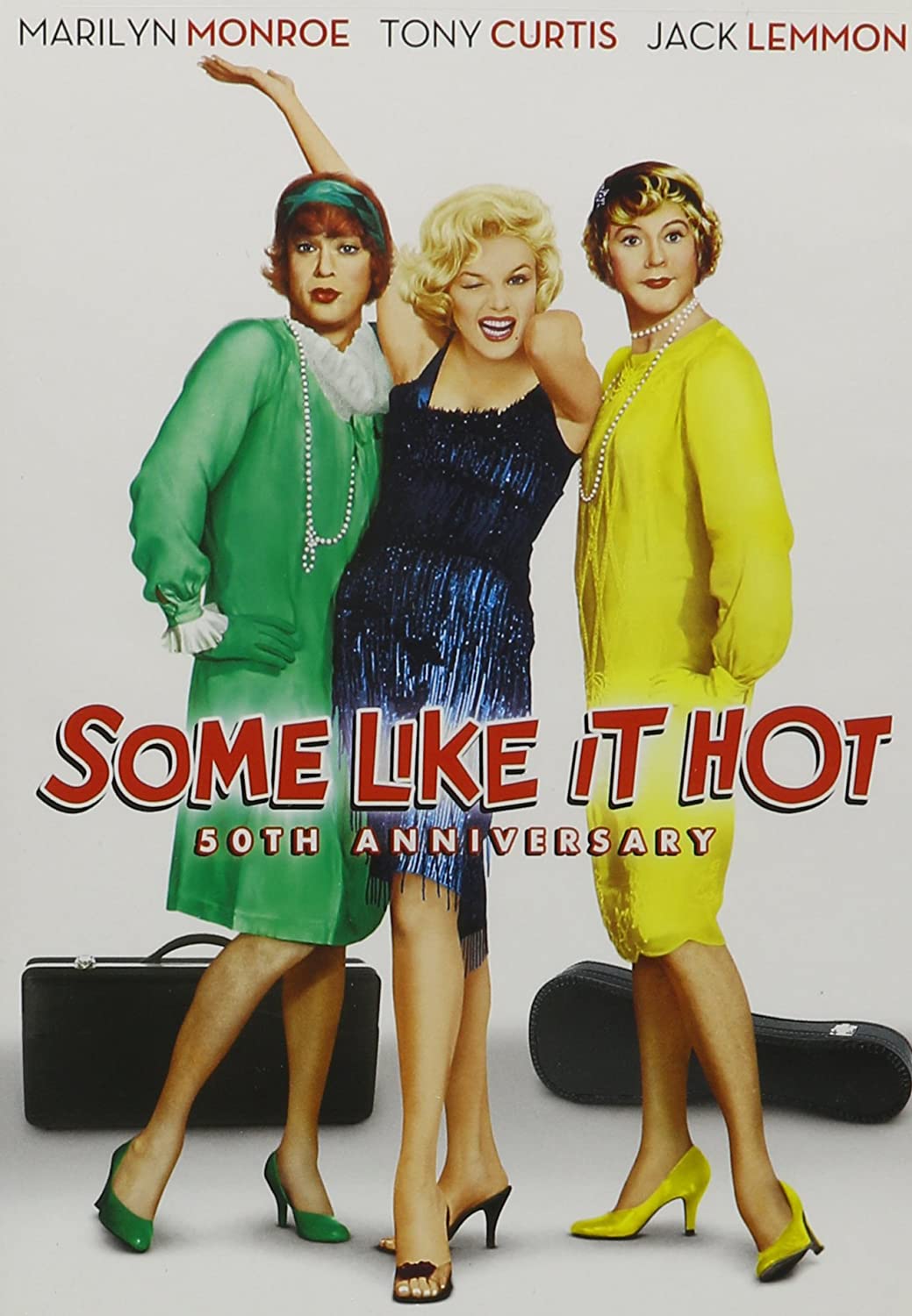
 In 1959, Billy Wilder and I.A.L.Diamond updated the “dame show” tradition by combining it with a gangster thriller in Some Like It Hot. In this beloved comedy, two musicians played by Tony Curtis and Jack Lemmon accidentally witness the St. Valentine’s Day Massacre. Desperate to escape detection, they disguise themselves as women and join an all-girl band en route from Chicago to Miami Beach. Their masquerade involves the usual men-dressed-as-women tropes, as they wobble in high heels and struggle to project coy feminine charm. But the two authors add their own hilarious touches, as Curtis takes on a second identity (that of a grieving millionaire who’s lost his sex drive) in order to woo band singer Marilyn Monroe, while Lemmon somehow finds himself engaged to marry dingbat tycoon Joe E. Brown.

 Twenty-three years later, Larry Gelbart and some others put a new theatrical spin on the man-in-woman’s-clothing comedy. The film was Tootsie: its central character, Michael Dorsey—played by Dustin Hoffman—is a talented but pugnacious stage actor who’s burned so many bridges that he can only land an acting job by trying on a new gender. As Dorothy Michaels, he lands a gig on a soap opera, quickly becoming a fan favorite. Tootsie is full of subtle commentary on how women are treated, as Michael’s attitudes evolve while his fanbase grows.

Then (sigh) there’s 1993’s Mrs. Doubfire, in which Robin Williams, faced with losing his children to divorce, gets the bright idea of turning himself into a cozy British nanny in order to be near them. Completely fooling his ex-wife and everyone else, he manages to prove that he’s indispensable to the happy running of their household. I tried watching this on a recent plane flight, and found the playing out of this family story grotesque in its reliance on crude gender stereotypes. A dad as Mr. Mom showing off a D-cup? Yuck.