Showing posts with label Robin Williams. Show all posts

Tuesday, August 26, 2025

Leaving Home to Find a Home: “Moscow on the Hudson”

There are émigrés from Soviet Russia in my extended family circle, so I’ve heard plenty of stories about the bad old days in the USSR. And this year’s Oscar-winning Anora gave me an indelible glimpse of today’s globe-trotting Russian oligarchs, as well as the pockets of old-school Russian culture in New York’s Brighton Beach. All of which made me eager to enjoy Robin Williams in Paul Mazursky’s gentle 1984 comedy about a defector from Moscow in the era of Ronald Reagan.

 The film is an extended flashback, following a glimpse of Wiliams’ Vladimir Ivanov showing a newer arrival to NYC the ropes. So we know from the start that nothing very terrible is going to happen to Vladimir after he impulsively decides to make New York City his new home. Vladimir, a saxophone player with a great love of American jazz, has traveled to the Big Apple as part of a Russian circus troupe. On the group’s last day, during a quickie group shopping spree at Bloomingdale’s, he suddenly eludes the grim-faced Soviet minders and declares his intention of staying on in this “decadent” new land. His impulsive decision of course has major consequences: the American public and America media briefly rally on his behalf, but he’s cut off forever from the close-knit Russian family he loves.

 Mazursky, always good with social details, researched life in 1980s Moscow and blended this with his own grandfather’s memories of emigrating from Ukraine to the U.S. at the turn of the twentieth century. For me (and for many critics) the film’s richest moments come in its first third, when we are introduced to Vladimir in the context of his Old World relatives. We spend time in their cramped apartment, and see their heartfelt joy when Vladimir comes home with gifts: he’s braved a very long line in order to successfully purchase armloads of toilet paper rolls. He’s saved one roll as a romantic offering to the curvaceous young woman he habitually beds in the flat borrowed from a friend, Anatoly, for this purpose. Anatoly, one of the clowns in Vladimir’s circus, brashly declares himself desperate to leave the Soviet Union in search of the freedoms promised by the U.S.A.  But though Anatoly speaks often about defecting, he ultimately can’t bring himself to take the risk. (He’s played by the Latvian-born Elya Baskin, whose tragicomic face I’ll long remember.) Anatoly’s ultimate fear of making a change is why Vladimir’s impulsive action is such a surprise to those around him. And the moment of  his defection—complete with security guards, the press, the FBI, a very gay Bloomie’s salesclerk, and a lot of others—is hilarious.

 From this point forward, the film loses some steam, spending much of its time on Vladimir’s on-again-off-again romantic relationship with a pretty Italian-born salesclerk played by Maria Conchita Alonso (who’s not exactly Italian, but you get the idea). Part of Mazursky’s point is that in America almost everyone (aside from some key African American characters) is a recent arrival from somewhere else. And immigration is portrayed in such a glowing light that I could only shake my head at how times have changed. There’s a touching little scene in which Alonso’s character and a host of others ceremonially take the oath to become U.S. citizens. And in a diner, after a worn-down Vladimir dares to briefly criticize his new country, the other patrons—from a host of cultures—take him to task, even movingly reciting from the Declaration of Independence about how all men are created equal. We certainly need some of that idealism today. 


Tuesday, July 15, 2025

The Family That Gays Together . . . “The Birdcage”


The strange, sad death of Gene Hackman somehow led me to re-watch a movie that is joyous and full of life. The Birdcage, which pokes genial fun at intolerance of all kinds, seemed a good antidote for an era in which being different is often considered a crime. How ironic that a man who died alone, cut off by circumstance from his loving helpmeet and his pets, is one of the stars of a film whose theme song is Sister Sledge’s exuberant “We Are Family.”

 La Cage aux Folles started out in 1973 as a popular French stage farce. Five years later it became a French-language film, sometimes billed internationally as Birds of a Feather, that racked up international fans and awards (including three Oscar nominations) and later gave rise to two sequels. By 1983 it had been transformed into an English-language stage musical with music and lyrics by Jerry Herman (Hello, Dolly!) and a book by the always madcap Harvey Fierstein. It took until 1996 for an English-language film to surface. The Birdcage, as it was called, marked the reunion of one-time comedy duo Mike Nichols and Elaine May. He directed and she wrote the saucy screenplay for an adaptation that changed the film’s setting from Saint-Tropez to Miami’s South Beach but maintained its lively, lovable spirit.

 Hackman plays a U.S. Senator with impeccable Conservative credentials. A co-founder of something called The Coalition for Moral Order, he’s a big believer in mom, apple pie, and conventional sexuality. What he doesn’t know is that his daughter’s intended was raised in a household headed by two gay men. To make matters worse, when he and his agreeable wife (Dianne Wiest) head down to Florida for a meet-the-parents visit, the press is in hot pursuit, because his close political crony has just been caught in a deeply humiliating scandal. (Sex with an underage prostitute? Check. And does she happen to be African-American? Check.)

 With all this going on, long-time partners Armand (Robin Williams) and Albert (Nathan Lane) are redoing their home décor to suggest to their visitors that the family couldn’t be more conventional, and that they have nothing at all to do with the drag club on the ground floor. Armand, who dresses well and has a neat little mustache, feels he can certainly carry off a masquerade as a straight man. Albert, though, is a bit of a problem. Flamboyant and emotional, he wants to be present for the young lad he considers his son, but there’s no good way to conceal his sexuality. This is the rare film in which the always-vivid Robin Williams steps aside and lets someone else take center stage. Broadway darling Nathan Lane returns the favor by presenting a master class in role-playing. As the glamorous Starina, he headlines the shows at the Birdcage, but remaking himself for the approval of Hackman’s U.S. Senator turns out to be a lot more of a challenge. There’s a priceless scene in which Armand coaches him to ramp up his machismo, à la John Wayne, but of course this proves impossible. After a lot of chaos, some of it involving young Val’s long-absent birth mother (Christine Baranski) and a grotesquely swishy houseboy (Hank Azaria), Albert saves the day by suddenly appearing—in a powder-pink suit and pearls—as Val’s actual mother, a genteel and sensible sort who quickly wins over Hackman’s politician, since they seem to share similar values.

 It's then that the press descends, for a slam-bang conclusion in which the now-united couples work to save Hackman’s reputation as a leader of the moral majority. Fun! 


Tuesday, August 9, 2022

The World According to Busby Berkeley: “Garp” and “Footlight Parade”

I don’t ever walk out on movies in theatres, even when they fail to fulfill my expectations. But there are times when, sitting on my couch at home, I realize it’s just not worth my time to continue watching something I find dreary. Such was the case with The World According to Garp, George Roy Hill’s 1982 adaptation of John Irving’s bestselling saga about eccentric people and random acts of violence. Never having read the novel, I can’t comment on the film’s fidelity to its source. But such actors as Robin Williams in the title role, Glenn Close (in her screen debut) as his gutsy mother, and John Lithgow as a star-football-player-turned-transsexual are always fun to watch—until they aren’t. When the opening scene introduced a charming cameo by stage greats Hume Cronyn and Jessica Tandy as Close’s parents, horrified by her flouting of social convention to the point of fainting dead away, I was ready to buy into the whole megillah. But approaching the two-hour mark, I’d had enough.

 Which is why I turned to something reliably amiable: the 1933 Warner Bros. pre-code classic, Footlight Parade. Like other Warner Bros. musicals of this era—including 42nd Street and Golddiggers of 1933Footlight Parade features clunky tap-dancing by Ruby Keeler and gags galore by other members of the WB stock company. Story? There’s always a bit of romance and a bit of back-stage drama. But what’s important is that these films, reveling in the opportunity presented by the coming of sound to the motion picture industry, lean heavily on exotic musical numbers choreographed by the P.T. Barnum of Hollywood musicals, the man with the unlikely moniker of Busby Berkeley. This is especially true of Footlight Parade, in which the three most audacious numbers are presented, one after another, to form the film’s climax.

 As always, there isn’t much plot. James Cagney, calling upon his naturally authoritative presence as well as his past career as a song-and-dance man, is a producer/director of Broadway musicals. Because they’re being replaced in the public’s mind with motion-picture talkies, his business is on the rocks . . . until he realizes he can produce the live-action “prologues” then popular on the motion picture circuit, as lead-ins to the feature films. His wife has left him; his smart, sassy secretary (Joan Blondell) quietly pines for his love. Meanwhile an upstart young tenor (Dick Powell) gets his big break, and discovers he’ll be playing opposite another office staffer (Ruby Keeler), who downplays the fact that she’s an ace musical performer. But what’s really urgent is Cagney proving his mettle by staging three elaborate prologues for a wealthy would-be backer on one New York evening.

 The three production numbers presented back-to-back-to-back are pure Busby Berkeley. The first, “Honeymoon Hotel,” is a naughty little fantasy about two just-marrieds capering through a hotel full of knowing lovers, all of whom have registered as Mr. and Mrs. Smith. The last, in which Cagney shows off his terpsichorean talents as a sailor looking for his Shanghai Lil, features Keeler impersonating a cute China doll in ways that today would seem appalling. The most classic Berkeley of the bunch is “By a Waterfall,” showcasing scores of beautiful blondes in skimpy attire. They cascade joyfully into a pool, and then reassemble for a kaleidoscopic water ballet. What we see on screen—the crane shots, the underwater filming—would of course be impossible in an actual theatre. This movie may be a salute to live entertainment, but only motion pictures could bring these dazzling moments to life.


Tuesday, April 12, 2022

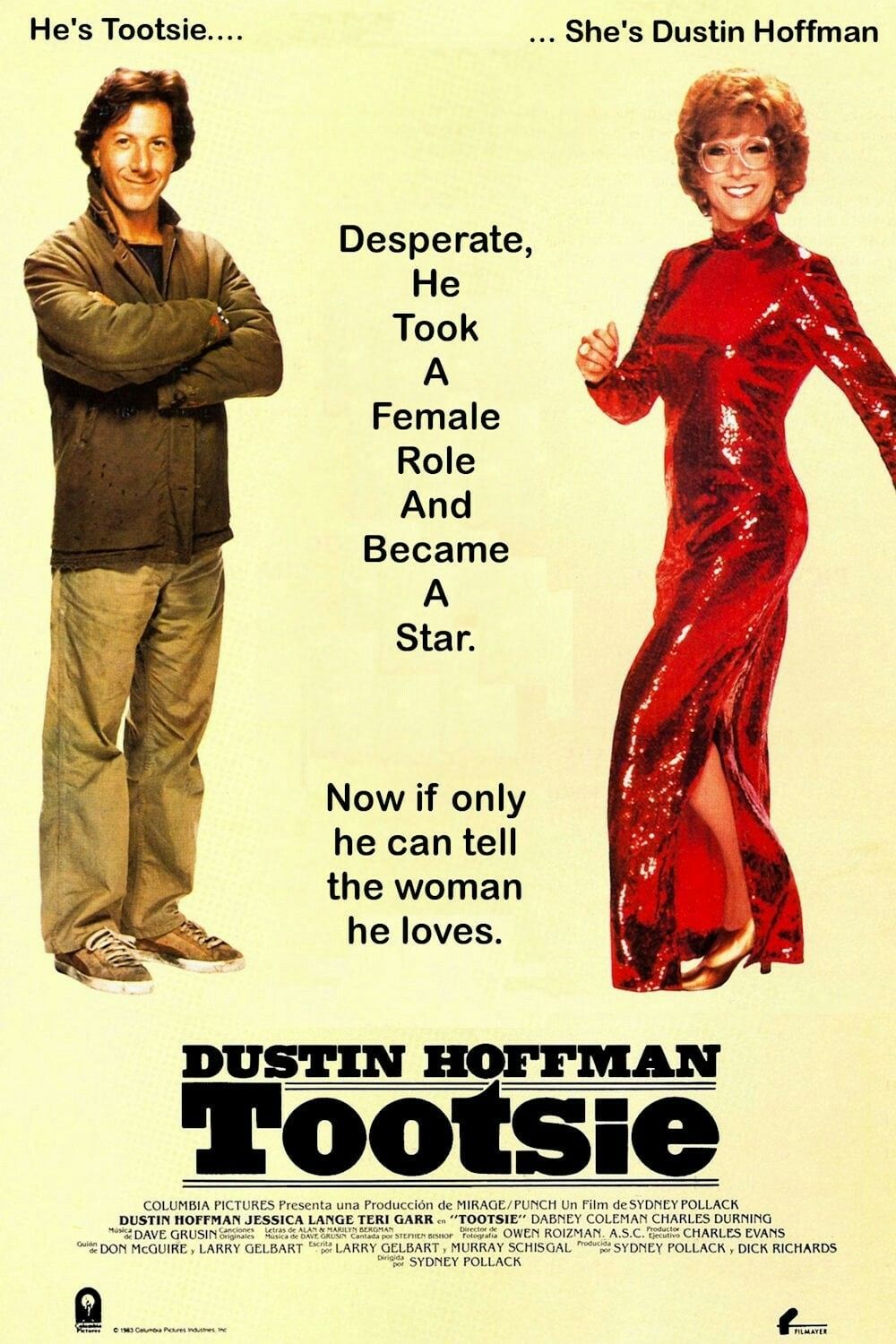
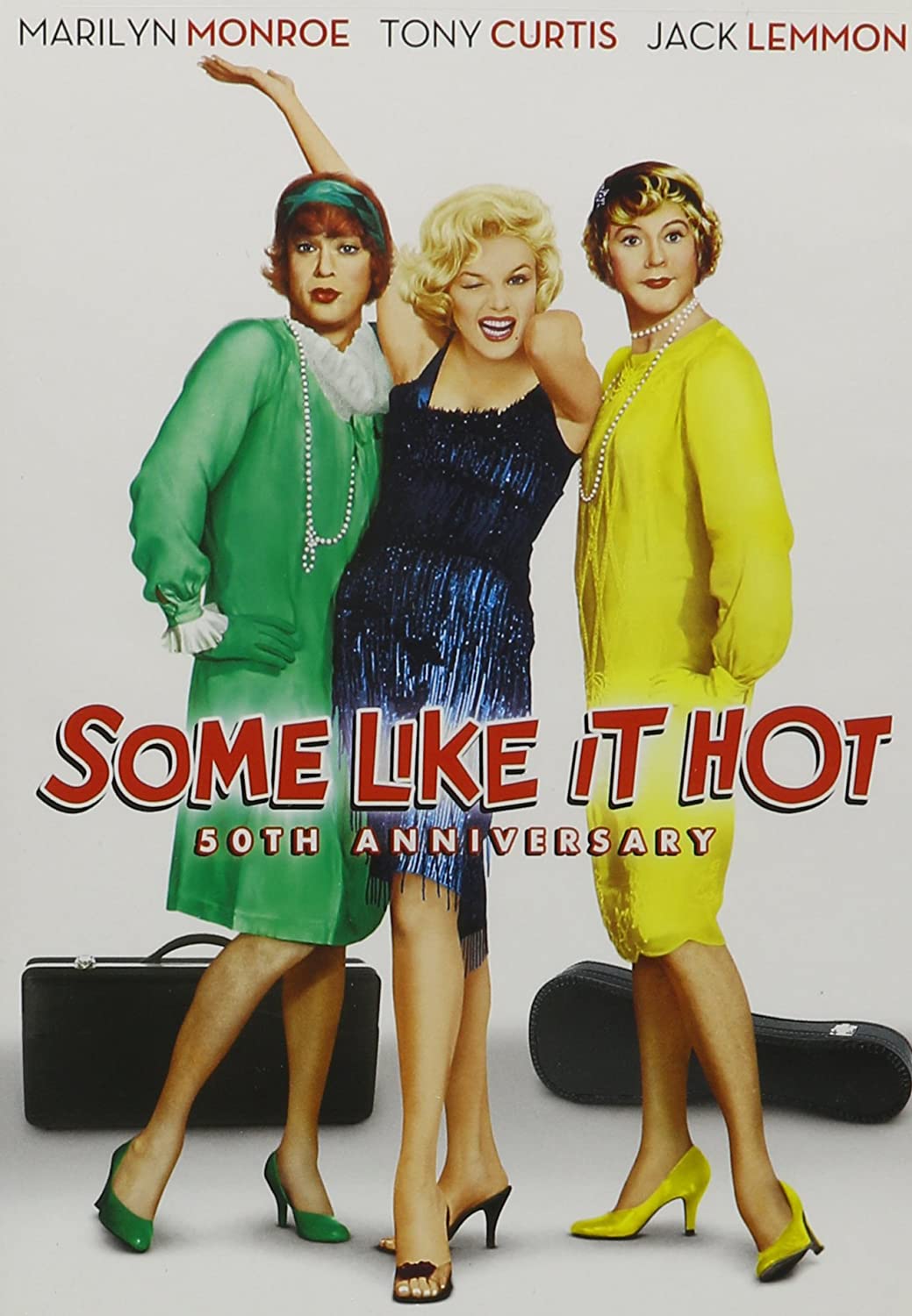
Clothes Make the Man?: “Some Like It Hot,” “Tootsie,” and “Mrs. Doubtfire”

It’s as old as Shakespeare: a man dressing up in women’s clothing. Of course in Shakespeare’s day there was an added complication. Because rules of public morality determined that it would be indecent to have a woman in a theatre troupe, young men put on dresses and wigs to play all the female roles. This helps explain why in so many Shakespearean comedies (like Twelfth Night and As You Like It) female characters spend much of their time in male disguise. The resulting gender confusion was explored by Tom Stoppard and company in one of my favorite romantic films, Shakespeare in Love. In that 1998 Best Picture winner, the theatre-mad Viola de Lesseps (Gwyneth Paltrow) disguises herself as a male—complete with a tiny mustache—so she can audition to join Shakespeare’s acting company. She ultimately originates the role of Juliet while having a doomed affair with the playwright himself.

 Usually, on stage and in movies, it’s men dressing up as women. Even long after actresses were accepted on stage, the British have continued to love the buffoonish spectacle of a well-padded man tricked out in a woman’s petticoat and bonnet. The so-called “dame show” has been a holiday staple for hundreds of years. Clearly it was this tradition that inspired Ray Bolger’s starring role in the hit musical version of a popular stage farce, Charley’s Aunt, in which a young man tries to further his romantic goals by disguising himself as a visiting dowager.  The British original, which debuted back in 1892, was ultimately filmed at least 13 times, in productions all over the world. No one, it seems, could get enough of a guy sporting a flouncy skirt.

 In 1959, Billy Wilder and I.A.L.Diamond updated the “dame show” tradition by combining it with a gangster thriller in Some Like It Hot. In this beloved comedy, two musicians played by Tony Curtis and Jack Lemmon accidentally witness the St. Valentine’s Day Massacre. Desperate to escape detection, they disguise themselves as women and join an all-girl band en route from Chicago to Miami Beach. Their masquerade involves the usual men-dressed-as-women tropes, as they wobble in high heels and struggle to project coy feminine charm. But the two authors add their own hilarious touches, as Curtis takes on a second identity (that of a grieving millionaire who’s lost his sex drive) in order to woo band singer Marilyn Monroe, while Lemmon somehow finds himself engaged to marry dingbat tycoon Joe E. Brown.

 Twenty-three years later, Larry Gelbart and some others put a new theatrical spin on the man-in-woman’s-clothing comedy. The film was Tootsie: its central character, Michael Dorsey—played by Dustin Hoffman—is a talented but pugnacious stage actor who’s burned so many bridges that he can only land an acting job by trying on a new gender. As Dorothy Michaels, he lands a gig on a soap opera, quickly becoming a fan favorite. Tootsie is full of subtle commentary on how women are treated, as Michael’s attitudes evolve while his fanbase grows.

Then (sigh) there’s 1993’s Mrs. Doubfire, in which Robin Williams, faced with losing his children to divorce, gets the bright idea of turning himself into a cozy British nanny in order to be near them. Completely fooling his ex-wife and everyone else, he manages to prove that he’s indispensable to the happy running of their household. I tried watching this on a recent plane flight, and found the playing out of this family story grotesque in its reliance on crude gender stereotypes. A dad as Mr. Mom showing off a D-cup? Yuck.