Showing posts with label Bradley Cooper. Show all posts

Friday, April 11, 2025

Get Him To the Greek: Harry Belafonte and Other Al Fresco Stars

Last weekend I toured Griffith Park’s venerable Greek Theatre, courtesy of the good folks at the L.A. Conservancy. Opened in 1931, with a mandate to bring culture to Angelenos, this outdoor venue now boasts 5780 seats. This makes it a small cousin to the colossal Hollywood Bowl, which seats some 17,500 music-lovers. We toured the stage, much changed from its early days, as well as the hallways where some famous acts of recent years have left their mark. And, in the distance, we spotted the hills where so-called “tree people” used to enjoy free access to the entertainment.  

These days, the Greek is primarily a pop music venue. It has also been featured in movies, like 2010’s Get Him to the Greek, a goofy Judd Apatow-produced comedy featuring Russell Brand as a free-spirited rock star and Jonah Hill as the recorder exec pressed into service as his chaperone. For the 2018 version of A Star is Born, the Greek was the stage on which Lady Gaga and Bradley Cooper performed the Oscar-winning “Shallow.”   

But I remember the Greek in a different mood. No, I don’t date back to the time when troops of ersatz classical nymphs frolicked on stage for the delight of theatregoers. But in the era (1952-1975) when impresario James A. Doolittle booked acts, I was taken by my parents to see some very classy entertainments from far-flung places. Here’s what I remember: Britain’s venerable D’Oyly Carte company performing Gilbert and Sullivan’s HMS Pinafore. The Grand Kabuki from Japan. The National Theatre of Britain staging an Elizabethan-style all-male production of Shakespeare’s As You Like It. The Comédie Française presenting Molière’s Le Bourgeois Gentilhomme in French, which was a very nice pay-off for my years of high school français. (My mother pointed out Maurice Chevalier in the audience.)

But I mainly associate the Greek Theater with the bi-annual summer visits by Harry Belafonte in his prime. His show, featuring singers, dancers, and a small group of musicians, was always a fabulous spectacle. He even followed up his best-selling Belafonte at Carnegie Hall live album with Belafonte at the Greek. My mother was such a fan that she saw each of his shows twice, once with my father and once with my younger sister and me. One year, when we arrived early, she’d scouted out the underground lot where headliners parked their cars. She stationed us near the exit, just in time to see the great man himself emerge. We chatted briefly, and he complimented me on the party dress I was wearing. Proudly I told him, “My mother bought it on sale.” (Behind me, Mom turned beet red.) 

Belafonte, as I was to learn over the years, had many talents. In early films like Carmen Jones, which didn’t always require him to sing, he was a handsome leading man, engaged in thwarted romances and dangerous doings. Later, teaming with longtime pal Sidney Poitier who also directed, he did a nifty Brando-as-the-Godfather imitation in a ghetto crime comedy called Uptown Saturday Night (1974). In his last film, 2018’s Blackkklansman, he performed for Spike Lee as an ageing activist, a role that meshed nicely with the passions that animated his private life. To my surprise, he gets little recognition at Washington’s National Museum of African-American History and Culture. Though, in the section of the museum dedicated to entertainers, the cover of his Calypso album can be found, there’s no display case dedicated to his career. But a  fiery Belafonte quote is on display at the museum connected with the Statue of Liberty: “Bring it on. Dissent is central to any democracy.” 


Tuesday, December 5, 2023

Maestro: Cigarettes and Love, Lenny-Style

Leonard Bernstein was an integral part of my childhood, and maybe yours too. From 1958  to 1972, he was on television with the New York Philharmonic, explaining to kids in a compelling way the joys of classical music. Then there were the musicals he composed that set our toes a-tapping: On the Town, West Side Story, Candide. I discovered the lively film version of On the Town (about three sailors on shore leave in New York City at the height of World War II) long after its release in 1949.  When West Side Story came out on film in 1961, it was seen by everyone I know, and long afterward the infectious score was still buzzing around in our heads. Though the much more recent Spielberg version of West Side Story may have its virtues, no one can rob us Baby Boomers of our affection for the original.

 But it’s only now that Bernstein himself is on film, not as a composer but as the leading man of a biopic. Bradley Cooper, inspired by the memoir by Bernstein’s daughter Jamie, had long wanted to put his complicated life on film. Ultimately, Cooper was to be a triple (at least) threat: as co-writer, director, and star of this labor of love. Much has been made of the prosthetic nose used to transform him visually from Bradley into Lenny. At the theatre where I saw this film (soon to show up on Netflix), photos of the real Bernstein in various stages of life reveal just how close the makeup artists got in transforming a Philadelphia gentile into a New York Jew.

 Far more important than Cooper’s look, however, is the spirit he brings to this role. His Lenny is smart, funny, impetuous, wildly sociable, nicotine-addicted, and wholly dedicated to his role on the music scene. He’s also far more attracted to men than to women, a distinction the film makes early on in showing a life-changing moment. He’s roused from sleep in the early morning hours by a phone call telling him that the great Bruno Walter, slated to be a guest conductor of the New York Philharmonic, is down with the flu. As the orchestra’s assistant conductor, the 26-year-old Lenny needs to pick up the baton—without rehearsal. He makes the appropriate sounds of regret, hangs up the phone . . . and indulges in a triumphant yell of which Tarzan would be proud. Then, jumping into a bathrobe, he affectionately pats the behind of the young man who had been sharing his bed, and heads for Carnegie Hall. In one of the film’s many surreal moments, he arrives in that grand space, still in his bathrobe, ready to take on the world.

 But Maestro is not solely about Lenny. The film’s focus is his marriage to Felicia Montealegre, played by the always luminous Carey Mulligan. From the start, Felicia knows her husband’s sexual predilections, but is at first willing to overlook them for the sake of home and family. Ultimately the tensions within the home threaten to destroy it (in a scene cleverly staged as the gigantic balloons of the Macy’s Thanksgiving Parade pass by the Bernsteins’ Central Park West window). Still, the genuine love between these two talented and complicated people is what the film is all about. This nicely fits the genuine Bernstein quote that opens the film: “A work of art does not answer questions, it provokes them; and its essential meaning is in the tension between the contradictory answers." Quite so.

 See this in a theatre, if you can, to revel in the Bernstein score.


Friday, February 4, 2022

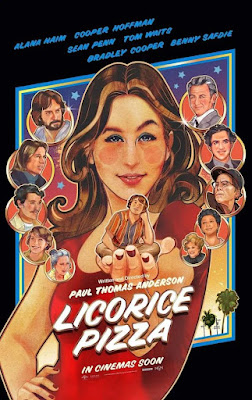
Taking a Bite Out of “Licorice Pizza”

In the course of Joel Coen’s The Tragedy of Macbeth, it takes a brisk one hour and forty-five minutes for a Scottish general to be goaded into murder, be crowned king, lose his wife and his wits, and finally die dramatically in a bloody duel. Paul Thomas Anderson’s Licorice Pizza requires 30 minutes longer for two ambitious but misdirected Valley kids to discover they’re in love. I by no means disdain stories on trivial subjects:  films that take a close-up look at intimate relationships are some of my favorites. (See, for one classic example, Paddy Chayefsky and Delbert Mann’s unforgettable Marty.) But though Licorice Pizza has two fascinating central characters, as well as a dead-on look at the San Fernando Valley circa 1973, its meandering structure gives its story little sense of urgency. By the end I was stealing glances at my watch, wondering when this saga would finally grind toward its conclusion.

 Licorice Pizza (named after a now-defunct Southern California record shop chain) follows fifteen-year-old Gary Valentine--a self-promoter who is by turns an actor, a waterbed salesman, a pinball magnate, and an all-around hustler—in his conquest of an “older woman,” the elusive Alana Kane. She by turns ignores Gary, teases Gary, works for Gary, rescues Gary, and finally acknowledges that theirs is a bond that can’t be broken. The two are played by cinema newcomers who share distinctive heritage: he’s the son of the late Philip Seymour Hoffman, and she is part of a trio of singing Haims whom Anderson previously directed in a series of music videos. (The entire Haim family appears on-screen in one dinner scene.) Both are complex and quirky, and I fully appreciate the fact that they appear au naturel, zits and all.

 Otherwise, what plot the film has is stuffed full of in-jokes, many related to the movie industry. John Michael Higgins plays an obnoxious restaurant entrepreneur with serial Japanese wives. I don’t know exactly what he represents in terms of Hollywood movie culture, but there’s no question that Sean Penn’s Jack Holden is a caricatured view of the ageing William Holden, hitting on girls young enough to be his granddaughters. The male lead character, Gary Valentine, is apparently based on a successful Hollywood type, Gary Goetzman, who went from being a child actor (and waterbed salesman) to a major career as a producer of hit films and television shows. And Bradley Cooper’s Jon Peters, who makes the mistake of buying one of Gary’s waterbeds for himself and main squeeze Barbra Streisand, is vividly portrayed as a larger-than-life blowhard chock full of his own sense of entitlement.

 For me the film’s biggest surprise comes when the script dips into the world of local politics, portraying Alana as a devoted volunteer for Valley councilman Joel Wachs in his bid to be mayor of Los Angeles. As someone who remembers the glory days of the real Wachs (he’s played here by Uncut Gems director Benny Safdie), I was surprised to see him portrayed on screen, with particular attention paid to his character flaws and his covert homosexuality. Wachs’ story is a potentially provocative one, but much less so if you don’t have a long memory of his political heyday. For those who could care less about decades-old mayoral contests in Southern California, what is this naming of real names supposed to prove?

 If you strip away the cameos, Licorice Pizza is an eccentric version of the classic formula: boy meets girl, boy loses girl, boy gets girl. It has its charming moments, but I’m still not sure why Hollywood critics are hopelessly devoted.


Tuesday, January 18, 2022

A Stroll Down Nightmare Alley: The Deceiver Deceived

Director Guillermo del Toro is in love with the fantastic and the macabre. Sometimes his grotesque figures turn out to be benign, even heroic, as is the case with his sexy aqua-man in the Oscar-winning The Shape of Water. In the magnificent Pan’s Labyrinth, a girl in retreat from the brutality of everyday life finds solace in the make-believe world of magical creatures. In his new Nightmare Alley (based on a 1946 novel that was previously filmed in 1947 with Tyrone Power in the central role), del Toro turns to film noir stylistics to explore the surreal lives of carnival folk. One big difference from his previous work: in this film the magical tricks and stunts all are given logical explanations. Though they seem eerily supernatural, they’re in fact 100% bogus.  Each is cleverly designed to fake out the credulous, all the better for unscrupulous men (and women) to exploit their “marks.”

 The setting for most of Nightmare Alley (probably too much, given the film’s excessive length), is a seedy traveling carnival, circa 1940. It’s the depths of winter: snow, slush, and torrential rain are constant reminders that the natural world can be harsh indeed. Into a tumble-down tent stumbles Stanton Carlisle (Bradley Cooper), a man who’s clearly seen better days. He’s desperate for work and a sense of belonging. Soon he’s part of a team led by the carnival’s owner, played by the always sinister Willem Dafoe. Among Stan’s new comrades are midgets, fortune-tellers, a pretty young woman who conducts electricity through her body, assorted freaks, and (literally) geeks. (If you don’t know the grotesque original meaning of that currently popular term, you’ll certainly learn it here.)

 Though the season remains winter, matters considerably heat up when Stan falls for Molly, the electric girl (Rooney Mara), and takes the tricks he’s learned as a carny into the wider world. Quickly he evolves into “The Great Stanton,” charming uptown folks with a flashy mentalist act in which he divulges secrets and facilitates conversations with the dead. The point seems to be that credulity knows no boundaries of class or economic status. Wealthy, powerful men approach Stan, desperate to initiate contact with lost loved ones. Stan is, of course, more than happy to oblige, though the results are not quite what he anticipates. I will not go into the role played here by the protean Cate Blanchett (so very different from the flashy TV host she plays in the current Don’t Look Up.), except to say that it reinforces the movie’s overall theme: that no one can really be trusted. It should not surprise us that when the film’s ending finally rolls around, Stan’s essentially back to where he started, with one grim difference. At least he’s wised up enough to know where he stands in the carny hierarchy . . . and in the universe.

 Nightmare Alley is effective, if you know in advance you’re in for a long sit. In addition to Bradley Cooper (who dynamically conveys his character’s weaknesses as well as his strengths), the carnival folk include such reliable presences as Toni Collette (as Zeena the Seer), David Strathairn (as her hapless husband Pete), and Ron Perlman (as Molly’s hulking guardian figure). The world of the rich is inhabited by Mary Steenburgen (in a poignant and ultimately shocking small role) and an almost-unrecognizable Richard Jenkins, a del Toro favorite. Visually, the seedy carnival world, juxtaposed with the art deco elegance of Cate Blanchett’s office, is not easily forgotten. It’s the stuff that can haunt your dreams.