Showing posts with label Philip Seymour Hoffman. Show all posts

Tuesday, June 23, 2026

The Shadow of a Doubt

I have no doubt that Harvey Weinstein deserves his long prison term for multiple sexual offenses  It’s shocking to me that a man with such a strong creative vision could behave so badly toward women over whom he had professional power. I would never ever dream of campaigning for his early release. Still, I look back fondly on the glory years of Miramax, the production and distribution company named after his and brother Bob’s parents, Max and Miriam. Miramax (which was founded in 1979 as an independent company but later became part of the Disney empire) took artistic chances on films that were thoughtful and sometimes bold. Like, in the early days, Pulp Fiction; sex, lies, and videotape; The Crying Game; Heavenly Creatures; and the Oscar-winning Shakespeare in Love. Today I miss the richness of popular English-language films like these.

 A later Miramax hit was Doubt (2008), based on a Pulitzer Prize-winning play by John Patrick Shanley. The 2004 stage play, set almost entirely within the walls of a Catholic church and parish school, featured only four actors. As the film’s director, Shanley opened up the story to include the down-to-earth Bronx neighborhood in which St. Nicholas is located. And he enlisted four of Hollywood’s finest actors: Meryl Streep, Philip Seymour Hoffman, Amy Adams, and Viola Davis, all of whom were subsequently recognized with Oscar nominations for their roles. Shanley was nominated for his adapted screenplay too, but the Doubt won not a single statuette. (It was the year of Slumdog Millionaire, Benjamin Button, The Reader, and Milk. And Doubt, for all its artistic merit, was perhaps not a film that generated love.)

 Doubt (the stage version is titled Doubt: A Parable) is at base a clash between two powerful opposing figures. Father Brendan Flynn (Hoffman) is a youngish and liberal-minded cleric who’s respected within the church community. His take-no-prisoners adversary is the school’s principal, Sister Aloysius (Streep), who is zealous in enforcing her version of the truth. Prim and grim, she is a far cry from Streep’s glamorous Miranda Priestly in The Devil Wears Prada (2006), though in both films she wields power with an iron fist. (Miranda Priestly would not be caught dead wearing that terrible Sisters of Charity bonnet.) The clash between Sister Aloysius and Father Flynn evolves out of the priest’s apparently unorthodox friendship with the school’s single Black student, a young boy named Donald Miller. Aloysius sees nothing but evil in this boy-and-priest connection, and passes her suspicions on to the innocent but eager young nun played by Amy Adams. The highlight of the drama on both stage and screen is a confrontation between Sister Aloysius and Donald’s mother (Davis), who turns out to have her own unexpected reasons for accepting her son’s connection with the priest, whether or not it violates social and religious taboos.

 In some ways, Doubt is a story of the dangers of zealotry. Sister Aloysius herself admits that “in the pursuit of wrongdoing, one steps away from God." This view is reinforced by a late-in-the-film revelation that makes us further question Aloysius’s dominant role in this community. That being said, this is a work that (appropriately enough) ends with questions, not answers. I’ve read that the original 90-minute stage version generated an informal “second act” in which exiting theatregoers argued with one another about their interpretation of the events they’d seen play out on stage. The ending of the film is equally ambiguous—and well worth discussing.

 Too bad I can’t feel ambiguous about the guilt of Harvey Weinstein. But he surely knew how to produce a damn good movie.


Friday, May 22, 2026

Biography at the Movies

I’ll soon be taking a bite of the Big Apple. The occasion is the annual conference of Biographers International Organization, a group that came into being to serve the needs of both active biographers and those interested in the field of biography. Since 2010 there have been (in addition to regular newsletters and Zoom events) annual BIO conferences, mostly in New York City but sometimes in outposts like Boston, DC, Richmond, and even Los Angeles. Some attendees merely want advice on telling family stories; others are experienced writers and even recipients of major awards. My BIO pal Amanda Vaill just won this year’s Pulitzer for Pride and Pleasure: The Schuyler Sisters in an Age of Revolution.

 I don’t know if there’s any hope of Angelica and Elizabeth Schuyler showing up at the movies anytime soon. (The fact that they’re both major figures in Lin-Manuel Miranda’s Hamilton might surely get producer-types interested.) But I do know there’s a long tradition of concocting films about famous historical figures. Decades ago, it was considered acceptable to wrestle the biographical facts about a celebrity —whether a composer, a scientist, or a politician—to conform to Hollywood’s idea of an inspiring life story. Now I’d like to think we’re trying harder to be true to actual reality. But in any case, actors love portraying great figures of the past. If you look at lists of Oscar-winning performances, you’ll note there’s a lot of Academy love for stars able to get under the skin of the real people who helped create our world. See, in this century alone, Gary Oldman as Winston Churchill (Darkest Hour), Eddie Redmayne as Stephen Hawking (The Theory of Everything), Daniel Day-Lewis as Abraham Lincoln (Lincoln), Philip Seymour Hoffman as Truman Capote (Capote), and Jamie Foxx as Ray Charles (Ray).

 This enthusiasm for biographical films has paid major dividends for members of BIO. And several  I know personally have been thrilled by the care with which the motion picture industry has transmitted their work to the screen. BIO stalwart Kai Bird is probably still basking in the glow of Oppenheimer, the 2023 Oscar winner based on his and Martin J. Sherwin’s deeply researched American Prometheus. Jack El-Hai was pleased with last year’s Nuremberg, which developed out of his gripping historical study, The Nazi and the Psychiatrist. When a BIO honoree, Candace Millard, published a 2011 historical work called Destiny of the Republic: A Tale of Madness, Medicine and the Murder of a President, I  doubt she thought Hollywood would come calling. But someone at Netflix got involved, resulting in last year’s fascinating four-part miniseries, Death by Lightning, in which we follow the tragic trajectory of a nineteenth-century U.S. president, James A. Garfield, and his soon-to-be assassin, Charles J. Guiteau. This four-part series is too new to have come up for Emmy consideration, but many other awards-giving bodies have recognized the show’s excellence, with particular attention paid to lead actors Michael Shannon (as the appealingly idealistic Garfield) and Matthew Macfadyen (as the maddening and probably mad Guiteau).

 There is one honor that Death by Lightning has already won. Each spring, since 1988, the scholars behind the USC Scripter Awards have chosen the year’s best film adaptation of a work in print. Uniquely, at an awards ceremony held not long before Oscar night, both the screenwriter and the author of the original published work gain recognition  In 2016, USC added an award for episodic television series, and so Millard was in the winner’s circle when the TV Scripter went to her as well as to screenwriter Mike Makowsky. Bravo to them both.   


Friday, February 4, 2022

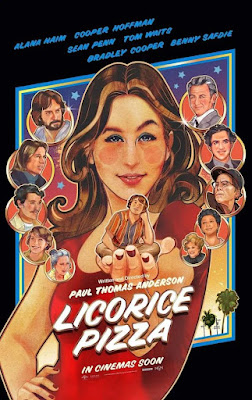
Taking a Bite Out of “Licorice Pizza”

In the course of Joel Coen’s The Tragedy of Macbeth, it takes a brisk one hour and forty-five minutes for a Scottish general to be goaded into murder, be crowned king, lose his wife and his wits, and finally die dramatically in a bloody duel. Paul Thomas Anderson’s Licorice Pizza requires 30 minutes longer for two ambitious but misdirected Valley kids to discover they’re in love. I by no means disdain stories on trivial subjects:  films that take a close-up look at intimate relationships are some of my favorites. (See, for one classic example, Paddy Chayefsky and Delbert Mann’s unforgettable Marty.) But though Licorice Pizza has two fascinating central characters, as well as a dead-on look at the San Fernando Valley circa 1973, its meandering structure gives its story little sense of urgency. By the end I was stealing glances at my watch, wondering when this saga would finally grind toward its conclusion.

 Licorice Pizza (named after a now-defunct Southern California record shop chain) follows fifteen-year-old Gary Valentine--a self-promoter who is by turns an actor, a waterbed salesman, a pinball magnate, and an all-around hustler—in his conquest of an “older woman,” the elusive Alana Kane. She by turns ignores Gary, teases Gary, works for Gary, rescues Gary, and finally acknowledges that theirs is a bond that can’t be broken. The two are played by cinema newcomers who share distinctive heritage: he’s the son of the late Philip Seymour Hoffman, and she is part of a trio of singing Haims whom Anderson previously directed in a series of music videos. (The entire Haim family appears on-screen in one dinner scene.) Both are complex and quirky, and I fully appreciate the fact that they appear au naturel, zits and all.

 Otherwise, what plot the film has is stuffed full of in-jokes, many related to the movie industry. John Michael Higgins plays an obnoxious restaurant entrepreneur with serial Japanese wives. I don’t know exactly what he represents in terms of Hollywood movie culture, but there’s no question that Sean Penn’s Jack Holden is a caricatured view of the ageing William Holden, hitting on girls young enough to be his granddaughters. The male lead character, Gary Valentine, is apparently based on a successful Hollywood type, Gary Goetzman, who went from being a child actor (and waterbed salesman) to a major career as a producer of hit films and television shows. And Bradley Cooper’s Jon Peters, who makes the mistake of buying one of Gary’s waterbeds for himself and main squeeze Barbra Streisand, is vividly portrayed as a larger-than-life blowhard chock full of his own sense of entitlement.

 For me the film’s biggest surprise comes when the script dips into the world of local politics, portraying Alana as a devoted volunteer for Valley councilman Joel Wachs in his bid to be mayor of Los Angeles. As someone who remembers the glory days of the real Wachs (he’s played here by Uncut Gems director Benny Safdie), I was surprised to see him portrayed on screen, with particular attention paid to his character flaws and his covert homosexuality. Wachs’ story is a potentially provocative one, but much less so if you don’t have a long memory of his political heyday. For those who could care less about decades-old mayoral contests in Southern California, what is this naming of real names supposed to prove?

 If you strip away the cameos, Licorice Pizza is an eccentric version of the classic formula: boy meets girl, boy loses girl, boy gets girl. It has its charming moments, but I’m still not sure why Hollywood critics are hopelessly devoted.


Monday, February 3, 2014

Philip Seymour Hoffman: The Death of a (Super) Salesman


The morning of the Super Bowl, I (like millions of other movie fans) was shocked to read about the death of Philip Seymour Hoffman. All signs have pointed toward a drug overdose, and I’m surprised by the depth of my own sadness and disappointment. I can shrug off the premature passing of a music legend destroyed by years of living large: immaturity and lack of impulse controls seem to go with the territory for pop idols and rock gods. I was sorry when the promising young actor River Phoenix died at 23, but I could attribute his drug abuse to an eccentric upbringing, followed by stardom at a too-young age. I felt much the same when learning of the passing of  28-year-old Heath Ledger, who seemed to have succumbed (via an accidental overdose of sleeping pills and anti-anxiety meds) to the pressures of having too much success too soon.

But Hoffman? He struck me as intelligent, mature, a grown-up. Apparently in many ways he was. At age 46, he was a doting dad to three school-aged children; the parents of their classmates have spoken of him as a regular guy, an involved member of the school community. Yes, while in his early twenties, he felt the lure of drink and drugs, but he long ago went public about his decades of sobriety. The word is that last May he briefly went off the wagon, then immediately checked himself into rehab. In the long run, alas, it didn’t work.

Why? I suspect even those closest to him are wrestling with that question. What did he need that life didn’t give him? In his chosen profession he had succeeded gloriously: though he lacked the looks of a classic leading man, there were plum roles, big paychecks, critical adulation, an Oscar. He had the respect of his peers, and a loving family. He also had, apparently, an addictive personality: he was naturally drawn to excess of all sorts. As he told a British journalist in 2011, “I had no interest in drinking in moderation. And I still don't.  Just because all that time’s passed doesn't mean maybe it was just a phase. That's, you know, who I am.” Happily for me, I don’t know what it’s like to spend your life constantly fighting addiction. But others, I think, have staved off that harsh disease, even if they can never entirely conquer it.

I can’t help looking to Hoffman’s acting career as both a symptom and an underlying cause of his problems. He was best known for playing men on the edge, those who struggled with power, with sexual confusion, with greed, with obsession, with secrets they couldn’t even admit to themselves. Often his characters were abusers of some sort. Since the heyday of the Actors Studio, many American actors have been trained to probe their own emotional memories and then look for connections between themselves and their roles. I know  little about Hoffman’s personal methodology, but I’d guess that bonding so intensely with the outrageous characters he played on stage and screen would ultimately take its toll.

Two of his recent powerhouse Broadway appearances stand out in my mind. Eugene O’Neill’s autobiographical Long  Day’s Journey into Night  lays bare a family destroyed by addiction. Willie Loman in Arthur Miller’s Death of a Salesman is not exactly an addict, but rather a man fatally determined to win success by making himself well-liked. Willie Loman’s “smile and a shoeshine” brand of salesmanship strikes me as remarkably close to an actor’s life. Hoffman smiled; sold himself for the crowd’s applause; died much too soon.