Showing posts with label George Hickenlooper. Show all posts

Friday, May 10, 2024

Remembering the Wives: Eleanor Coppola and Samantha Davis

In Hollywood, as in the rest of life, wives sometimes get overlooked. But two recent deaths have reminded me of how complicated (though rewarding) it can be to unite in marriage with a major showbiz figure. Eleanor Neil met Francis Ford Coppola in Ireland, where he was shooting his first professional film, a Roger Corman cheapie called, Dementia 13. (She was serving as assistant art director on the project. It came about because Corman had shot The Young Racers in the Emerald Isle, and figured that cast and crew could quickly crank out one more film before they all went home. ) The Coppolas wed in 1963, produced three children, and stayed married for the rest of their lives, despite a good deal of turbulence, as he moved from the glory years of the Godfather films into more complicated territory. In 1976 Eleanor was present in the Philippines, with very young kids in tow, as Coppola shot his Vietnam epic, Apocalypse Now (released in 1979). The chaos of that experience (including Martin Sheen’s nervous breakdown and a typhoon that destroyed an expensive set) was captured in her diaries, which she shaped into a pull-no-punches 1979 book, The Making of Apocalypse Now. It’s been years since I read it, but I recommend it as a fascinating behind-the-scenes look at the emotional toll that’s taken when a movie crew moves to a distant land to shoot a difficult film.

 So warmly was Eleanor Coppola’s book received that she helped turn it into a documentary film, which she co-directed with Fax Bahr and my old friend George Hickenlooper. Hearts of Darkness: A Filmmaker’s Apocalypse appeared in 1991, and quickly picked up awards, including an Emmy for "Outstanding Individual Achievement – Informational Programming – Directing.” Thereafter, Eleanor tried her hand at feature filmmaking, directing the 2016 romantic comedy, Paris Can Wait as well as 2020’s Love is Love is Love. She also published a second book, Notes on a Life, which chronicled the doings of her famous family, including the death of her first-born son Gian-Carlo at the age of 22 and her husband’s much-maligned decision to cast daughter Sofia in a key role in The Godfather, Part III. Nor did Eleanor give up documentary filmmaking, chronicling the making of Sofia’s 2006 feature, Marie Antoinette. 

 Eleanor passed away on April 12 of this year, at the age of 87 in Rutherford, California, seat of the family’s well-known winery There’s little question that hers was a remarkably productive life.

 Far less well-known was Samantha Davis, who died on March 24 at the age of 53. She was the longtime wife of Warwick Davis, who starred in George Lucas and Ron  Howard’s Willow.. In this 1988 fantasy film, the still-teenaged Davis (all of three foot six inches tall) played a hero who saves a kingdom from evil usurpers. Part of the drama takes place in the village of the Nelwyns (supposedly a race of tiny people all under four feet tall). For these scenes, little people were recruited from around the globe, and they joyously bonded with one another, leading director Howard to say, “To see them interacting, performing, working hard, laughing, playing, carrying on . . . that was to me I think maybe the greatest experience in the movie.”

 On set Warwick first got to know Samantha, and they married soon thereafter. Though in Willow she was simply a villager, she did rack up several other acting credits, including a role in one of the Harry Potter films. Together they founded a charitable organization, Little People U.K.  His tributes to her memory are deeply moving.


Tuesday, March 22, 2011

What's Up, Doc?: Conan O'Brien Can't Stop

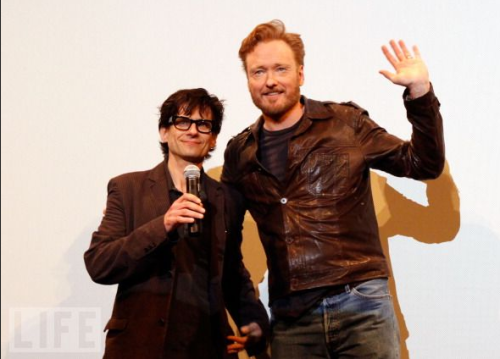
(Rodman Flender with Conan O'Brien)

There’s something about working for Roger Corman that sends Corman alumni out to make documentary films. Even Oscar-winner Jonathan Demme (Silence of the Lambs) has recently shot a slew of docs, on subjects as diverse as rocker Neil Young, former President Jimmy Carter, and Haitian human rights activist Jean Dominique. Demme of course has industry cred that allows him to move between documentaries and star-driven dramas. But Corman graduates who are much lower on the Hollywood totem pole also seem to find docs attractive. For one thing, it’s a way for talented but little-known filmmakers to make a name for themselves. By finding and tackling a worthwhile real-life subject, they can sidestep a life of churning out schlock sitcoms and thrillers of no particular distinction.

The late George Hickenlooper was a case in point. After a brief stay with Corman, he first made his mark with Hearts of Darkness, an eye-opening study of the filming of Apocalypse Now. Even while starting to be recognized for his feature film work, Hickenlooper continued to shoot documentaries, including 2003’s Mayor of the Sunset Strip (on pop music impresario Rodney Bingenheimer) and 2009’s ‘Hick’ Town, whose central figure was the energetic then-mayor of Denver. That mayor, John Hickenlooper, was George’s cousin: the obvious moral is that when you’re making documentaries it’s always smart to mine your own connections.

Adam Simon and Odette Springer are among the Concorde-New Horizons vets who’ve capitalized on their Corman links. Simon, who wrote and directed such blood-curdling Corman fare as Brain Dead and Carnosaur, interviewed his old mentor for a charming but little- seen segment of the Italian documentary Directors on Directing, before moving into an exploration of horror films, American Nightmare. Springer, a Concorde music supervisor in the 1990s, filmed Corman extensively for her probe of the women-in-jeopardy genre, Some Nudity Required. (Alas for Odette, the film she considered mainly an investigation of her own psyche came to be regarded by Roger—and by many Cormanites—as an unfair generalization about Concorde’s entire product line.)

My old buddy Rodman Flender served as Concorde head of production before going on to a modest career directing horror films (Idle Hands) and episodic television. Fortunately for him, his old buddy (dating back to their college days) is Conan O’Brien. When a post-Tonight Show O’Brien took his act on the road via his “Legally Prohibited From Being Funny On TV” tour, Rodman was there to record what happened. The result is a new documentary, Conan O’Brien Can’t Stop, that has wowed the crowds at Austin’s trendy South by Southwest Festival. Which goes to prove that there’s life after Corman—and life after being named Jay Leno’s heir apparent.

Friday, March 4, 2011

Post-Mortem

Well, now the silly pageantry of Oscar night is over. I’d hoped for something remarkable and unexpected, but instead there were uncharming hosts and predictable (if often well-deserved) awards. What lingers most for me was the In Memoriam section of the evening, hailing the movie legends who left us last year.

How moving to see photos of director Arthur Penn and film editor Dede Allen. Not long ago, I interviewed them both regarding Bonnie and Clyde. Both the feisty Allen and the gentle, thoughtful Penn were a delight. I’m lucky to have spent those hours in their company. (That's my snapshot of Penn at his art-filled home, above.)

What made me saddest, though, was the moment when there flashed on screen a photo of director George Hickenlooper. George died suddenly, and much too young, at age 47. I considered George a colleague and a friend. Like me, he began with Roger Corman. In George’s case, there was a brief stint as production assistant on a juicy little thriller called The Drifter (1988). Then with Hearts of Darkness, his documentary on the making of Apocalypse Now, George started gaining major attention. His reputation built as he made feature films like The Man from Elysian Fields and last year’s Casino Jack, a telling of the Jack Abramoff saga (starring Kevin Spacey) that was released after his death.

But I’ll always remember George for his grace under pressure. It was a few days after L.A. had emerged from the bloody civil disturbances of 1992. Roger Corman, who loves movies “ripped from the headlines,” had summoned the press, announcing that his new film would lay bare all the causes and effects of those dark days. He introduced George as his writer-director. As the news media waited expectantly, Roger turned to George, saying, “Tell them about your movie.” George had come into the office for a simple business meeting, and there was as yet no story. But he had to say SOMETHING.

Noticing a video camera in someone’s hands, he had a moment of inspiration. His film, he announced, would follow the path of a video camera as it moved from hand to hand through the L.A. streets, picking up all the chaos that the riots engendered. The newsmen were impressed, and went away to file their stories. We on the Corman creative team went to work—until Roger suddenly lost interest in the riots as a film topic. Spielberg was shooting Jurassic Park, and we were redirected to a new project: Carnosaur.