Showing posts with label Irene Papas. Show all posts

Tuesday, October 4, 2022

Dancing Down Memory Lane with Zorba the Greek

In 1964, the cool kids discovered Greece. Greek line-dancing was taught to enthusiastic hipsters at folkdance cafés across the country. Souvlaki was the snack of choice, and ouzo became a favored tipple. Everyone (even Joni Mitchell) wanted to go camp out on a lonely beach on some Greek isle. Why this passion for all things Hellenic? Chalk it up to the outsized success of a small film, Zorba the Greek.

 Zorba The Greek was directed by Michael Cacoyannis, a talented Cypriot who launched his career with works performed in Greek. In 1962 I first encountered his Electra, adapted from the classical text of Euripides, and I still remember its raw power. Years later I marveled at how he could people The Trojan Women with some of the world’s brightest international stars (Katharine Hepburn, Vanessa Redgrave, Genevieve Bujold, Irene Papas as Helen of Troy), set them against the rugged Greek landscape, and vividly convey what Euripides’ anti-war tragedy was all about.

 I was an arty kid, willing to read subtitles and open to watching the playing out of a text that dates back to 415 BC. Admittedly, not everyone in my generation had my arcane tastes. But we all found it easy to adore Zorba the Greek, a film full of love and laughter, at the same time that it explored in heart-wrenching detail the tragedies of life. Adapted by Cacoyannis from a well-loved novel by Nikos Kazantzakis, a nine-time nominee for the Nobel Prize for literature, the film gave Hollywood’s Anthony Quinn (who also produced) his most iconic role. He’s a marvel as a man who functions as a life-force: passionate, roguish, someone who fights off tears by dancing his heart out on the sands of Crete.

 Quinn’s opposite number in the film is Alan Bates as Basil, the strait-laced young Englishman who must be taught to laugh at fate. Then there’s Lila Kedrova, who picked up an Oscar for her portrayal of a vulnerable Frenchwoman, the keeper of a shabby hotel in a small Greek village, The final main character, played by Cacoyannis favorite Irene Papas, is known only as The Widow. Her essentially non-speaking role calls forth all her beauty and dignity. She’s the solitary young woman, clad in black from head to toe, who moves silently through the town, hated by all the local wives, lusted after by their husbands. It’s clear enough to all of us that something dreadful is about to happen.

 As viewers, we never find out anything about the Widow, nor what became of her husband. In a sense, we in the audience are in the same position as Alan Bates’ character: we’re outsiders, learning about a culture we don’t entirely understand. Though the movie contains some brief conversations in subtitled Greek, mostly it’s in English, spoken by characters (like Basil, like Kedrova’s Madame Hortense, even like Zorba himself) who are not genuinely part of the local scene. In a film that acknowledges a language barrier as one of the things that separate people from one another, visuals are particularly important. And so they are here. The Oscar-winning black & white camerawork of Walter Lassally graphically highlights the stark drama that’s part of this town’s life. One moment I particularly recall captures the moments immediately following the death of Madame Hortense. The elderly crones of the neighborhood, all clad in widow’s weeds, steal into the bedchamber where her illness-wracked body still lies. Like the harpies in classical tales, they silently make off with every trinket she owns, leaving her room stripped bare..

 Then of course there’s Mikis Thedorakis’ evocative, dance-worthy score. Opa!


Friday, September 16, 2022

A Salute to Three We’ve Lost: Jean-Luc Godard, Marsha Hunt, Irene Papas

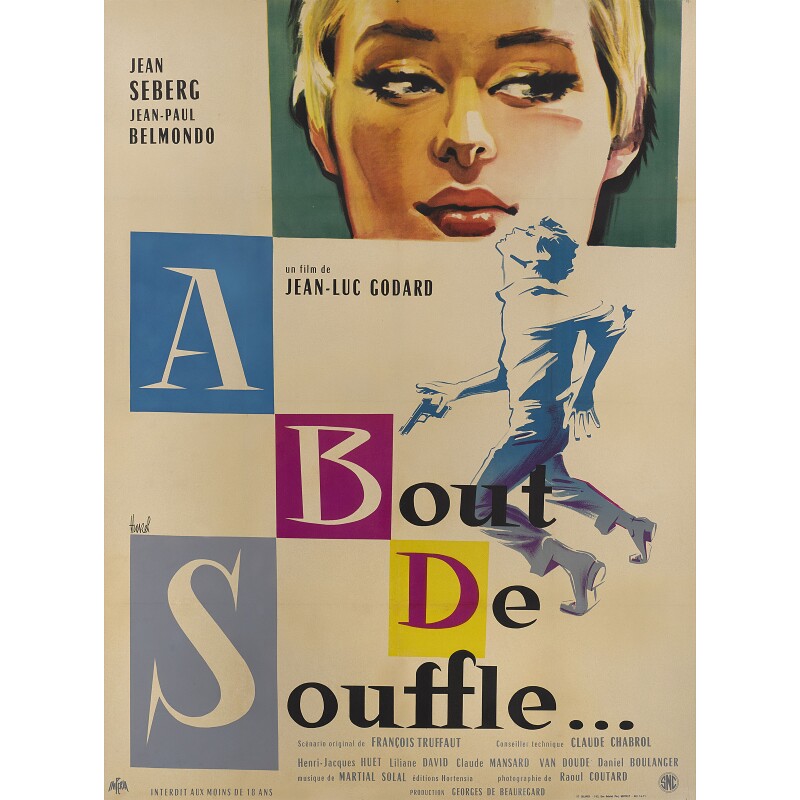
Original French poster for "Breathless"

I can’t pretend to be an enormous fan of Jean-Luc Godard, the French/Swiss cinephile whose movies shook up the status quo of the filmmaking world for a remarkable 60 years. Godard (who died September 13) made films I found far more provocative than enjoyable. But he always had something interesting on his mind, and he was certainly terrific with quips about the nature of cinema. Godard, who like most French filmmakers coming out of the Sixties began as a critic, certainly knew how to boil the film medium down to its essence. One of his most familiar aphorisms could also be the motto of my former boss, Roger Corman: “All you need to make a movie is a girl and a gun.”

  Godard’s appreciation for classic genre films (like American film noir and “lovers on the lam” flicks) led him to make his own hardboiled crime dramas. These obviously include the one that kickstarted his career, 1960’s Breathless, starring Jean-Paul Belmondo as a petty Paris crook and Jean Seberg as the girl who betrays him. Through my own research on the great American films of the late Sixties, I was surprised to discover the intimate connection between Godard’s sort of deliberately ironic filmmaking and 1967’s indelible Bonnie and Clyde. The unheralded young writers of that script, Robert Benton and Thomas Newman, were such fans of the French New Wave that they watched films like Breathless and François Truffaut’s Jules and Jim multiple times and sought to make their own hero, Clyde Barrow, a cool gangster-type in the Belmondo mold.

 When Benton and Newman managed to meet Truffaut in New York City to discuss their project, he showed his passion for low-rent American crime drama by screening for them 1950’s Gun Crazy, a sleek and moody black & white road pic starring Peggy Cummins and John Dall. But despite his enthusiasm for Bonnie and Clyde, Truffaut was already committed to filming Fahrenheit 451, his only English-language film.  (Big mistake, in my opinion!) That’s why he turned the script over to his pal Godard, who seriously considered it. As I recollect, Godard aimed to move quickly, paying little mind to the Texas locale and the period authenticity of Clyde and Bonnie’s historic crime spree, so I’m relieved that the material finally came into the hands of Arthur Penn, a meticulous craftsman who made it his masterpiece. Still, Godard didn’t give up on his fascination with gangsters, treating them with fierce and funny irony in Pierrot le Fou.

 We’ve seen two other important movieland deaths in the last week or so. Marsha Hunt, a rising actress whose career was derailed by the Red Scare of the 1950s, lived to be 104. Though a mention in Red Channels stopped her career momentum forever, she never lost her courageous commitment to causes in which she believed. I met her about ten years ago at a do-good event related to climate change. Appropriately, she was treated as a most honored guest.

 I was especially saddened to read about the passing of the lovely and soulful Greek actress, Irene Papas. In the era when I was discovering foreign-language cinema, her appearances in films based on the classical Greek tragedies were not to be missed. Yes, she also made Hollywood movies like The Guns of Navarrone, but I will always think of her in the title roles of Antigone and Electra. In the latter film, she was directed by the great Michael Cacoyannis, who used her cinematic firepower again later in The Trojan Women and Iphigenia . . . and of course in Zorba the Greek.