Showing posts with label Leonardo Dicaprio. Show all posts

Thursday, April 23, 2026

Dreams and Reality on “Revolutionary Road”

Revolutionary Road strikes me as a curious name for a novel, or a movie . . . or a street address. When I think of its implications, I conjure up a battlefield, with a lot of Minuteman types carrying muskets and wearing their hair in a pigtail. But Revolutionary Road is the title of the 1961 debut novel by Richard Yates that has nothing overt to do with the American Revolution of 1776. Rather, it’s a domestic drama set in the leafy suburbs of Connecticut circa 1955. The young couple who decide to start their family in a big white house on Revolutionary Road are hardly revolutionary in the military sense. Nor are they, really, American patriots. But after some thought I’ve come to see Frank and April Wheeler as yearning for their own private revolution, one that will raise them high above their earthbound suburban neighbors.

 Once the novel was in print, Hollywood came calling, and a screenplay emerged. But for many years no one came forward to produce this morose story with its grim ending. Then British actress Kate Winslet, always ripe for challenging roles, fell in love with the project and became determined to play the female lead. Fortunately for her, she had a husband, Sam Mendes, with his own Hollywood cred. Primarily a stage director, he had won an Oscar for helming his debut film, 1999’s American Beauty, which like Reluctionary Road took an intimate look at the collapse of an American marriage. Since that time he had won more acclaim, particularly for his very dark and poignant Road to Perdition (2002). When 2008 rolled around, he was releasing a movie that starred not only his wife but also her close friend and one-time on-screen love, Leonardo DiCaprio.

 Also culled from the Titanic cast was Kathy Bates, who had once played Molly Brown on that ill-fated voyage and was now asked by Mendes to play a local realtor who befriends April and Frank. The key supporting role of her truth-teller son was taken by Michael Shannon, a character actor who ended up with the Academy’s single acting nomination for Revolutionary Road. In all it was nominated for three Oscars (including Best Costumes and Best Production Design), but won none of them. Most recently the versatile Shannon has played the martyred President James Garfield in TV’s Death by Lightning and a key judge in last year’s Nuremberg.

 What is revolutionary about Revolutionary Road? It focuses in on a married couple determined to live a life of their own choosing. April, a frustrated local actress, is the one who comes up with the plan for her husband to quit his workaday job so the family can move to Paris and discover their bliss. Frank at first resists his wife’s urging but soon comes to accept the idea that in Paris he’ll intuit how to really put his undefined talents to use. They make plans and tell all their neighbors . . . but reality gets in the way. And the couple eventually discover that their thinking is not so in sync after all. The ending, when it comes, is tragic, and the final scene gives the family (and us) little solace.

 Which is probably why the film, well-made as it is, did not drawn in audiences. In Titanic, Jack and Rose were a couple madly in love, until an iceberg destroyed their dreams of romantic bliss. Here the same actors show romance crumbling because of their own unrealistic goals. Ironically, Winslet’s own eight-year marriage to Mendes didn’t last much beyond the film’s release.


Friday, November 14, 2025

The Very Flexible Diane Keaton

In memory of the late Diane Keaton, I wanted to re-watch one of her films. But which one? Of course I remembered her hilarious teaming with Woody Allen in so many of his early flicks. I can still see the two of them in Sleeper (1973), elaborately pretending to be surgeons charged with cloning an assassinated political leader from his one remaining body part: a nose.  I’m also very partial to Love and Death (1975) and of course Keaton is justly adored for her Oscar-winning title role in the ultimate romantic comedy, Annie Hall (1977).

 In truth I fell for Keaton in her very first film: Lovers and Other Strangers (1970). In this charming ensemble outing, set amid the chaos of a big family wedding, she has the small role of Joan Vecchio, married to the groom’s older brother. Her appearance causes some tension at the festive gathering, because she and husband Richie are seriously thinking of separating. The problem: Joan has discovered that, after several years of wedlock, Richie’s hair no longer smells like raisins.

 Of course Keaton was later to play other wedding scenes, notably in The Godfather, where she was Michael Corleone’s naïve young wife-to-be, meeting the family at the lavish nuptials of Michael’s sister . But as she aged she hardly lost her on-screen sex appeal. In 2003’s Something’s Gotta Give, a wealthy playboy (Jack Nicholson) gives up an attractive young woman in order to woo her mother, played by Keaton, who was then almost 60. Still, the course of true love never does run smooth. In a 1996 comedy, The First Wives Club, Keaton (who in real life never married) is one of a trio of reluctant divorcees determined to get revenge on the husbands who dumped them for much younger cuties.

 Though Keaton was known for her flair for comedy, she also played highly dramatic roles. In 1977, the same year in which the world fell in love with her Annie Hall, she starred as a secretly promiscuous schoolteacher who meets a tragic fate in Looking for Mr. Goodbar. Four years later, she starred with Warren Beatty in Reds, an Oscar-winning epic saga of the Russian Revolution as seen through the eyes of real-life American activists John Reed and Louise Bryant. But I decided to re-visit Keaton by way of a much smaller drama. Released in 1996, it was called Marvin’s Room. And, like Reds, it earned Keaton an Oscar nomination for Best Performance by an Actress.

 If Keaton’s Louise Bryant in Reds was heroic, her Bessie in Marvin’s Room is downright saintly. (That’s a new one for me—Diane Keaton as a saint!) In this story of a medical crisis that brings s fractured family together, Meryl Streep is the bitchy Lee, unhappily raising two misfit kids by herself ever since her no-good husband walked out. (One of her sons, a teenaged Leonardo DiCaprio, has just burned her house down.) She’s received word that her younger sister Bessie (Keaton) has been diagnosed with cancer and desperately needs a bone marrow donor. So Lee and the kids reluctantly drive from Ohio to Florida to help out a relative with whom Lee has had no contact for 20 years.

 Keaton’s Bessie, who lost her first love to an accident many years back, has spent decades of her life looking after her bed-ridden father (Hume Cronyn) and her wacky aunt (an unrecognizable Gwen Verdon). Despite the physical challenge she herself is facing, she has a radiant optimism about the days ahead. In service to others, she finds joy, and we believe every word she says. 


Friday, October 24, 2025

One DiCaprio After Another

Leonardo DiCaprio, who’s been making films since 1991, was first introduced to audiences as an appealing young teen. Over the years he’s scored in a wide range of roles, playing everyone from Romeo to the young Howard Hughes (The Aviator) to J. Edgar Hoover to Jay Gatsby. His choices have been remarkably diverse, but many of his best roles have been marked by two characteristics that I suspect are shared with DiCaprio himself: energy and shrewdness. Perhaps my very favorite DiCaprio role is that of real-life conman and charmer Frank Abnagale Jr. in Spielberg’s delightful Catch Me If You Can. That’s the 2002 crime film wherein he bamboozles pretty much everyone he meets.

One thing I’ve discovered about DiCaprio’s recent roles: he’s not afraid to look foolish. As an over-the-hill TV star in Tarantino’s Once Upon a Time in Hollywood (2019), he escapes death at the hands of the Manson gang by sheer luck. In 2023’s Scorsese-directed Killers of the Flower Moon, he’s downright stupid, unable to see that his uncle’s clear intention is to kill his own beloved wife as a way to steal her family’s fortune. From what I’ve read, DiCaprio—involved with the project from the start—was originally slated to play an early FBI agent. Thomas Bruce White Sr. was a key heroic figure in David Grann’s book, an historical account of the Osage murders and their aftermath. But when DiCaprio and longtime mentor Scorsese decided to focus the film version on the plight of the oil-rich but highly vulnerable Osage, DiCaprio agreed to play the distinctly non-heroic Ernest Burkhart, who genuinely loves wife Mollie but is blind to what’s being done to her.

Now, in Paul Thomas Anderson’s One Battle After Another, DiCaprio is a man good with things that go boom. but not exactly smart about the world around him. Paul Thomas Anderson’s epic film is very loosely based on a 1990 post-modern novel, Vineland, by Thomas Pynchon. If I’d realized going in that Pynchon’s world-view was the basis for Anderson’s film, I would have been far less confused at the start. Pynchon’s writings about America capture the ethos of various eras in a comically exaggerated fashion. This particular novel is about the Reagan era, but Anderson has updated it to reflect the upheavals of today, particularly the militaristic treatment of the undocumented. But here’s the thing: no one is particularly virtuous. Certainly not the military (led by Sean Penn’s crazed Colonel Steven J. Lockjaw), but also not the wildly brutal rebels who confront the Armed Services with their own weapons of major destruction. (Their leader is Teyana Taylor’s unforgettably angry Perfidia Beverly Hills – yes, there are some bizarre names here.) With leaders like these, for which side should the viewer root?

DiCaprio, as “Rocketman” Bob Ferguson (in the course of the film he has several noms de guerre) is Perfidia’s lover and loyal follower, but there’s no real sense that he has any idea about the commitment he’s made to her cause. True,  he’s a dedicated rebel, but against what? In the film’s later innings, after she’s been captured and disappeared, his numbe-one interest seems to be lying on his living-room couch and smoking a lot of weed. But he has another interest too: looking after the feisty teenage daughter who may or may not be his.   

Before I saw this film, I was unclear about what genre it fell into. I heard it was violent; I heard it was very funny; I heard it had meaning for today. All true, but don’t expect to like any of the characters very much.  


Tuesday, August 19, 2025

Juliet . . . & (eventually) Romeo

Methinks that every generation has its own Romeo and Juliet, in which the tragic lovers reflect the concerns of the day. The 1936 film directed by George Cukor came out in the midst of the Great Depression. This was a time when young people going the movies craved glamour and sumptuous production values, things they couldn’t find in their own daily lives. Cukor’s MGM-based production featured major (though overaged) stars. Leslie Howard, as Romeo, was in his forties, and Norma Shearer, who played Juliet (and was married to studio honcho Irving Thalberg), was about 34, more than double the age of Shakespeare’s teenage heroine. The film was shot decorously, on elaborate sets, and given the full prestige treatment, complete with splashy roadshow engagements where illustrated programs were sold. (Yes, my mother bought one, and saved it for many decades)

 More than 20 years later, in 1957, a much-updated version of Romeo and Juliet became the toast of Broadway. This of course was West Side Story. The Leonard Bernstein-Stephen Sondheim musical reimagined the star-crossed lovers as recent New Yorkers from rival cultural backgrounds, with Tony as a Polish-American founder of a street gang called the Jets, and Maria, newly arrived from Puerto Rico, as naturally affiliated with the Sharks. The hit play became in 1964 a mega-hit film that gobsmacked everyone at my high school. We were much taken, in that era, with the promise of social justice for all, and the tragic story of lovers unable to transcend the enmity all around them hit us hard. (Steven Spielberg’s 2021 rethinking of the same musical has its merits, but its box-office reception was far less overwhelming, probably because the concerns of moviegoers had much changed in the intervening fifty-plus years.)

 What I consider MY Romeo and Juliet was the Franco Zeffirelli version that came out in the fraught year 1968. It was filmed on location in medieval Italian towns, and was the first cinematic version to feature actors close in age to Shakespeare’s actual characters. Zeffirelli apparently considered casting Paul McCartney and other rock gods of the era, but ended up with two unknowns, Leonard Whiting and Olivia Hussey, who were cast when they were 16 and 15, respectively, but aged a year in the course of filming. We college students of the era, many caught up with our own first big romances, watched this movie in a sort of swoony daze, fully understanding the erotic passions of the two young lovers.

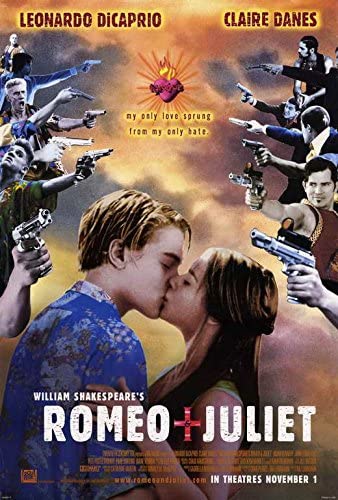
 Leave it to Baz Luhrmann to jazz up the Shakespearean story, giving it a kind of hipster sensibility. The year was 1996, and the stars were Leonardo DiCaprio (then 21) and Claire Danes (about 17). The feuding families were played as 20th century Miami mobster types, with the Capulets now having some Latin roots. The setting was Verona Beach, and one key scene was played in a swimming pool. There’s still some well-spoken Shakespearean poetry, but also guns and party drugs.

 I’m reminiscing about all this because I’ve just seen the L.A. stage production of & Juliet, a London and Broadway hit musical that posits Juliet (waking in the tomb beside the dead Romeo) deciding not to kill herself for love. What follows is a riotous comedy in which pop songs from Max Martin are incorporated into Juliet’s romantic adventures in Paris. (Brittany Spears’ “Oops!... I Did It Again” becomes an acknowledgement that Juliet falls for cute guys a tad too quickly.) The many teens in the house cheered for Juliet’s developing feminist consciousness and for the “woke” gay empowerment motif that predominates. Me? I just felt rather old.


Thursday, July 25, 2024

Killers of the Flower Moon: On the Page and On the Screen

I saw Killers of the Flower Moon last fall, when it first arrived in theatres. There’s no question that a 206-minute film makes for a lengthy sit, but I was enthralled by a story I previously knew nothing about. I was fascinated by the realization that a Native American tribe had, thanks to the 1897 discovery of oil on tribal lands, become so fabulously wealthy that by the 1920s some were buying luxury cars, fancy clothing, and jewelry, sending their children to private schools, and traveling to Europe on vacation. It was not uncommon for them to hire white Americans as housekeepers and chauffeurs.

 Inevitably, this accumulation of wealth in Osage County, Oklahoma, attracted grifters and conmen of all sorts. Many were out to corner Osage riches for themselves, and there was a system in place that made this relatively simple. Congress, in its wisdom, had decided that the Osage were too childlike to hold onto their money without help, and so a system of “guardians” was established. Needless to say, the guardians were white men from the community. And suddenly the members of the Osage tribe were dying in great numbers, with whole families wiped out, from causes that were never adequately investigated. The years of the killings (mostly 1921-1926) are remembered by today’s Osage as a “reign of terror,” in which some 60 wealthy Osage mysteriously went to their deaths.

 I bring this up now because I’ve just finished reading the book on which the film is based, David Grann’s 2017 best-seller, Killers of the Flower Moon: The Osage Murders and the Birth of the FBI. I was aware from the start that virtually everyone I knew who had read Grann’s book was disappointed by the motion picture adaptation. Upon reading Killers of the Flower Moon, I could see why. Addressing the same historical subject matter contained in Scorsese’s film, Grann arranges it in an entirely different way. He chooses to divide his material into three “chronicles.” The first, “The Married Woman,” focuses on Mollie Burkhart, the Osage woman played memorably in the film by Lily Gladstone. Her mother and three sisters are among those killed off by greedy white men for their oil rights, and she herself barely survives being poisoned by her own Anglo husband (Leonardo Di Caprio), who loves her, but perhaps loves money (and his nefarious uncle. William Hale) more. This material, with its twisted love story, is where Scorsese focuses.

 The second “chronicle,” titled “The Evidence Man,” is devoted to Tom White, a serious-minded Texas lawman who arrives at the FBI at a time when J. Edgar Hoover is transforming it from the so-called Department of Easy Virtue to a serious law enforcement body. This was the era when detectives came into their own, both on the screen and in real life. White as a character has a small role in Scorsese’s movie, nicely played by Jesse Plemons. But the implications of his whole career could support a fascinating film, perhaps a more sophisticated version of The FBI Story (a 1959 James Stewart flick, heavy on heroics, that relied mightily on Hoover’s full cooperation).

 Finally, Grann spends his third “chronicle,” in the first-person, detailing how he himself, as an investigative reporter showing up almost 100 years after the crimes were committed, uncovered new evidence and was able to trace the long-term repercussions of the murders among today’s Native American community. As a reader who’s also a writer, I found it exciting to learn how much evidence a dedicated reporter can find, even decades after the fact. Maybe a documentary is in order?


Thursday, November 23, 2023

Shine On, Flower Moon: Scorsese on the Prairie

Recently I’ve heard from several admirers of David Grann’s 2017 bestseller, Killers of the Flower Moon: the Osage Murders and the Birth of the FBI. These readers—including Jack El-Hai, a colleague known for his work as a biographer—are disappointed by Martin Scorsese’s new film adaptation of Grann’s book. They find the film, among other things, too long, too lacking in sympathetic characters, and too focused on one family’s egregious behavior to capture the magnitude of the problem the book confronts.

 I can’t agree with them, partly because I’ve never read Grann’s book. So I don’t exactly know what was lost in the transfer from page to screen. I do know that the filmmakers, deeply aware of the strong emotions invested in this project by indigenous groups, worked hard to avoid any accusation that this was a “white savior” project. They didn’t want this, in other words, to be one of those movies in which white-skinned men of good conscience rescue suffering Native Americans from their oppressors. Scorsese even goes so far as to make an appearance at the beginning of the film, spelling out his intentions. And I’ve heard that star Leonardo DiCaprio, a longtime Scorsese collaborator, made the gutsy decision not to star as an heroic FBI agent but rather to play a not-too-bright World War I veteran whose credulous nature contributes to the disastrous love story at the center of the film version.

 Taking the film as a film—and not as an adaptation of an important book—I have to say that I found it enthralling. Though well over three hours long, it caught me in its grip and wouldn’t let go. Partly this is a matter of a brilliant production design, best appreciated on an IMAX screen. I will long be haunted by the memory of Osage men, having sadly concluded that their traditional way of life is dead and buried, suddenly reveling in a spurting plume of crude oil on their land. And there’s a stunning moment much later in the film when firefighters battling an arson blaze seem like inhabitants of Dante’s Inferno.

 Moviegoers who have watched loads of classic westerns will be enthralled by this apparently authentic look at the Osage people, circa 1920, following the discovery of oil. These Native Americans do not live in wigwams or hogans, nor do they dress in buckskin and wear feathers in their hair. Now wealthy because of their land rights, they speak good English, attend the local Catholic church, and glide into their squalid Oklahoma town in taxis driven by white men. Young women like Mollie may proudly wrap themselves in tribal blankets, but also cover their heads in stylish chapeaux. Played by rising star Lily Gladstone, Mollie is hardly the pathetic little squaw of many a western. Strong and spirited, she has no problem in choosing DiCaprio’s Ernest as her husband, and sharing with him (at least at first) an intense connubial life.

 If Ernest doesn’t seem worthy of his bride, it’s at least partly because of his allegiance to his uncle, played by Scorsese regular Robert De Niro as William King Hale. In his illustrious career, De Niro has played many bad hombres. But there must be a special circle of hell for the man he portrays here. King Hale speaks the Osage language and loudly touts his friendship with the Osage people. But ultimately his eye is on those lucrative Osage land rights, and the devil take the consequences.

 A clever (though controversial) device at the film’s end invites us to put this tragic story into perspective. Bravo, Mr. Scorsese.


Tuesday, October 11, 2022

Baz Luhrmann Brushes Up on His Shakespeare with “Romeo + Juliet”

When I was college-age and in love, the movie to see was Franco Zeffirelli’s 1968 adaptation of William Shakespeare’s timeless tragedy, Romeo and Juliet. The art direction was lush; the secret lovers were gorgeously young (Leonard Whiting was 17 and Olivia Hussey a mere 15); the cinematography and musical score were swoon-worthy. Though the screen showed us a  convincing depiction of Old Verona (as well as young bodies), we could surely identify with the social concerns of these lovers and this timeframe. In the Zeffirelli film, dying for love seemed both sad and inspiring, especially for those at the right age to discover love, and sex, and the burdens of family obligations, and the rules that govern a community.

 Somewhere along the line, I watched the most admired screen Romeo and Juliet of my parents’ era. That would be an MGM spectacular, directed by George Cukor in 1936. This elegant but stodgy black & white rendering of the immortal love story featured Leslie Howard (age 43) and Norma Shearer (age 36) as the “young” lovers: Shearer was the much-adored wife of producer Irving Thalberg, whose pet project this had long been. Roadshow screenings of this extravaganza sold elaborate program booklets, and ads of the era touted the Howard/Shearer paring as a repeat of their romantic chemistry in a popular melodrama called Smilin’ Through. There’s no way that my peers and I could have connected with Howard and Shearer. But the virile young Whiting and the gloriously delicate Hussey were to us completely captivating. (I’ve talked to men of my generation who first discovered, on watching the bridal-bed scene, that their tastes ran more to Romeo than to his fair young bride.)

 I suppose every era must have its own Romeo and Juliet. In 1996, along came Australian filmmaker Baz Luhrmann, fresh off the success of an outrageous little dance movie, Strictly Ballroom (1992). It was a gigantic jump from a Down Under production full of no-name ballroom dance aficionados to a major Hollywood release, but Luhrmann clearly enjoys the bursting of boundaries. He brought with him the concept of a Romeo and Juliet set not in a musty Italian city but rather in a gaudy neverland named Verona Beach. His rival Montagues and Capulets are gangs of punk rockers and Hawaiian-shirted bros, brawling in the service of the adult gangster-types who run things. There are guns, cigarettes, tattoos, and swimming pools, along with a flamboyant Catholicism when religion is required. In defiance of the “whites only” classical productions of Shakespeare, here actors come in many colors, John Leguizamo swaggers through the role of Tybalt, and Juliet’s nurse has an unmistakable Latino accent But somehow the language of Shakespeare holds, though the Bard’s verbal formalities are often used ironically.

 What of the central love story? Luhrmann certainly chose well. His Romeo is a baby-faced  twenty-two-year-old Leonardo DiCaprio, speaking eloquently while looking really cute. Opposite him is Clare Danes, age 17, as earnest and wide-eyed as a Juliet can be. Though some of their scenes together take on a surreal quality because of their location (part of the dialogue from the famous balcony scene is played in a fabulous swimming pool), young love is definitely in the air. (The word is that Danes developed a genuine crush on DiCaprio, who wasn’t interested—so much for youthful ardor.) I’m not sure I can forgive Luhrmann for tweaking some details of the play’s ending. At any rate, high school teachers reportedly adore this version because it speaks so vividly to their students. And I can hardly complain about that.