Showing posts with label William Shakespeare. Show all posts

Tuesday, January 13, 2026

All The World’s a Stage: “Hamnet”


 A fair number of high-powered film critics don’t seem to care for Hamnet. The film was wholly shut out by such august bodies as the New York Film Critics Circle and the National Society of Film Critics, both of which chose to honor more outrageous flicks, like One Battle After Another. For them, I gather, Hamnet is an old-fashioned tearjerker, without much connection to our own troubled times.

 Actors, though, clearly hold this film in high esteem. Wednesday’s nominations for the Actor Award, the newly-renamed honor from the Screen Actors Guild, include individual recognition for Jessie Buckley (up for female actor in a Leading Role) and Paul Mescal (actor in a Supporting Role). Even more impressive: the film was nominated (along with, among others, One Battle After Another and Marty Supreme), for the coveted ensemble award honoring the featured cast.

 And what do I think? As a dedicated filmgoer with a decided literary bent, I found this rendering of the relationship between William Shakespeare and his wife thoroughly mesmerizing. Adapted by Oscar-winning director Chloé Zhao and novelist Maggie O’Farrell from Farrell’s best-selling novel, this is a story about familial love and loss. In the absence of much hard evidence, many literary types have speculated about the marriage of the brilliant English playwright and the rustic young woman he abandoned for so many months while pursuing his career in London. It’s easy to guess, as many have done, that the pair had little in common aside from the three children who stayed home in Stratford with their mother. (No wonder , they reason, that Will looked for greener pastures elsewhere! No wonder that upon his death he left his wife merely the second-best bed!)

 I think the romantics among us are delighted to find in O’Farrell’s rendering a genuine marital union, though one challenged by Will’s long absences. And, of course, further threatened by the plague-death of the couple’s only son, Hamnet, at an early age. The story,  then, becomes one in which a  couple need to find—somehow—their way out of grief. For the earthy Agnes (more usually known as Anne), there’s despair, fury at her long-absent spouse, and a deep connection with nature. For Will there are words to be written, and a play to be produced. I’ve seen other films re-creating the performance of an Elizabethan drama on the stage of the Globe Theater (see Shakespeare in Love, for example). But never before have I seen this set-up used so movingly, with Agnes—standing among the groundlings at the very edge of the stage—mesmerized by the words her husband has written, finding in them personal meaning to help soothe her agony.

 I’ve always liked Jessie Buckley’s performances in modest indies, but the role of Agnes calls forth from her whole new depths. Her radiance is impossible to ignore, and I suspect big prizes may be coming her way. Paul Mescal’s role as William Shakespeare is smaller, but also requires—and gets—real intensity. I also want to praise the child actors who are essential to this plot, particularly Jacobi Jupe as 12-year-old Hamnet, whose death tears the Shakespeare family asunder. Fittingly, young Jacobi’s 20-year-old brother, Noah, is featured in the climactic Globe Theater scenes, on stage in the role of Hamlet, perhaps Shakespeare’s most famous protagonist. (The film makes clear at the outset that Hamnet and Hamlet were, in sixteenth-century England, essentially the same name.)

 Huzzah for Hamnet’s production values, including glorious cinematography that captures Agnes’s closeness to the natural world. Perhaps because women created her, she’s a heroine unlike any Shakespeare ever wrote.

 A final note: it wasn’t until I belatedly talked to viewers who hadn’t read the novel that I realized not every moviegoer knows at the outset that Paul Mescal’s character, Will, is a creative portrait of the bard-to-be, William Shakepeare. The feeling among several who spoke to me is that this was intentional on the part of the filmmakers: they wanted the audience to respond to the country lad who falls for Agnes without initially recognizing the literary genius he will become. I wonder: does this strategy help or hurt the film’s success?

Tuesday, August 19, 2025

Juliet . . . & (eventually) Romeo

Methinks that every generation has its own Romeo and Juliet, in which the tragic lovers reflect the concerns of the day. The 1936 film directed by George Cukor came out in the midst of the Great Depression. This was a time when young people going the movies craved glamour and sumptuous production values, things they couldn’t find in their own daily lives. Cukor’s MGM-based production featured major (though overaged) stars. Leslie Howard, as Romeo, was in his forties, and Norma Shearer, who played Juliet (and was married to studio honcho Irving Thalberg), was about 34, more than double the age of Shakespeare’s teenage heroine. The film was shot decorously, on elaborate sets, and given the full prestige treatment, complete with splashy roadshow engagements where illustrated programs were sold. (Yes, my mother bought one, and saved it for many decades)

 More than 20 years later, in 1957, a much-updated version of Romeo and Juliet became the toast of Broadway. This of course was West Side Story. The Leonard Bernstein-Stephen Sondheim musical reimagined the star-crossed lovers as recent New Yorkers from rival cultural backgrounds, with Tony as a Polish-American founder of a street gang called the Jets, and Maria, newly arrived from Puerto Rico, as naturally affiliated with the Sharks. The hit play became in 1964 a mega-hit film that gobsmacked everyone at my high school. We were much taken, in that era, with the promise of social justice for all, and the tragic story of lovers unable to transcend the enmity all around them hit us hard. (Steven Spielberg’s 2021 rethinking of the same musical has its merits, but its box-office reception was far less overwhelming, probably because the concerns of moviegoers had much changed in the intervening fifty-plus years.)

 What I consider MY Romeo and Juliet was the Franco Zeffirelli version that came out in the fraught year 1968. It was filmed on location in medieval Italian towns, and was the first cinematic version to feature actors close in age to Shakespeare’s actual characters. Zeffirelli apparently considered casting Paul McCartney and other rock gods of the era, but ended up with two unknowns, Leonard Whiting and Olivia Hussey, who were cast when they were 16 and 15, respectively, but aged a year in the course of filming. We college students of the era, many caught up with our own first big romances, watched this movie in a sort of swoony daze, fully understanding the erotic passions of the two young lovers.

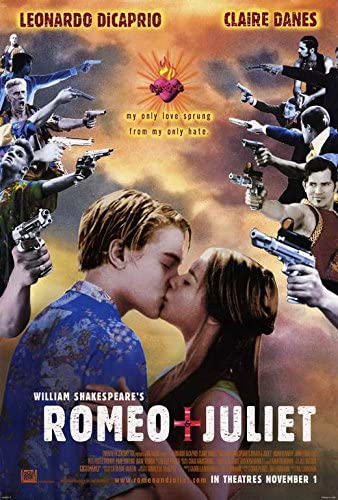
 Leave it to Baz Luhrmann to jazz up the Shakespearean story, giving it a kind of hipster sensibility. The year was 1996, and the stars were Leonardo DiCaprio (then 21) and Claire Danes (about 17). The feuding families were played as 20th century Miami mobster types, with the Capulets now having some Latin roots. The setting was Verona Beach, and one key scene was played in a swimming pool. There’s still some well-spoken Shakespearean poetry, but also guns and party drugs.

 I’m reminiscing about all this because I’ve just seen the L.A. stage production of & Juliet, a London and Broadway hit musical that posits Juliet (waking in the tomb beside the dead Romeo) deciding not to kill herself for love. What follows is a riotous comedy in which pop songs from Max Martin are incorporated into Juliet’s romantic adventures in Paris. (Brittany Spears’ “Oops!... I Did It Again” becomes an acknowledgement that Juliet falls for cute guys a tad too quickly.) The many teens in the house cheered for Juliet’s developing feminist consciousness and for the “woke” gay empowerment motif that predominates. Me? I just felt rather old.


Tuesday, October 11, 2022

Baz Luhrmann Brushes Up on His Shakespeare with “Romeo + Juliet”

When I was college-age and in love, the movie to see was Franco Zeffirelli’s 1968 adaptation of William Shakespeare’s timeless tragedy, Romeo and Juliet. The art direction was lush; the secret lovers were gorgeously young (Leonard Whiting was 17 and Olivia Hussey a mere 15); the cinematography and musical score were swoon-worthy. Though the screen showed us a  convincing depiction of Old Verona (as well as young bodies), we could surely identify with the social concerns of these lovers and this timeframe. In the Zeffirelli film, dying for love seemed both sad and inspiring, especially for those at the right age to discover love, and sex, and the burdens of family obligations, and the rules that govern a community.

 Somewhere along the line, I watched the most admired screen Romeo and Juliet of my parents’ era. That would be an MGM spectacular, directed by George Cukor in 1936. This elegant but stodgy black & white rendering of the immortal love story featured Leslie Howard (age 43) and Norma Shearer (age 36) as the “young” lovers: Shearer was the much-adored wife of producer Irving Thalberg, whose pet project this had long been. Roadshow screenings of this extravaganza sold elaborate program booklets, and ads of the era touted the Howard/Shearer paring as a repeat of their romantic chemistry in a popular melodrama called Smilin’ Through. There’s no way that my peers and I could have connected with Howard and Shearer. But the virile young Whiting and the gloriously delicate Hussey were to us completely captivating. (I’ve talked to men of my generation who first discovered, on watching the bridal-bed scene, that their tastes ran more to Romeo than to his fair young bride.)

 I suppose every era must have its own Romeo and Juliet. In 1996, along came Australian filmmaker Baz Luhrmann, fresh off the success of an outrageous little dance movie, Strictly Ballroom (1992). It was a gigantic jump from a Down Under production full of no-name ballroom dance aficionados to a major Hollywood release, but Luhrmann clearly enjoys the bursting of boundaries. He brought with him the concept of a Romeo and Juliet set not in a musty Italian city but rather in a gaudy neverland named Verona Beach. His rival Montagues and Capulets are gangs of punk rockers and Hawaiian-shirted bros, brawling in the service of the adult gangster-types who run things. There are guns, cigarettes, tattoos, and swimming pools, along with a flamboyant Catholicism when religion is required. In defiance of the “whites only” classical productions of Shakespeare, here actors come in many colors, John Leguizamo swaggers through the role of Tybalt, and Juliet’s nurse has an unmistakable Latino accent But somehow the language of Shakespeare holds, though the Bard’s verbal formalities are often used ironically.

 What of the central love story? Luhrmann certainly chose well. His Romeo is a baby-faced  twenty-two-year-old Leonardo DiCaprio, speaking eloquently while looking really cute. Opposite him is Clare Danes, age 17, as earnest and wide-eyed as a Juliet can be. Though some of their scenes together take on a surreal quality because of their location (part of the dialogue from the famous balcony scene is played in a fabulous swimming pool), young love is definitely in the air. (The word is that Danes developed a genuine crush on DiCaprio, who wasn’t interested—so much for youthful ardor.) I’m not sure I can forgive Luhrmann for tweaking some details of the play’s ending. At any rate, high school teachers reportedly adore this version because it speaks so vividly to their students. And I can hardly complain about that.


Friday, January 28, 2022

A Tale of Sound and Fury: The Tragedy of Macbeth

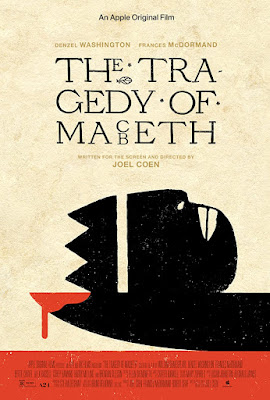
The Tragedy of Macbeth, Joel Coen’s first filmmaking venture apart from brother Ethan, owes something to Akira Kurosawa and something to Alfred Hitchcock. Of the many cinematic versions of Shakespeare’s famous tale. Kurosawa’s 1957 Throne of Blood seems the closest match to what Coen has accomplished. The Japanese-language Throne of Blood, freed of the need to grapple with Shakespeare’s challenging but beautiful language, is marked by spare, spooky stylistics. Shot in black & white, it fills the screen with bleak, ominous visuals. The scene of a fog-shrouded “Birnam Wood” slowly creeping toward the new lord’s Spider’s Web Castle is as spectacular as it gets. Calling on Kabuki tradition, Kurosawa alters the familiar tragedy to enhance the bombastic acting style of the classical Japanese stage. But it’s the look of his film that has stayed with me, and clearly with Joel Coen too. (The American Society of Cinematographers has just named this Macbeth one of  5 nominees for this year’s ASC award, along with Dune, Nightmare Alley, Belfast, and The Power of the Dog.)

 As for the Hitchcock influence, let’s simply say that in The Tragedy of Macbeth there will be birds.

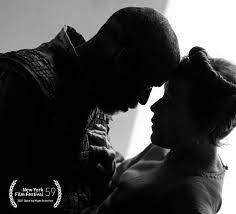
 Visually, Coen strips his Macbeth down to the bare bones: even the unusual aspect-ratio makes for a movie screen—almost square—that hints at long ago and far away. Realism is hardly the point here. Props and set décor are kept to a minimum. Color is bleached out: this is one of several  important 2021 films that stick (as Kurosawa did) to stark black & white. Characters wander through nearly empty halls photographed from often-exotic angles.

 And what about those characters? Commendably, Coen has chosen to be color-blind in his casting, peopling his landscape with actors of different races. The fact that a Black Macbeth (Denzel Washington) is closely allied with a white Lady Macbeth (Coen’s wife Frances McDormand) is never held up for comment. Though the screen is shared by British and American actors, no attempt is made to unify their speech patterns. For this I have some slight misgivings. Though I’ve never been a fan of old Hollywood’s “mid-Atlantic” accent that makes everyone seem vaguely British (see Price, Vincent), I appreciate the vocal precision that the English actors in this cast bring to their roles. McDormand (who can do no wrong in my book) does a magnificent job of articulating her lines while not departing from basic American speech. Alas, I had a harder time with Washington, who sometimes seemed less comfortable in “speaking the speech” while pulling away from the naturalism he brings to present-day American-based stories. 

 I wanted to love Washington’s performance, as many critics have.  But in the play’s key early moments, I couldn’t quite feel the tug-of-war going on in him between Macbeth’s ambition and his fundamental civility. It was only in the later scenes, wherein the newly crowned king lashes out at anyone who stands in the way, that I felt the full force of his portrayal.  McDormand, though, is from the start a forceful Lady McDormand, in love with her husband and his potential for greatness, however he achieves it. There are many fine supporting players, including Brendan Gleeson as King Duncan, Corey Hawkins as a well-spoken Macduff, and Alex Hassell as an enigmatic Ross (whose role is given an extra twist by Coen).  

But many kudos have rightly gone to British stage actress Kathryn Hunter, who uses her voice and a highly flexible body to channel all three of the Weird Sisters who accost Macbeth on that heath. Hers is an otherworldly performance just right for this somber, exhilarating tale.