Showing posts with label Denzel Washington. Show all posts

Friday, September 1, 2023

Illuminated by Friday Night Lights

When I started watching the 2004 high school football film, Friday Night Lights, I had no idea who won the big game. Nor was I aware that the film is based on a much-acclaimed non-fiction book by journalist H.G. Bissinger. In his  Friday Night Lights:  A Town, a Team, and a Dream, Bissinger closely observes a scruffy west Texas oil town that pours money and love into the Permian High School Panthers as a way to bring a community together.

 Bissinger’s 1990 book was hardly without controversy. While spending a year in Odessa, Texas, he investigated far more than a local football team. His in-depth look at a town where the football coach out-earned the high school principal revealed rules violations, a cavalier approach to classroom behavior, and off-the-field scandals. There was, in addition, a quiet streak of black-white racism that ran through the nominally integrated school community.

 What I saw in the film version did not focus on race. (I was most aware of racial issues in the lead-up to the climactic game, in which the Panthers take on Dallas Carter High School, an all-Black team of behemoths who not only dwarf our heroes but do not shy away from some late hits and other dirty tricks.) We are naturally drawn to root for the Panthers, depicted as a nice group of kids—both Black and white—who play hard but face their fair share of bad breaks.

 The worst break of all comes at the start of the season, when running-back James “Boobie” Miles suffers a career-ending knee injury. The cocky, gregarious Boobie (Derek Luke) instantly goes from being a star heavily recruited by major college teams to a guy on the sidelines. It’s a heartfelt performance by Luke, who has also played the title role in Denzel Washington’s  Antwone Fisher. Another key team member is hard-working quarterback Mike Winchell (Lucas Black), a good guy in permanent thrall to his ailing mother. (Black has since gone on to be featured in the Fast and the Furious franchise.) Perhaps the toughest situation of all is that of Don Billingsley (Garrett Hedlund), whose on-field jitters are made far worse by his abusive father (country music star Tim McGraw in a credibly raw performance), himself once a standout on a championship team.

 Though many of these young supporting players (including Hedlund) have gone on to rise within the industry, the film’s clear star is Oscar-nominated actor Billy Bob Thornton, who plays Gary Grimes, the team’s head coach. By turns feisty and gentle, Grimes understands these boys, their aspirations, and their worries. We also catch a glimpse of his strong, supportive spouse, played by Connie Britton. She would repeat her role in a TV series based on the film, one that ran for five seasons. Never a ratings juggernaut, the series was much admired by critics. It seems a perfect fit for television, since high school athletics imply a revolving cast of characters arriving each fall to be led by coach Grimes and his staff to triumph or to tragedy.

  At its start, the series was written and directed by Peter Berg, the power behind the original film. I don’t know Berg’s career in depth (mostly he seems to be a television guy), but his work on the Friday Night Live film has made me a fan. The screenplay doesn’t seem written so much as it seems lived by its characters. The multiple storylines come together naturally, avoiding any confusion. And the on-field action has a “you are there” quality that conveys the brutal excitement of football. Yay, team!  


Friday, January 28, 2022

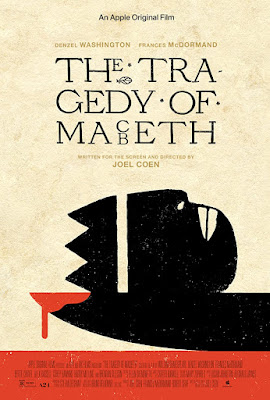
A Tale of Sound and Fury: The Tragedy of Macbeth

The Tragedy of Macbeth, Joel Coen’s first filmmaking venture apart from brother Ethan, owes something to Akira Kurosawa and something to Alfred Hitchcock. Of the many cinematic versions of Shakespeare’s famous tale. Kurosawa’s 1957 Throne of Blood seems the closest match to what Coen has accomplished. The Japanese-language Throne of Blood, freed of the need to grapple with Shakespeare’s challenging but beautiful language, is marked by spare, spooky stylistics. Shot in black & white, it fills the screen with bleak, ominous visuals. The scene of a fog-shrouded “Birnam Wood” slowly creeping toward the new lord’s Spider’s Web Castle is as spectacular as it gets. Calling on Kabuki tradition, Kurosawa alters the familiar tragedy to enhance the bombastic acting style of the classical Japanese stage. But it’s the look of his film that has stayed with me, and clearly with Joel Coen too. (The American Society of Cinematographers has just named this Macbeth one of  5 nominees for this year’s ASC award, along with Dune, Nightmare Alley, Belfast, and The Power of the Dog.)

 As for the Hitchcock influence, let’s simply say that in The Tragedy of Macbeth there will be birds.

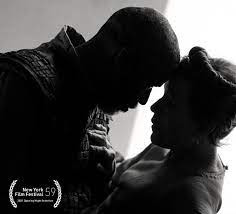
 Visually, Coen strips his Macbeth down to the bare bones: even the unusual aspect-ratio makes for a movie screen—almost square—that hints at long ago and far away. Realism is hardly the point here. Props and set décor are kept to a minimum. Color is bleached out: this is one of several  important 2021 films that stick (as Kurosawa did) to stark black & white. Characters wander through nearly empty halls photographed from often-exotic angles.

 And what about those characters? Commendably, Coen has chosen to be color-blind in his casting, peopling his landscape with actors of different races. The fact that a Black Macbeth (Denzel Washington) is closely allied with a white Lady Macbeth (Coen’s wife Frances McDormand) is never held up for comment. Though the screen is shared by British and American actors, no attempt is made to unify their speech patterns. For this I have some slight misgivings. Though I’ve never been a fan of old Hollywood’s “mid-Atlantic” accent that makes everyone seem vaguely British (see Price, Vincent), I appreciate the vocal precision that the English actors in this cast bring to their roles. McDormand (who can do no wrong in my book) does a magnificent job of articulating her lines while not departing from basic American speech. Alas, I had a harder time with Washington, who sometimes seemed less comfortable in “speaking the speech” while pulling away from the naturalism he brings to present-day American-based stories. 

 I wanted to love Washington’s performance, as many critics have.  But in the play’s key early moments, I couldn’t quite feel the tug-of-war going on in him between Macbeth’s ambition and his fundamental civility. It was only in the later scenes, wherein the newly crowned king lashes out at anyone who stands in the way, that I felt the full force of his portrayal.  McDormand, though, is from the start a forceful Lady McDormand, in love with her husband and his potential for greatness, however he achieves it. There are many fine supporting players, including Brendan Gleeson as King Duncan, Corey Hawkins as a well-spoken Macduff, and Alex Hassell as an enigmatic Ross (whose role is given an extra twist by Coen).  

But many kudos have rightly gone to British stage actress Kathryn Hunter, who uses her voice and a highly flexible body to channel all three of the Weird Sisters who accost Macbeth on that heath. Hers is an otherworldly performance just right for this somber, exhilarating tale.


Tuesday, December 1, 2020

At the Core of the Big Apple: The Taking (and Retaking) of Pelham 123

Back when I used to travel to Manhattan for business and pleasure, I often jumped on the Lexington line, heading downtown. You can see all sorts of sights on New York subways, but happily I never encountered a quartet of desperate men, disguised with hats and fake mustaches, commandeering a train car and threatening to kill passengers, one by one, if their outrageous financial demands aren’t met. That’s central to The Taking of Pelham One Two Three, a superior thriller released in 1974.

 I became intrigued when I read a comment by actress Cynthia Nixon, who called this “my absolute favorite movie of all time. When it comes to movies about New York City, this one blows the competition out of the water.”  Given how many great NYC movies have been made over the years, Pelham had to overcome some mighty stiff competition to be at the top of Nixon’s list. Now that I’ve seen it, I understand where Nixon, a native New Yorker, is coming from. The film presents a vibrant cross-section of New York life: its characters reflect a range of ethnicities and social strata, but they all share a cranky obstinacy that makes them truly seem to be at the core of the Big Apple.

 Perhaps the crankiest and most obstinate is Walter Matthau, as the head of New York Transit’s police division. It’s his job to figure out what’s going on with the southbound train called Pelham One Two Three, but his life is made no easier by the visiting Japanese dignitaries whose knowledge of English only seems limited, nor by the co-worker at headquarters who questions his every move. Eventually the city’s inept mayor and his oily chief of staff become part of the situation too, as do scores of irked commuters. But of course they’re all essentially being held hostage by the greedy, lethal, and (yes) obstinate hijackers, led by Robert Shaw. Also part of the plot is Martin Balsam, who—after some serious mayhem—features along with Matthau in one of the greatest final scenes ever.

 When you’ve got a movie this good, why bother to remake it? Funny you should ask. In 2009, Tony Scott decided to work his action-film magic on the property, slightly retitling it The Taking of Pelham 123. In Scott’s hands the movie has become twice as hectic, twice as violent, and at least four times as bloody, making room for lots of car crashes and other adrenaline-pumping moments. And the original ensemble piece (directed by Joseph Sargent) has somehow evolved into a star vehicle for two of Hollywood’s biggest names. John Travolta plays the twitchy leader of the bad guys, a man not just greedy but totally screwed up, motivated by a kind of weird Catholic death wish. And instead of average-schmo Walter Matthau, the head of the good guy team is now Denzel Washington, who’s not just a subway dispatcher but also a man who’s been demoted into this job because of an ethical lapse of which he may or may not be guilty. Moreover, he’s a former motorman himself, so at a certain point he ends up being summoned to take over the controls of the hijacked train car. Which puts him face to face with Travolta in the kind of movie-star showdown we could have anticipated from the start, with Denzel looking for redemption and Travolta wanting . . . well, what the heck does he really want, anyway?

 A side note: the $1 million sought by the hijackers in 1974 has become $10 million in 2009. You can always count on inflation.