Showing posts with label Frances McDormand. Show all posts

Tuesday, April 26, 2022

There Simply Will Be Blood: The Coens’ “Blood Simple”

Last night I partied hearty with two of filmdom’s most talented bros: Joel and Ethan Coen. Fran McDormand was there too, along with a gaggle of Coen pals, on the main street of the quaint semi-rural village where they make their home. My goal was to conduct an interview about filmmaking, but my questions were swept away as we ate, drank, and caroused, culminating in a exuberant hora.

 Then I woke up.  (Well, it was fun while it lasted.)

 The cause of this dream, I am sure, was my late-night viewing of the Coens’ very first feature, Blood Simple. This twisty neo-noir from 1984 marked a number of other firsts for the brothers. It was shot by Barry Sonnenfeld, then a recent film-school graduate but now an acclaimed director of such films as Get Shorty. The score was the Coens’ first of many collaborations with the talented Carter Burwell. It was the first film editor credit for Roderick Jaynes, the Dickensian film editor who is the pseudonym for the busy Coens when they’re in editing mode. It was the first-ever professional screen credit for McDormand, who has been married to Joel Coen since the year the film was made.

 The Coens are known for bloody tales laced with black humor. And they love to explore out-of-the-way geographical locales where violence is always on the brink of erupting. That’s what brought them to suburban Texas for a story about a crass bar owner (Dan Hedaya) his restless wife (McDormand), a no-better-than-he-should-be employee (John Getz), and a private detective who’s up to no good (played by the always memorable M. Emmet Walsh). As is often true in the Coen universe, none of them is exactly made of heroic material. But their various forms of greed and lust intertwine in ways that are sometimes gruesome, sometimes darkly funny, as when a corpse doesn’t seem to want to stay dead.

 The video release of Blood Simple I watched had an extra treat for film buffs: a featurette in which Sonnenfeld and the two Coens look back at this early work and explain in detail what they could and should have done differently. Blood Simple was made on the slimmest of budgets, after the brothers created an enticing trailer as a way to drum up funding, and some of their economizing proves amusing to discuss. In an early dialogue scene, Getz and McDormand are seen seated in a moving car as the rain pours down. As we learn, the “rain” is actually a crew member on the roof, manning a water-squirting contraption, and the car in question is three highly different vehicles, each of which has certain qualities (like seats close together) that the scene requires. Much later, there’s a violent clash between McDormand and her screen husband on a suburban lawn. In the featurette, Joel and Ethan  explicitly point out which parts of the cobbled-together scene were shot on the Texas location, and which parts were pickup shots staged in various east coast locales.

 That’s the nature of filmmaking on a low budget, but the brothers are also frank about the ways in which their newness to the filming process ended up working against the aesthetic results. They complain now about their early fondness for lurid lighting effects (like “congo blue” filters) and about their apparent inability to keep some of the actors in focus. They point out with chagrin that the light source on their characters’ faces keeps changing directions, and admit to other lazy choices. They can afford to be honest, because they’re now among the most honored filmmakers of their generation.  


Friday, January 28, 2022

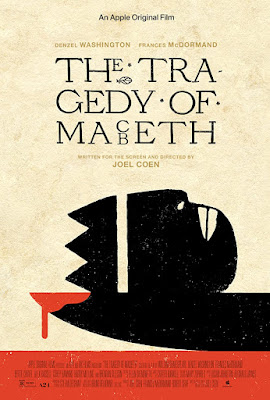
A Tale of Sound and Fury: The Tragedy of Macbeth

The Tragedy of Macbeth, Joel Coen’s first filmmaking venture apart from brother Ethan, owes something to Akira Kurosawa and something to Alfred Hitchcock. Of the many cinematic versions of Shakespeare’s famous tale. Kurosawa’s 1957 Throne of Blood seems the closest match to what Coen has accomplished. The Japanese-language Throne of Blood, freed of the need to grapple with Shakespeare’s challenging but beautiful language, is marked by spare, spooky stylistics. Shot in black & white, it fills the screen with bleak, ominous visuals. The scene of a fog-shrouded “Birnam Wood” slowly creeping toward the new lord’s Spider’s Web Castle is as spectacular as it gets. Calling on Kabuki tradition, Kurosawa alters the familiar tragedy to enhance the bombastic acting style of the classical Japanese stage. But it’s the look of his film that has stayed with me, and clearly with Joel Coen too. (The American Society of Cinematographers has just named this Macbeth one of  5 nominees for this year’s ASC award, along with Dune, Nightmare Alley, Belfast, and The Power of the Dog.)

 As for the Hitchcock influence, let’s simply say that in The Tragedy of Macbeth there will be birds.

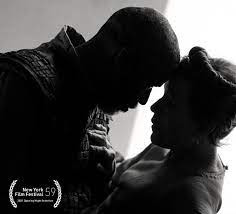
 Visually, Coen strips his Macbeth down to the bare bones: even the unusual aspect-ratio makes for a movie screen—almost square—that hints at long ago and far away. Realism is hardly the point here. Props and set décor are kept to a minimum. Color is bleached out: this is one of several  important 2021 films that stick (as Kurosawa did) to stark black & white. Characters wander through nearly empty halls photographed from often-exotic angles.

 And what about those characters? Commendably, Coen has chosen to be color-blind in his casting, peopling his landscape with actors of different races. The fact that a Black Macbeth (Denzel Washington) is closely allied with a white Lady Macbeth (Coen’s wife Frances McDormand) is never held up for comment. Though the screen is shared by British and American actors, no attempt is made to unify their speech patterns. For this I have some slight misgivings. Though I’ve never been a fan of old Hollywood’s “mid-Atlantic” accent that makes everyone seem vaguely British (see Price, Vincent), I appreciate the vocal precision that the English actors in this cast bring to their roles. McDormand (who can do no wrong in my book) does a magnificent job of articulating her lines while not departing from basic American speech. Alas, I had a harder time with Washington, who sometimes seemed less comfortable in “speaking the speech” while pulling away from the naturalism he brings to present-day American-based stories. 

 I wanted to love Washington’s performance, as many critics have.  But in the play’s key early moments, I couldn’t quite feel the tug-of-war going on in him between Macbeth’s ambition and his fundamental civility. It was only in the later scenes, wherein the newly crowned king lashes out at anyone who stands in the way, that I felt the full force of his portrayal.  McDormand, though, is from the start a forceful Lady McDormand, in love with her husband and his potential for greatness, however he achieves it. There are many fine supporting players, including Brendan Gleeson as King Duncan, Corey Hawkins as a well-spoken Macduff, and Alex Hassell as an enigmatic Ross (whose role is given an extra twist by Coen).  

But many kudos have rightly gone to British stage actress Kathryn Hunter, who uses her voice and a highly flexible body to channel all three of the Weird Sisters who accost Macbeth on that heath. Hers is an otherworldly performance just right for this somber, exhilarating tale.


Friday, March 19, 2021

Nomadland: On the Road Again

At a time of lockdown, the allure of Nomadland seems particularly potent. While many of us are stuck at home, consigned to staying within our own familiar ruts, the characters in this quietly magical film keep on trucking. Partly it’s a matter of economic distress, but mostly it’s a choice: these are people who frankly love the romance of the open road. And the Oscar-nominated cinematography of Joshua James Richards (one of six nominations garnered by Nomadland this past week) captures the landscape of the American west so gorgeously that afterwards I wanted to pack up and set out for Arizona or the South Dakota badlands. Maybe it takes a foreigner like the Beijing-born director Chloé Zhao to teach us to look with new appreciation at our own land.

 But the film is more than a travelogue. Director Zhao has a clear passion for cinéma verité. Here, as in her acclaimed earlier film, The Rider, she incorporates in central roles the people—non-actors—who are really living the tale she wants to tell. This means that such just-plain-folks as Linda May, the charismatic Bob Wells, and the feisty, dauntless Swankie appear as (presumably) the van-dwelling travelers they really are. And the film’s lead actors, including the much-honored Frances McDormand and David Strathairn, pitch their performances to match the everyday rhythms of the non-pros, convincing us that they too are part of this special world.

 For a while, in watching this film, you’ll find yourself expecting some big drama to burst onto the screen. We’re so conditioned to appreciate movies full of blood and guts that we’re waiting for impending disaster: a rapist on the loose, a disastrous accident, a crippling loss. As we eventually discover, the undulations here are so much more subtle than the big crescendos of most Hollywood movies. McDormand’s Fern, whom we first meet as she’s signing in for a shift at an Amazon warehouse, has long since adapted to life on the road. The big events of her time on earth--her leaving the family home, her long marriage, the loss of her husband and of the mining community that once sustained them both—have all occurred long in the past, and she’s made her peace with the lifestyle of a wanderer, traveling the back roads in a rickety old van that doubles as her home. It’s a life that she (mostly) finds emotionally sustaining, full of peripatetic friendships, a variety of odd jobs, and wide open spaces tantalizing in their beauty. So attached is she to this vagabond way of life that she can’t be tempted by a comfy bed in the home of an hospitable friend. No, she’s got to keep shoving on.

 Which is not to say that she’s always happy. Aside from the daily challenges of life on the road, Fern is quietly facing her past and her future. A dying road buddy is a reminder that she won’t always have the capacity to survive on her own.  And, though it takes us a while to fully recognize it, the loss of her husband and of the house they shared for so many years is not something that her chipper attitude toward the world can fully mask. It’s a subtle performance, but one of McDormand’s best, indicative of her ability to disappear into salt-of-the-earth roles that make this extraordinary actress seem wholly average.

 I’ve just discovered McDormand will soon appear as Lady Macbeth, opposite Denzel Washington, in a film directed by her husband, Joel Coen. Macbeth’s blood-thirsty lady is hardly the salt-of-the-earth type, and I can’t wait to see the results.