Tuesday, August 9, 2011

Topkapi: Does Crime Pay?


So D.B. Cooper is back in the news. Forty years ago, a well-dressed man hijacked a Boeing 727, extorted $200, 000 in ransom money, then parachuted into uncharted terrain, never to be seen again. Last week’s newspapers contained fresh speculation as to his true identity, but the mystery of D.B. Cooper remains intact. The question is: why has D.B. Cooper become a folk hero? Why do we cheer for rogues who take what doesn’t belong to them, and get away with it?

For an easy-on-the-brain summer treat, I just saw Topkapi, 1964’s comic gem about a gang of thieves bent on spiriting an emerald-encrusted dagger out of a Turkish museum. Topkapi was directed by Jules Dassin, who in Rififi (1955) had given us a dead-serious take on a jewel heist. Here Dassin is in a more light-hearted mood, reveling in the exotic beauty of Istanbul and in the vivid eccentricities of his actors. These include the smooth-as-silk Maximilian Schell and the plump, dotty Robert Morley, along with Dassin’s own wife, Melina Mercouri of Never on Sunday fame. Her eyes sparkling with mischief, her voice a rusty purr, her laugh (an important plot element) throaty and infectious, she is a creature to love, but not to trust. When the film was released, most kudos went to Peter Ustinov, whose portrayal of a “schmo” with a fear of heights won him an Oscar for Best Supporting Actor. I was also fascinated by Gilles Ségal as an aerialist whose ability to do remarkable things while hanging upside down is the key to the theft.

I won’t spoil the ending, but it strikes me that there are two kinds of heist movies: those in which the rogues make off with their ill-gotten gains and those in which (despite all the planning, all the scheming) the theft goes awry at the very last second. We love heist movies partly because of the ingenuity of their plotting. I think we love them too because, in a world where mediocrity abounds, it’s a pleasure to observe true expertise: the nimble-fingered safecracker, the mechanical genius, the chameleon who can impersonate anyone. And, of course, there’s the lovely fantasy of getting rich the easy way (though it never turns out to be so easy in the end).

Why don’t we resent characters who simply take what they want, instead of struggling like the rest of us working stiffs? Because, secretly, we’d like to do the same. And many heist-type films stack the deck by making the crime seem victimless. We’re not terribly bothered if a bank or a big Vegas casino gets ripped off. In The Sting, the guy who gets fleeced is so despicable that we’re free to regard the con-men played by Newman and Redford as heroes. Sometimes the thieves and con artists appear to be righting a wrong, so that robbing the rich becomes an essentially virtuous act.

I have a soft spot for William Wyler’s sparkling How to Steal a Million, in which Audrey Hepburn must break into a museum to steal a statue her family already owns. Here we don’t need to feel the slightest moral qualm: Hepburn turns thief not to amass riches but rather to save her father’s reputation. How nice that along the way she finds love. This is one film (among many) in which crime definitely does pay, and the audience is the big winner.

Friday, August 5, 2011

Planet of the Apes: How the Monkeys Saved Fox


Rise of the Planet of the Apes is here. Its arrival marks yet one more opportunity for Twentieth Century Fox to cash in on a series that’s been a bonanza since 1968. In that year the original Planet of the Apes became an unexpected Fox hit. Producer Arthur Jacobs was supposed to strike it rich for Fox with Doctor Dolittle, a big-budget musical confection trying to blend the whimsy of Mary Poppins with the wit and post-Victorian elegance of My Fair Lady. Hoping to please the entire family, Fox spent $18 million (a huge sum in those days) on Doctor Dolittle, then advertised it grandiloquently as “Twentieth Century-Fox’s Christmas Present to the World.”

Only one problem: this movie featuring talking animals and singing humans (Rex Harrison among them) was a true Christmas turkey. That didn’t stop it from being nominated for a Best Picture Oscar (along with Guess Who’s Coming to Dinner, In the Heat of the Night, Bonnie and Clyde and The Graduate). Veteran producer Mike Medavoy (Black Swan), upon being reminded that Doctor Dolittle was up for Best Picture in a very strong year, quipped to me that “this tells you a lot” about the way the industry operates. In 1968, Fox’s award-season strategy was both simple and effective. It involved seven plush screenings of the film to accommodate members of Hollywood’s craft branches, each kicking off with champagne or cocktails, and then a buffet supper in the studio commissary.

Nine nominations notwithstanding, Fox made no money on Doctor Dolittle. But the following year, Arthur Jacobs moved from Dolittle’s sausage-cooking chimpanzee to a screenfull of talking apes, and hit the jackpot. The tale of American astronauts stranded on a distant planet where humans are subjugated by gorillas and orangutans struck a nerve in audiences already made anxious by wars, assassinations, and other man-made disasters. The surprise ending had particular impact. Who can forget that half-submerged Statue of Liberty? Writer-producer J. J. Abrams (Lost), when asked about his favorite plot twist of all time, cited the climax of Planet of the Apes, “when you realize, ‘Oh my God, he’s never getting home because that is home.’”

Planet of the Apes was also viewed in the Sixties as an allegorical look at the rising tension between the races. This was hardly intended. In 1968, when Sammy Davis Jr. enthused that Planet of the Apes was the best film he had ever seen about black/white relations, Jacobs had no idea what he was talking about. Davis’s comment was later relayed to Eric Greene, who was then researching his Planet of the Apes as American Myth (1996). Years before, at age five, Greene himself had seen a Planet of the Apes movie, and had quickly become a devotee of the entire series. Greene didn’t understand back then why he was drawn to the Apes films. But as a child of mixed racial heritage he felt a special bond to these stories that so poignantly investigated racial “otherness.”

Planet of the Apes was a movie in which the once-mighty white race had become a subject population. In this dystopian vision of the future, white men are slaves. As for white women, they’re either dead (the female astronaut who never makes it to the planet) or dumb (Linda Hamilton, beautiful but unable to speak).In those circumstances, being a monkey’s uncle—or aunt—sounds pretty good to me.

Monday, August 1, 2011

Michael Cacoyannis and Zorba the Greek: Shall We Dance?


Michael Cacoyannis? Not a name most people know. Zorba the Greek? Mention this title, and I feel like dancing. I suspect I’m not alone.

When I learned last week that Cacoyannis had died at the age of ninety, my thoughts immediately turned to the 1964 film that gave Anthony Quinn his last Oscar nomination. Quinn, the Irish-Mexican actor who grew up in the barrios of East L.A., played characters of many ethnicities, but found his signature role in Alexis Zorba, the part-time handyman/full-time life force who teaches repressed Englishman Alan Bates to celebrate the joy of being alive. On the beaches of Crete, Zorba sounds his barbaric yawp (to use an appropriately Whitmanesque phrase), staving off death, grief, and failure by lifting his arms skyward and dancing out his pagan emotions.

The film, based on the novel by perennial Nobel Prize runner-up Nikos Kazantzakis, was brilliantly filmed by Cacoyannis, who tightened the story, choreographed its dramatic moments for maximum impact, and brought to the screen the austere beauty of Crete’s landscape and its people. A huge international hit, it was nominated for seven Oscars (including best picture) and won three. The big winner that year was My Fair Lady, and the contrast between the glossy Technicolor musical and the small black-and-white art film could not have been more striking. Every young person I knew would have given the nod to Zorba the Greek, which we adopted as a statement of the kind of adult life we all wanted to live. Listen to Zorba summing up the young Englishman’s character: “You’ve got everything except one thing: madness! A man needs a little madness, or else . . . he never dares cut the rope and be free.”

We of the Baby Boom generation, who were quickly approaching adulthood in 1964, yearned to be free. We wanted political freedom, intellectual freedom, sexual freedom. In 1964, some of us were traveling to the Deep South as Freedom Riders, trying to extend the freedom of the voting booth to those who’d been denied it for generations. Many of us would soon be marching in the streets in defiance of the military that was sending young American men to fight and die in Vietnam. The advent of birth control pill was changing the way we viewed our bodies. Not all of us were activists, but at least we could dance. And dance we did. Zorba the Greek launched a national movement that saw folk dance clubs spring up across America. There, to the lilt of bouzouki music—the kind we knew and loved from Mikis Theodorakis’s Zorba the Greek score—we could leap and sway and sweat, dancing out our youthful hopes for the future.

Michael Cacoyannis made films other than Zorba the Greek, fifteen in all. Two years before Zorba, I’d been galvanized by his Greek-language adaptation of Euripides’ classic tragedy, Electra, starring the soulful Irene Papas. It is visually arresting, using silence as powerfully as any movie I know. Cacoyannis was also gutsy enough to bring Greek tragedy to the American screen, by starring Katharine Hepburn, Vanessa Redgrave, Genevieve Bujold, and Papas in The Trojan Women. I remember this as an unsparing rendition of the ancient tragedy, in which the defeated women of Troy lament the loss of their husbands, lovers, and sons. An impeccable film, but not fun to watch: I badly missed the exuberance of Zorba. Today I salute him and Cacoyannis: Opa!

Thursday, July 28, 2011

Remembering Polly Platt: Housewife and Powerhouse


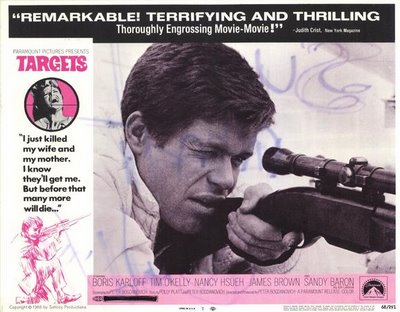
Critic Jason Zinoman recently spoke to Terry Gross of Fresh Air about his new book, Shock Value: How a Few Eccentric Outsiders Gave Us Nightmares, Conquered Hollywood, and Invented Modern Horror. The interview kicked off with discussion of a low-budget 1968 film that helped launch the modern horror genre. This was Targets, which unforgettably pairs the aging Boris Karloff with a sniper holed up at a drive-in movie theatre. Zinoman praised Targets as a Peter Bogdanovich film: Bogdanovich not only wrote and directed, but also plays a version of himself, a young filmmaker trying to persuade horror star Byron Orlock (Karloff) to appear in one last movie. As the producer who had stipulated that Karloff footage from The Terror must be incorporated into the new film, Roger Corman got mentioned too.

But no one said a word about Polly Platt. In 1968, Platt was Bogdanovich’s wife and artistic partner. Though content to stay in the background as Bogdanovich’s star rose, she contributed hugely to Targets, as well as to films before and since. I’ve just learned that Polly, whom I interviewed at length in 2008, has succumbed to the ravages of Lou Gehrig’s disease. It seems time to set the record straight.

Polly Platt and Peter Bogdanovich were young marrieds, passionate about film, when they met Roger Corman in 1961, following a screening of Last Year at Marienbad. As Polly described it to me, “Roger wanted to make money and we wanted to make movies. It was a perfect marriage.” By 1964, the pair were polishing Chuck Griffith’s ungainly script for Corman’s The Wild Angels. While Bogdanovich, as Corman’s all-purpose production assistant, did chores on the Wild Angels set and ended up directing second unit, Platt designed the costumes and served as stunt double for female lead Nancy Sinatra. She also played supportive spouse. A friend from those days remembers Bogdanovich’s near-total dependence on her: “Polly, what do I want for breakfast?”

On Corman’s Voyage to the Planet of Prehistoric Women, a Russian-made sci-fi film with added footage featuring Mamie Van Doren as a mermaid, Peter directed the new material under a pseudonym, while Polly was the very novice production coordinator. Then came Targets. The germ of the story was Polly’s realization that for Baby Boomers true horror was represented by President Kennedy’s sudden death.. She told me, “I had this terrible fear that some day I would open the front door of our house on Saticoy Street and somebody would just shoot me for no reason. Or that someone would drive by with a rifle and shoot Peter in bed, “ By then the mother of a young daughter, she carved out time to contribute to Targets’ script as well as its production design.

In 1971, she had an equally hands-on role in Bogdanovich’s break-through film, The Last Picture Show. But she suffered tremendous emotional pain when, during production, he left her for the film’s ingénue, Cybill Shepherd. A true survivor, Polly went on to a successful mainstream career as a costume designer, Oscar-nominated production designer, and producer of such hits as Broadcast News and Say Anything. . . . One of her final projects was Corman's World: Exploits of a Hollywood Rebel. She graciously served as executive producer for this film tribute to the mentor who made it all happen, for better and for worse.


Monday, July 25, 2011

The Fantastic Four: Revenge of the Invisible Film


With the triumphant arrival of Captain America, another comic-book superhero has made his mark at the movies. Frankly, I’ve not enough of a comic-book geek to fully appreciate films like this one. When I was Roger Corman’s story editor at Concorde-New Horizons, his wife Julie often spoke of filming Spiderman, for which the Cormans briefly held the rights. Julie had me read treatments for a Spiderman movie, but I had a hard time imagining how we’d come up with special effects that were anything but laughable. Spiderman, I learned, slings webs and shimmies up the sides of buildings. On a budget of $1 million (or less, much less), it would be hard to avoid looking cheesy.

But in late 1992, I found myself working on The Fantastic Four. The Only-in-Hollywood story has often been told: how Bernd Eichinger, of the Munich-based Neue Constantin, owned the movie rights to this Marvel Comics series about four colleagues who gain eccentric superpowers (like invisibility and the tendency to burst into flame) after being struck by cosmic rays during a space mission. Eichinger envisioned a lavish Hollywood epic, costing $40 million or so, but time was running out. Unless he started shooting by the end of 1992, the rights were no longer his. Enter Roger Corman, who was kicking himself for having missed the chance to buy the Teenage Mutant Ninja Turtles franchise. A deal was made for a fast and cheap co-production. Stan Lee came aboard as creative consultant, making sure we stuck to every detail of the original storyline, and my Concorde colleagues set to work on characters they had loved since childhood.

Holiday plans were scrapped, and the film went before the cameras on December 28, 1992. For director Oley Sassone and his no-name cast, this was a labor of love. They did their best, in a pre-CGI era, to replicate such superpowers as team leader Reed Richards’ impossibly stretchy limbs. And they reached into their own pockets to help bankroll a publicity effort that took them to comic book stores and fanboy conventions around the country. There was a big unveiling of the film’s trailer at L.A.’s Shrine Auditorium on July 11, 1993. Plans were also made for two celebrity galas when the film debuted in early 1994, raising money on behalf of critically ill children.

Then in December 1993, exactly one year after filming began, came word that Eichinger had just paid big bucks for Roger’s share of The Fantastic Four. He promptly shelved the finished movie, which allowed him to proceed with a major studio version that ultimately appeared in 2005. One of many disheartened by this turn of events was the director of the Children’s Miracle Network, which had just lost out on its gala charity premiere. Her wry comment: “If they were going to throw $2 million at a movie that will never be seen, I wish they would have thrown it our way.” Actors and crew members were equally crushed. There’s a bit of sweet revenge in the fact that the officially non-existent movie survives everywhere in bootleg copies, treasured by fans for its sincere, if threadbare, loyalty to its source material.

Hollywood insiders debate whether Roger Corman knew while the film was being made that it would never be released. He claims he’s not that conniving. But, being Roger, he focuses on the bottom line: “I was disappointed that we didn’t get a chance to release it, but I was also happy to make a whole lot of money off it.”

(Here's an essential link for Fantastic Four enthusiasts, sent my way by the screenplay's author, Craig Nevius. Thanks, Craig!)

Friday, July 22, 2011

The Big Parade: A War Film to End All War Films?


The other night, I treated myself to a screening at the Academy of Motion Picture Arts and Sciences. Right now the Academy is featuring silent films, and as always it is generous in giving patrons their money’s worth. The evening kicked off with a real rarity, the family comedy short “Brownie’s Little Venus,” starring a moppet called Baby Peggy and an extraordinarily well-trained pooch. (Baby Peggy, now known as Diana Serra Cary, was in attendance: she’s over ninety, still charming, still feisty. Brownie, alas, has gone to that big dog house in the sky.)

But it was the main attraction I was there to see. The Big Parade (1925) is King Vidor’s take on the War to End All Wars. It was introduced by silent film historian Kevin Brownlow, who told us that the war movie clichés we know all too well were brand-new ideas when The Big Parade was shot. I believe he was talking about the comrades-in-arms whose differences in social background don’t keep them from bonding; the dramatic shots of long columns of marching men; the brief moment of communion between two soldiers on opposite sides of the fray; a GI desperately searching for the buddy who’s beyond help.

Though The Big Parade is saddled with a romantic story that makes for a sappy ending, I found its battlefield scenes remarkably fresh. What surprised me most of all was the film’s fundamentally anti-war attitude. Less than a decade after the American side emerged victorious over Germany and its allies, Vidor’s cast brings home to the viewer the horrors of armed conflict. True, in the film’s early scenes, the United States’ entry into World War I is treated as an exciting adventure. Leading man John Gilbert starts out as an idle rich boy who enlists because his fiancée thinks he’ll look handsome in a uniform, and because a patriotic parade down Main Street stirs his blood. But the film’s second half makes clear that war means dirt and pain and death. For me, Gilbert’s most memorable speech comes in the thick of battle, when he says (on title-cards, of course), “What the hell do we get out of this war anyway! Cheers when we left and when we get back! But who the hell cares . . . after this?

I found this approach striking because Hollywood’s later World War II films (such as Sands of Iwo Jima) were traditionally dominated by actors like John Wayne, men who made self-sacrifice in battle seem glorious. Though Wayne himself never served in the military, his brand of on-screen patriotism made a deep impression on the men of his era, and on their sons too. A young man named Ron from Massapequa, New York grew up at the movies, watching war films and sobbing when the Marine Hymn came on the soundtrack. Later he wrote, “I loved the song so much, and every time I heard it I would think of John Wayne and the brave men who raised the flag on Iwo Jima that day.” Ron's passion for Wayne helped propel him into the Marine Corps right out high school, in 1964. That’s when Ron Kovic discovered that war is not beautiful. He returned from Vietnam paralyzed from the chest down, and later wrote, “I gave my dead dick for John Wayne . . . .”

Ron Kovic's memoir, a powerful one, is called Born on the Fourth of July. In 1989, it was made into a movie.

Tuesday, July 19, 2011

Warwick Davis: Standing Tall in "Harry Potter and the Deathly Hallows"


So—Harry Potter mania is upon us again. In Harry Potter and the Deathly Hallows: Part II, a pantheon of English actors take their final bows as characters in J.K. Rowling’s wizarding world. This seems a fitting time to salute one British thespian who puts a distinctive twist on the old saw that there are no small parts, just small actors. Warwick Davis may stand a mere 3 ½ feet tall, but he’s no small actor in my book. He’s probably unique among the Harry Potter cast in that he plays, with aplomb, two very different roles: the plucky Professor Flitwick (definitely one of the good guys) and the conniving goblin Griphook (indisputably one of the bad).

I interviewed Warwick Davis while working on Ron Howard: From Mayberry to the Moon . . . and Beyond. We spoke by phone, and I couldn’t help being surprised by his rich baritone voice. But he was hardly a baritone when he got his first role. Purely by chance, his grandmother heard a commercial seeking people under four feet tall to play the furry Ewoks in Return of the Jedi. Warwick was eleven years old, and stood a mere three feet eleven. George Lucas cast him on the spot, then quickly noticed that the tiniest Ewok was imbuing his role with some character. Unexpectedly, his time in drama class was paying off. Warwick explained to me, “Because I was a very outgoing and social sort of child, my mum felt that quite a good way of channeling all this energy was to send me to a drama group. It really wasn’t because she felt I would have a career in acting. It was just something for me to do on a Saturday morning.”

Another stroke of luck: the actor set to play a scene with Princess Leia contracted food poisoning. Young Warwick took over, and earned the character name of Wicket the Ewok. Some years later, Lucas hired rising director Ron Howard to helm a sword-and-sorcery epic, Willow, and Warwick nabbed the title role. Aside from the challenge of starring in an action film, he was faced with the fact that, at seventeen, “I was going to be playing the father of two children, a man of the world. And of course I’d never even lifted a baby, let alone had the experience of being a father at that point.” Ron Howard (whose own wife Cheryl was about to give birth to their fourth child) prepared Warwick to interact—as the plot required—with a full-sized baby by scheduling two weeks in which “they had the mothers bringing these children in. I would just rehearse holding them and carrying them and feeding them and changing their diapers.” By the end of the shoot he felt ready for fatherhood, though it took several decades to get that joyful opportunity.

Since then, Warwick has played the creepy title character in the Leprechaun films, a wacky android in A Hitchhiker’s Guide to the Galaxy, and the treacherous Black Dwarf in The Chronicles of Narnia. For most roles, he’s resigned to spending long hours in the makeup chair. He’s not bothered that he rarely gets to portray a regular guy in a regular situation: “I’m an actor, and creating characters is what I do, and often these strange creatures are actually more challenging and interesting to create as an actor.” Still, Ricky Gervais has written him a new sitcom, Life’s Too Short, in which he’ll be able to play—for a change—a version of himself.

An update: Here's a great review of the new series. Looks like Warwick's got himself a hit!