Thursday, April 7, 2022

“A Foreign Affair”: Billy Wilder 's Bittersweet Take on Post-War Germany

My Billy Wilder journey continues, as I work my way through Joe McBride's comprehensive Billy Wilder: Dancing on the Edge. This week I saw one of Wilder’s more unheralded triumphs, the 1948 A Foreign Affair. This dark romantic comedy stands out partly because of where it was filmed: in the rubble of Berlin, following the end of World War II. (At the close of his wartime service in the U.S. Army, Wilder was promised government assistance if he shot a movie in occupied Deutschland, thus giving a boost to the ruined German economy as well as to the revival of the German film industry.) A Foreign Affair deals, sometimes sardonically, with the Allies’ efforts to rebuild the devastated German capital. But its primary subject is, as always with Wilder, the vagaries of the human heart. Though Nazis, and their collaborators, are hardly looked on with favor in the course of the film, the occupying American army does not escape unscathed. And a visiting American congressional delegation on a fact-finding tour is treated with all the satirical thrust that Wilder can muster.

Jean Arthur came out of retirement to play Phoebe Frost, a strait-laced Iowa congresswoman bent on improving the morale of the occupying U.S. troops. When she strays from the official tour, she’s alarmed to find that young American servicemen, mistaking her for a blonde fraulein, are eager to canoodle. She’s also appalled when she observes that locals (especially attractive young women) are more than happy to bestow their favors on Americans who can provide them with chocolate bars and nylon stockings. Pretending to be a giggly German maedchen, she goes along with two G.I. Joes to a seedy local club. That’s where she frowns with disapproval on a nightclub singer, Erika von Schlütow, played by Marlene Dietrich with her usual potent mix of glamour and irony.

Though Dietrich herself was known for her unrelenting opposition to Hitler and his thugs, her character in this film represents the German citizens who will do whatever it takes to get by. That’s why, although she’s embroiled in a powerful (and possibly sado-masochistic) relationship with an American officer, John Lund’s Captain Pringle, there’s also a Nazi higher-up lurking in her past. The film’s most striking moments involve her encounters with Congresswoman Frost, who in an ironic turnabout must look to Erika to save her from public humiliation, not to mention  legal jeopardy. Connecting the two women is Captain Pringle, who is not above taking on romance as part of his military duties.

 Looking back on Wilder’s life, as McBride does so effectively, it’s rather startling to see him focusing on the post-war neediness of the German populace. Wilder, a Jewish man who grew up in Vienna and began his filmmaking career in Berlin, was never able to save his own mother and other relatives from the Nazi death camps. Needless to say, he had no great love for the German hierarchy that led the country into war. And his life in the United States, from 1933 onward, paved the way for fame and fortune in his adopted land. Still, unlike Congresswoman Phoebe Frost, he cannot view the German people as undeserving of sympathy.  Scrounging for food and small luxury items (as well as the occasional moment of fun) in their bombed-out city, they awaken his compassion. And it’s in keeping with his mordant temperament that he resists simple delineations of right and wrong. So A Foreign Affair offers up not (as per its poster) hilarious comedy, but rather food for thought, which is far more nourishing than a chocolate bar.

 Joe McBride, the man himself, adds to this post with some important info for cinéastes:"Did you know I did the audio commentary on the recent Kino Lorber Blu-ray edition?For a long time the film was MIA in home video." He adds the all-important Amazon link: https://www.amazon.com/Foreign-Affair-Blu-ray-Jean-Arthur/dp/B07SNNNMQ7


Tuesday, April 5, 2022

Now You See Him: The Many Faces of Roger Corman

Not long ago, I found myself watching Ron Howard’s spectacular Apollo 13 on a big-screen TV. As the tense drama unfolded, I spotted several members of the Howard family. These included brother Clint as a quirky engineer in the NASA control room and father Rance as a minister on hand to comfort Jim Lovell’s kinfolk during the patriarch’s perilous return to earth. After a round of tough auditions, Howard gave in to his father’s lobbying efforts and cast his own mother, Jean, in the small but showy role of Lovell’s grandmother, who has absolute faith that “if they could get a washing machine to fly, my Jimmy could land it.” I wasn’t surprised to see all these Howards: though Ron is no pushover when it comes to casting, he enjoys working with members of his family. But I was momentarily surprised at an early scene where, among a congressional delegation touring a NASA facility, I spotted my former boss. Yes, Roger Corman.

 Roger ‘s role, that of a congressman grilling NASA reps about cost containment, is a knowing nod to the Corman reputation as a penny-pincher. The part gave Howard an opportunity to salute the man who’d made him a film director. There’s a long tradition of Corman alumni giving cameo roles to their former boss. It’s a tradition that had previously been sidestepped by Howard, who didn’t think much of Roger’s acting chops. But fellow director Jonathan Demme—who’d used Roger in both The Silence of the Lambs (as the head of the FBI) and Philadelphia (as a crafty businessman) convinced him that Roger’s dramatic skills had vastly improved. Hence his tiny but effective role in what may be Howard’s very best film.

 The first Cormanite to hire his former boss as an actor was Francis Ford Coppola, who cast him in The Godfather Part II as a U.S. Senator on a high-profile panel investigating organized crime.. Coppola had observed that politicians, when in front of news cameras, came off as intelligent and dignified, but also slightly self-conscious. This description fit Roger perfectly.

 Director Joe Dante has joked to me that part of the pleasure of using Corman in a cameo role is paying him the minimum wage allowable by the Screen Actors Guild: “Everybody wanted Roger to work for them for nothing, because we all worked for him for nothing.” When Dante made his own first post-Corman film, the highly successful The Howling ,he asked his old mentor to do a walk-on in a barroom scene. It was Corman’s idea, enthusiastically adopted by Dante, that he spoof his cheapskate image on camera by checking a pay telephone’s coin-return slot for loose change. Most Corman cameos, however, take advantage of his naturally authoritative presence, as Demme did when making him the FBI chief, with his photo beaming down from office walls.

 In 2011, though, a very different Roger appeared in a spoofy TV movie. Here’s how I once described his scene in Sharktopus: “Fade in on a pristine stretch of tropical shore, where we spot an old codger with his shirt unbuttoned halfway down his chest. Sauntering along, he ogles a bikini-clad lovely who has just bent down to dig up a rare coin. When a tentacled sea-beast unexpectedly looms, dragging the shrieking beauty into the surf, he reacts with mild surprise. Then, shrugging off the carnage, he makes a beeline for the coin she’s dropped in the sand. The scene ends on his self-satisfied grin.” Roger had fun playing that greedy beach bum. And on his 96th birthday I wish him lots more fun in the years ahead.


Friday, April 1, 2022

The Eyes of Tammy Faye Are Upon You

The Eyes of Tammy Faye, the film that just won Jessica Chastain a best-actress Oscar after two previous nominations, opens with a short close-up scene in which a cosmetologist, apparently trying to give the televangelist a new look, asks her to wipe away the mascara and lip-liner that have turned her middle-aged face into that of a glamorous gorgon.  She wipes—and nothing much happens. It seems most of that makeup is tattooed in place, or as she says, “permanent.” As she emphasizes, coyly, looking straight into the camera, “This is who I am.”

 The scene resonates because by the end of the film she’s re-assuring adoring TV audiences that “God loves you, just the way you are.” The irony, of course, is that Tammy Faye Bakker has—throughout the course of this movie—continually undergone physical change. Starting out as a perky but wholesome brunette who meets her future husband at a Bible college, she quickly metamorphoses into a platinum blonde and then a redhead. Her demure bob changes, over the decades, into a flip, then a cascade of curls, then a bouffant coif. God may love her as she is, but she herself has seemed much too restless to be satisfied with her appearance. Is she trying to please God? Her husband? Herself? The movie doesn’t venture a guess, but it’s worth some conjecture on the part of the audience.

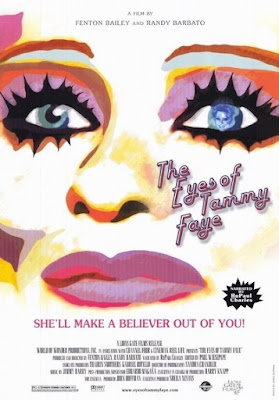
 There’s one thing about Tammy Faye, though, that remains consistent throughout the film: the basic innocence of her nature. She seems to be someone who truly basks in the glow of God’s love. Not for her the secret cynicism and the overt ethical lapses of her husband, played with smarmy intensity by the ubiquitous Andrew Garfield (so good as a striving young musical theatre guy in tick, tick . . . BOOM!) Much of Tammy Faye’s posthumous legend has evolved out of the gratitude of the gay community because she had embraced AIDS victims in a way that no other evangelical would even consider doing. Chastain—who earned her Oscar because, despite all of her character’s physical permutations, she managed to hold onto the purity of Tammy Faye’s spirit—alluded in her acceptance speech to this all-embracing love.

 I was impressed by Chastain’s deeply felt performance, which hardly means that I loved this movie. As I was watching it, the film that came to mind was another flamboyant but true story, that of Patrizia Reggiani, played by Lady Gaga, who plots the murder of her fashion tycoon husband in House of Gucci. Milan’s high-fashion circles would seem to have little in common with the evangelical world generally linked to the American South, but both are over-the-top environments prone to heightened emotions, dark deeds, outrageous clothing, and strained accents. In both films we leap rather breathlessly from place to place and from era to era, seeing how characters evolve from appealing to appalling. At one point Patrizia and Tammy Faye even show up in similar all-white winter outfits, complete with poufy, furry hats. You’d think maybe they were sisters under the skin.

 But though I found I had little patience for either film, I cannot equate Tammy Faye with the eager, ambitious Reggiani. Lady Gaga was fun to watch for a while, but her greed was ultimately a turn-off. Not so, Tammy Faye, whose final triumphant scene, belting out “The Battle Hymn of the Republic” in front of a mesmerized Christian audience, seems earned. Despite the clown makeup, I find I have new respect for someone who had always seemed to me the butt of a bad joke.

Poster for the 2000 documentary, made by two gay filmmakers, that influenced the current film