Showing posts with label Bette Davis. Show all posts

Tuesday, April 28, 2026

Baby Jane Grows Up

Well, none of us is getting any younger. And Hollywood actresses, who’ve always relied on youth and beauty to fuel their careers, know better than most that ageing is tantamount to career suicide. Ten years ago, Amy Schumer went so far as to join with gal pals Tina Fey, Julia Louis-Dreyfus, and Patricia Arquette in a darkly comic video short, all of them desperate to stave off the approach of their so-called “Last F**kable Day.”    

 But things were perhaps even worse in Old Hollywood. When Audrey Hepburn, still under 30, was romantically paired with fifty-six-year-old Gary Cooper in 1957’s Love in the Afternoon, this confirmed the basic Tinseltown understanding that—for women, at least—the freshness of youth was everything. As for those talented actresses who weren’t as young as they used to be, they had to accept that they were now considered by studio honchos to be damaged goods. And so it happened that two of the Golden Age’s most revered stars suddenly had to accept lesser projects to fill up their dance cards.

 Bette Davis, who arrived in Hollywood in 1930, had some rough years before she triumphed in the powerful role of a slatternly waitress in a screen adaptation of Somerset Maugham’s Of Human Bondage: it led to a unique write-in Oscar nomination. Thereafter she made her mark in a series of historical and romantic dramas, including Jezebel (1938); Dark Victory (1939); Now, Voyager (1942); and the wonderful All About Eve (1950): she ultimately won the Best Actress Oscar twice, and was officially nominated a record ten times.  For years she was Warner Bros.’ most bankable star, specializing in bold, uncompromising portrayals of strong women.

 Joan Crawford, started out as a Broadway dancer, then in 1925 was signed to a contract at classy MGM, where she first specialized in playing flappers and then working girls who made good. Depression audiences loved her, and she was a marvelous hussy in The Women (1939), but eventually she wore out her welcome at MGM and moved to Warners in 1943. The noirish Mildred Pierce (1945) revived her career and won her an Oscar, but sharing the Warners lot with Queen Bee Bette Davis was a challenge.

 By 1962, Davis and Crawford (both in their fifties) found their careers had essentially dried up. That’s when someone got the bright idea of pairing these two fading stars in a Grand Guignol-style horror movie, What Ever Happened to Baby Jane? Their fabled real-life feud made audiences run to see them play two sisters who were once stars of the silver screen and now live together in a mansion where bad things happen. Someone has said that on film Davis is the quintessential sadist and Crawford (with her tremulous expressions) the quintessential masochist. In this film, so it plays out. Davis’s character, once the golden-haired kiddie star Baby Jane, is a drunk with a skewed view of reality. Crawford plays her sister, formerly a leading lady but now confined to a wheelchair after a mysterious accident that is explained (in a way that thoroughly baffled me) at the end of the film. Both are essentially grotesque, but Baby Jane revived their popularity, and Davis (though not Crawford) thereby racked up one more Oscar nom.

 Sad, though, that two fifty-year-old actresses needed to stoop to such trashy material. Happily, at least one great actress today still has her pick of roles. Everywhere I turn, I see photos of Meryl Streep, at 77, looking devastatingly glamorous in ads for The Devil Wears Prada 2.  Yes, she plays a sort of villain, but a gorgeous one.


Tuesday, November 5, 2024

Why It Happened One Night (at the Biltmore Hotel in 1935)

It’s rare that a comedy wins the Oscar for Best Picture. You wouldn’t think a slight romantic farce about a runaway heiress and a down-and-out newspaperman would stand a chance. Oscars usually go to intensely dramatic films, especially those linked to major historical events like the Civil War (see Gone With the Wind), World War II (see Patton, The Bridge on the River Kwai, From Here to Eternity), and Vietnam (The Deer Hunter, Platoon). Social problem movies like Gentleman’s Agreement and 12 Years a Slave also make for Oscar bait.

 But in 1935 the five top Oscar categories (Best Picture, Best Director, Best Actor, Best Actress, Best Adapted Screenplay) were filled by a quickly-made little picture called It Happened One Night. It wasn’t expected to be a hit. Robert Riskin’s script was turned down by many stars. Claudette Colbert, no fan of director Frank Capra, demanded that she receive twice her usual salary (that is to say $50,000) to play Ellie Andrews, and that shooting be finished in four weeks so she could go on a planned vacation. Male lead Clark Gable also had his doubts about the project. Fortunately, the film was a simple one to shoot (entirely on the Columbia lot and in the L.A. area), and interaction between Colbert and Gable turned out to be comedy gold.

 To understand the accolades for It Happened One Night, it helps to look back on the Oscar ceremony for 1935, only the seventh time that the golden statuettes were presented to Hollywood’s finest. The stars and the moguls gathered in the ballroom of L.A.’s Biltmore Hotel to fête the winners. No fewer than 13 nominees vied for best picture. I’ll name a few: Flirtation Walk (starring Ruby Keeler and Dick Powell in a romantic film about West Point cadets),The Gay Divorcee (an Astaire/Rogers musical), The Thin Man (first in a long series of comic  mysteries), Viva Villa1 (a much-fictionalized biography of the Mexican revolutionary starring Wallace Beery). The ultra-serious prestige picture as top vote-getter was something Hollywood had clearly not yet discovered.

 Frank Capra competed with only two other directors: Victor Schertzinger for One Night of Love and W.S. Van Dyke for The Thin Man. Clark Gable, who beautifully played a raffish reporter in It Happened One Night (and changed men’s sartorial habits overnight when he took off his shirt and revealed a bare chest), vied only with the always amusing William Powell (The Thin Man) and Frank Morgan, playing an Italian duke in The Affairs of Cellini. Colbert, as the headstrong heiress, had more competition: opera star Grace Moore for One Night of Love and Norma Shearer, playing the frail Elizabeth Barrett Browning in The Barretts of Wimpole Street, along with a popular write-in candidate, Bette Davis as a slatternly waitress in Of Human Bondage. Colbert, who disliked her own film, was so sure she would lose that when the winner was announced she was boarding a train for a cross-country trip. Studio chief Harry Cohn immediately dispatched an underling to drag her off her train so she could appear at the ceremony. Though Colbert was quite cranky about the whole production experience, she’s delightful as the petulant Ellie—and it’s worth noting that she starred in three other films that same year, including two additional Best Picture nominees, the epic Cleopatra and the socially-conscious Imitation of Life. So maybe she really did need a vacation.

  Why the film’s popularity? It’s fun, it’s fresh, and it comically addresses the  inequities of the Depression era, with the common folk coming out on top. What’s not to love?


Friday, June 23, 2023

The Eyes Have It: Bette Davis in “Dark Victory”

In 1974, two music industry veterans wrote a song called “Bette Davis Eyes.” Nine years later, the tune became a major hit for Kim Carnes, and the 73-year-old diva wrote a letter thanking everyone involved for making her “a part of  modern times.”  (She also noted that the song had won her new respect from her grandson.) Davis’s prominent eyes were indeed distinctive. When she was at the  height of her filmmaking powers, young movie fan (and future novelist) James Baldwin overcame his sense of his own ugliness when he recognized that he too had “Bette Davis eyes.”

 Which makes it all the more striking that “Dark Victory,” one of Davis’s most major screen triumphs, is about a woman who’s going blind. To be clear, she spends most of the movie with her sight intact, but the threat of blindness hangs over her throughout. What’s the problem? It’s one of those mysterious movie diseases that I suspect never show up in any medical textbook, but there’s a brain tumor involved somehow. Davis’s Judith Traherne is a socialite, headstrong and bold, who suffers a serious riding accident when her vision suddenly fails her as she tries to urge her horse over a fence. Despite her initial defiant resistance, she allows surgeon Frederick Steele to operate, and all seems well. But in fact the tumor remains present, and medical experts agree that she’ll soon succumb to blindness and die almost instantly thereafter.    

 The bulk of the film is devoted to various characters’ attempts to conceal from one another the fatal prognosis.  Out of love, Dr. Steele hides from Judy the deadly truth. Of course she discovers what’s going on, and tries to resist Steele’s marriage proposal, assuming it’s an act of pity. To me, one of the film’s most dramatic moments is the use of a match struck to light a cigarette:  Judy’s sudden awkwardness tells us that she’s experiencing double vision, a symptom of her neurological problem. But I also loved the late section of the film in which Judy—usually as tough and egocentric as only Bette Davis can be—is blissfully in love, reveling in a modest domestic life far from her previous haunts. In this part of the story she seems physically transformed, and her gaiety is infectious. But then, of course, life comes crashing in on her, leading to a heroic but weepy conclusion.

 Warner Bros. released Dark Victory (a stage hit for Tallulah Bankhead) in 1939, a year that’s often touted as the greatest in Hollywood history. Davis’s Oscar-nominated performance was upstaged by Vivian Leigh in Gone With the Wind, and other big films included Goodbye, Mr. Chips, Mr. Smith Goes to Washington, Ninotchka, and The Wizard of Oz. Though Dark Victory won no prizes, Davis has called it her favorite performance. Co-starring with her was George Brent, a reliable but (to me) somewhat stolid actor who played alongside Davis in multiple films and was involved with her in a tumultuous two-year affair. But I was more intrigued by two featured players. None other than Humphrey Bogart plays Davis’s stablemaster, Michael O’Leary. He wrestles with an Irish accent but aces a scene in which he reveals his unrequited love for her. (I’m told there was once a final scene of him weeping after Judy’s demise, but test audiences would have none of that.) 

 Also aboard is a future U.S. president. Yes, Ronald Reagan is featured as a wealthy playboy He’s always around in the party scenes and apparently has a yen for Judy but knows that a serious-minded swain like Dr. Steele is more her type.


Tuesday, December 7, 2021

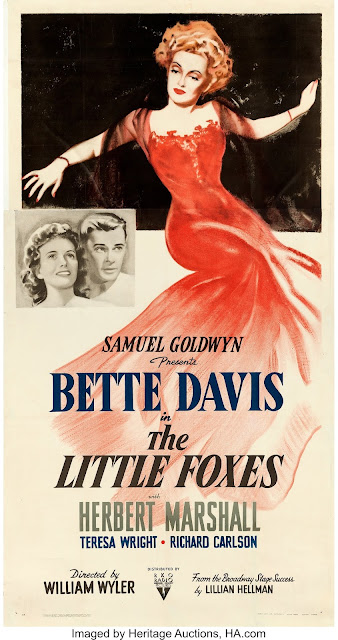
A Little Look at “The Little Foxes”

 It may be because of The Little Foxes that, after the screen mega-triumph of The Graduate, director Mike Nichols never again worked with the film’s breakout star, Dustin Hoffman. Lawrence Turman, who produced The Graduate, has a faint recollection of the moment when Nichols and Hoffman parted ways. It seems that once The Graduate was complete, Nichols signed on to direct an all-star revival of the Lillian Hellman drama at Lincoln Center. In the leading role--that of a scheming woman determined to make a financial killing at her brothers’ expense—would be Mrs. Robinson herself, Anne Bancroft. Others in the cast included Margaret Leighton, E.G. Marshall, and George C. Scott. The production, enthusiastically received, soon moved to Broadway, racking up over 100 performances. If Larry Turman’s memory is correct, Dustin Hoffman was asked to take part, but turned down the opportunity. Turman mused to me that Nichols, despite a tough exterior, could sometimes be intensely vulnerable. So the turn-down by Hoffman “might have engendered Mike’s frustration, anger, hostility, who knows what.”

 That’s pure speculation, of course. But we know that Lillian Hellman’s The Little Foxes has been a stage perennial since it debuted on Broadway in 1939, headed by Tallulah Bankhead.  There’ve been five Broadway productions in all, the last in 2017, with Laura Linney and Cynthia Nixon alternating in the roles of the cold-blooded Regina Giddens and her fragile sister-in-law, Birdie Hubbard. When the play was transformed into a film in 1941, most of the Broadway cast held onto their roles. But film director William Wyler decided that the star of two of his earlier film triumphs should anchor the movie. So Bette Davis, a great admirer of Bankhead’s stage performance, wrestled with ways to make the role her own. Though Bankhead had hinted that Regina was a victim as well as a villain, Davis went for the jugular. It was apparently her idea (decried by Wyler) to coat her face in white powder to give her character a spectral, almost Kabuki-like, look. The result: a woman you love to hate.

 Seeing the film for the first time, I was delighted by its old-fashioned craftsmanship. Having recently suffered through some arty contemporary dramas in which you’re never quite sure who’s doing what or why, I appreciated the solidity of the film’s sets and performances. The Little Foxes, which reflexes the grotesque money-grubbing in Hellman’s childhood home, takes place in a small Southern town where everyone is always impeccably dressed and groomed. The screen adaptation (by Hellman herself, with some Dorothy Parker additions), is highly literate, and does a good job of breaking free of the gussied-up parlor that’s the play’s single setting. Instead we see something of the town, something of Regina’s shady veranda, something of the train that takes daughter Alexandra to fetch her father home as a way to serve Regina’s devious purposes. As for the cinematography, suffice it to say that the camera team was led by Gregg Toland, who shot Citizen Kane.

 Though the film is definitely a period piece, made 80 years ago to reflect small-town life at the start of the 20th century, some aspects of it still seem current. Near the very end, when Regina has conclusively one-upped the smarter of her two brothers, he bears no grudge. Instead Charles Dingle as Ben Hubbard essentially congratulates Regina, saying, “The world's open for people like you and me. There's thousands of us all over the world. We'll own the country some day. They won't try to stop us. We'll get along.” I wish those words didn’t sound quite so contemporary.

Tuesday, March 9, 2021

Mother Knows Best?: “Now, Voyager” and “Miss Juneteenth”

 In Now, Voyager, Bette Davis is displayed like a rare jewel. Dressed in sleek Orry-Kelly suits, fabulous face-framing hats, and shimmering evening gowns, she radiates sophisticated charm. But when we first meet her in this classic 1942 melodrama, she’s a dowdy spinster, wearing a drab housedress, thick glasses and a frightened look. She’s in this frumpy state because she’s in thrall to her dowager mother, a ferocious old tyrant played by Gladys Cooper. Mrs. Henry Vale, of the Boston Vales, is a wealthy, imperious snob, one who takes pride in the family’s lineage and feels there are few outsiders who can equal it. Daughter Charlotte (Davis’s character) is her late-in-life child, cursed with the obligation to be her mother’s companion and caregiver. For her efforts, she is constantly belittled, made to feel she’ll never measure up to the standards that previous Vales have set.

 Thankfully, a kindly psychiatrist sympathetic to Charlotte’s plight helps spring her from this house of horrors and convinces her of her own worth. She cultivates a sense of style and, on a “recuperative” South American cruise, discovers she’s capable of loving and being loved. Eventually, though, she must return to her mother’s house, where Mama expects her to fit back in to her old life. (There’s a bit of a twist at the ending, but let’s not spoil things.)

 I thought of Now, Voyager after having watched the 2020 Sundance hit, Miss Juneteenth. At first glance, the two flicks couldn’t be more different. Though Now, Voyager is set among Boston Brahmins, Miss Juneteenth takes place in a suburb of Fort Worth, Texas, where young African American girls vie to win the title of Miss Juneteenth, an honor that comes with a college scholarship and a full load of expectations. Turquoise Jones won the pageant in 2004, on the strength of her natural beauty, her smarts, and a dramatic reading of Maya Angelou’s poem, “Phenomenal Women.” Now she wants her daughter, 15-year-old Kai, to follow in her footsteps, even to the extent of reciting the very same inspirational poem. Kai, needless to say, is not exactly enthused. Both films, then, depict mothers pressuring their daughters to live up to their expectations, and to accept maternal standards as their own.

 Big difference, though: Miss Juneteenth is far less about a daughter’s muted rebellion than about why Mama is so desperate to lay down the law. Yes, Turquoise won that competition in 2004, but she has not gone on to the worldly success that the judges had predicted for her. Her future was derailed by love, and by an early-arriving baby. No, as a single parent, she works two jobs, as the manager of a local bar and as the cosmetician making up stiffs at the local black mortuary, so that her daughter can have a bright future of her own. Given her thwarted expectations, it’s no surprise that Turquoise dreams of better for Kai. Her determination that her little girl succeed at all cost, though, threatens to derail what has always been a close mother/daughter bond.

 In the Disney Princess version of this story, Kai would certainly be crowned Miss Juneteenth. (The title refers to the historic day -- June 19, 1865 – when news of Lincoln’s 1863 Emancipation Proclamation finally reached the state of Texas.) In this appealing indie, Kai makes her mother proud while essentially striking out on her own. But the movie belongs to Turquoise who, in its final moments, is finally on track to finding her own adult success. She’s not exactly the glamorous Bette Davis, but she too is reaching for the stars.


Friday, May 5, 2017

A Post-Feud Bette Davis Goes Skyward


The enthusiasm with which TV audiences and critics have greeted Feud, and its unfurling saga about the making of Whatever Happened to Baby Jane?, proves that megawatt stars like Bette Davis and Joan Crawford never fall completely out of fashion. The opportunity to see Susan Sarandon and Jessica Lange go toe to toe as legends of the past is something to be cherished. All this excitement reminded me of a little-known episode in Davis’s great career. In 1980, some eighteen years after the filming of Baby Jane,  Davis signed on to star in one of fledgling director Ron Howard’s first movies for television. 

Howard, who had made his directorial debut with a 1977 Roger Corman car-chase flick, Grand Theft Auto, tried to further his career with a series of modest movies for television. Cotton Candy (1978) and Through the Magic Pyramid (eventually released in 1981 but made several years earlier) did him no favors. But in 1980, having just made an emotional departure from the cast of Happy Days, he embarked on a gutsy project that was to star a true Hollywood dragon lady. The film was called Skyward.

Skyward was made for NBC under the terms of Howard’s new three-year contract. It was produced in conjunction with Howard’s former Happy Days co-star Anson Williams, who was also looking for new career options. While making a personal appearance, Williams had once chatted with a glum young man in a wheelchair, who complained, “I’m tired of looking up.” From this, Williams devised a story idea about a disabled boy and an old black man who teaches him to fly an airplane. Writer Nancy Sackett transformed this barebones premise into a two-hour teleplay about a wheelchair-bound girl, overprotected by her well-meaning parents, who finds a new lease on life when she learns to pilot a bi-plane. Skyward was a landmark production because it was the first television drama in which a handicapped character was portrayed by an actor with a genuine disability. For the role of sixteen-year-old Julie Ward, Howard chose Suzy Gilstrap, a plucky teenager whose spine had been crushed by a falling tree during a school outing. Howard showed courage in hiring as his leading lady a paraplegic who was also a complete acting novice. He was equally brave when it came to casting Bette Davis as the veteran stunt pilot who shows Julie how to take to the sky. 

Howard has often recounted what it was like, at age twenty-six, to direct the seventy-two-year-old Davis. Then near the end of her long and lively career, Davis accepted this part because she had never before played an aviator. She loved the script, but was suspicious of her director’s youth and inexperience. At first, she was icily polite, refusing to call him anything but “Mr. Howard,” because “I don’t know whether I like you yet.” 

On the set, she loudly questioned his ideas—until he sweet-talked her into trying one scene his way, and she found herself pleased with the results. From that point forward, life improved immensely. At the end of the shooting day, she patted him on the rump and said, “See you tomorrow, Ron.” 
What Howard quickly discovered was that actors—even legendary ones—will respond well when they are treated as trusted collaborators. Skyward was praised by critics for broaching big issues while avoiding cheap sentimentality, and roundly applauded by groups that advocate for the disabled. The film’s official premiere took place in Washington, D.C., in conjunction with a yearlong federal focus on disability issues. In Los Angeles, Mayor Tom Bradley proclaimed “Skyward Day.” 

 On the subject of Happy Days, a not-so-happy farewell to Erin Moran, whose career soared when she was cast as Ron Howard’s kid sister on that long-running series.