Showing posts with label Olivia de Havilland. Show all posts

Tuesday, March 8, 2022

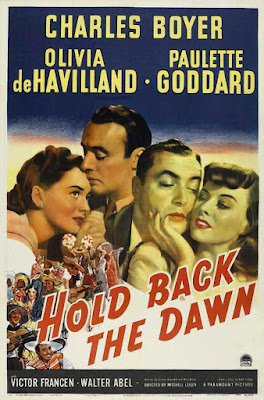
Holding Forth on Billy Wilder and “Hold Back the Dawn”

I’ve been on a Billy Wilder kick lately, sparked by reading Joseph McBride’s mammoth 2021 appreciation, Billy Wilder: Dancing on the Edge. McBride, yet another Roger Corman alumnus who’s made good, has been in the course of his long career a screenwriter, a journalist, a critic, and a professor of film. As a biographer of great movie directors he’s endlessly prolific, with a book on the Coen Brothers newly available this month.

 Joe’s writing has whetted my appetite for the more overlooked films in the Wilder canon. Of course I’ve seen such classics as Sunset Boulevard and Some Like It Hot. One Wilder movie not remembered much today is 1941’s Hold Back the Dawn, on which he served as a screenwriter, along with writing partner Charles Brackett, for journeyman director Mitchell Leisen. The well-received film was nominated for six Oscars, including Best Picture, Best Adapted Screenplay, and Best Actress. (Leading lady Olivia de Havilland lost out to her sister, and arch-rival, Joan Fontaine, who won for Hitchcock’s Suspicion.) But neither Brackett nor Wilder looked back on this project fondly.

 Joe McBride agrees with me that Hold Back the Dawn was partly harmed by a title that seems to promise the wrong things. Before watching the film I jumped to the conclusion that it was an action thriller, maybe a World War II drama with partisans bravely staving off the enemy. It’s definitely war-related, but this is hardly an action film. Instead, it’s a sensitive tale of desperate European immigrants, at the height of the Nazi era, stuck in Mexico while they try to find a way across the border. What makes it particularly fascinating for Joe and for me is  that it mirrors in several key ways Wilder’s own story. The leading character in Hold Back the Dawn, played by Charles Boyer, is a Romanian in a Tijuana-like border town, trying to reach the U.S. Back home he was a dancer and, it’s strongly implied, a gigolo. When he comes across his former dance partner, now visiting Mexico as a tourist, she persuades him that the way to gain access to the U.S. is to marry some innocent American dupe, keeping up the deception just long enough to gain legal status. And so he quickly woos and wins de Havilland, a naïve schoolteacher from Azusa, California, who’s south of the border with a broken-down van and a gaggle of noisy schoolkids.  Sweetly, though improbably, it turns into a love story.

 Wilder would doubtless deny ever being a gigolo, but as a struggling journalist in Berlin he had worked in swanky cafes as an eintänzer (or dancer for hire), charming the ladies who lunched. And he had his own moment of immigrant desperation in Mexico, urgently persuading a member of the American consulate staff to let him cross the border and make his way to Hollywood. McBride posits that Wilder’s take on life was permanently stamped by the era in which he fled Nazi Germany, where his Jewish roots were about to deprive him of a flourishing film career. He quickly found success in movieland, but was never able to rescue his mother and other family members ultimately lost to the Holocaust. Such life experiences naturally helped shape an acerbic outlook that many have called cynical, at the same time that his films reveal a subtle romantic streak. It was Leisen’s cutting of a scripted moment in Hold Back the Dawn—the so-called “cockroach scene” in which Boyer’s character expresses his own despair—that convinced Wilder to direct his own material in future. The rest is movie history.


Tuesday, October 26, 2021

An Autumnal Tribute to “A Midsummer Night’s Dream”

Anita Louise as Titania, the Fairy Queen

As a long-time theatre buff, I’ve been suffering serious withdrawal symptoms during the pandemic. The few opportunities I’ve had to see actors on stage have been outdoor performances, sometimes awkwardly staged in parking lots. But I did celebrate the end of summer with a Midsummer Night’s Dream in the most magical locale you can imagine. Topanga Canyon’s Theatricum Botanicum was founded in 1973 by the actor Will Geer (Grandpa on TV’s The Waltons). Blacklisted during the McCarthy era, Geer had moved his family to the wilds of Topanga to live off the land. Eventually, their domain became an artist’s colony, and the site of an annual repertory season. The playing area is entirely outdoors, and it’s no wonder that A Midsummer Night’s Dream is a standard annual offering. Ensconced in surprisingly comfortable seats in a beautifully woodsy glen, you truly feel as though you too are in the middle of a vast forest, communing with fairy creatures.

 (My pleasure in this particular performance was enhanced by the fact that a neighbor’s son, Steven Taub Gordon, had risen from the ranks of the understudies to play one of show’s quartet of lovers, the charmingly addled Lysander.)

 Back when talkies were something new and exciting, Hollywood’s big studios went out of their way to launch prestige projects, including elaborate screen versions of Shakespeare’s best-loved plays. MGM, for instance, staged a 1936 production of Romeo and Juliet, starring members of the studio’s prized acting stable: John Barrymore as Mercutio, Basil Rathbone as Tybalt, Edna May Oliver as Juliet’s nurse. The two young lovers were played by long-in-the-tooth Leslie Howard (age 43) and Norma Shearer (the 34-year-old wife of producer Irving Thalberg). It’s a well-spoken production, but also one that’s stiff and unconvincing in its portrayal of youthful passion.

 Up until now I’d never managed to see the Warner Bros. contribution to the Shakespeare derby. A Midsummer Night’s Dream, which had been staged as an early silent film back in 1905, was filmed in 1935 by Austrian stage and screen director Max Reinhardt, who had just fled rising anti-Semitism in Europe. Reinhardt adored spectacle, and the film spends much of its length on musical interludes, featuring woodland creatures (fairies, nymphs, trolls) frolicking in the moonlight to the lush strains of Felix Mendelssohn. Today all those supernatural beings, photographed in shimmering black & white, can get a bit tiresome, with the oodles of fairies (all with long silvery tresses and filmy gowns) seeming not far removed from the stylized routines that made Busby Berkeley famous. Still, Victor Jory (wearing what looks like a crown of twisted twigs) makes a stalwart Oberon, and Anita Louise is a lovely Titania.

 Among the mortal lovers, perennial juvenile Dick Powell plays Lysander as a ready-for-anything college boy, in a performance that has always been much scorned, even by Powell himself. Opposite him is the very young Olivia De Havilland, making her screen debut. They and the two additional star-crossed lovers, Ross Alexander and Jean Muir, are pretty silly, in roles that always require a certain amount of silliness.

 Naturally, it’s the most earth-bound characters who come out best, particularly James Cagney as Bottom the Weaver and the wide-mouthed Joe E. Brown as Flute, who must don a dress to play opposite Bottom in the world’s wackiest performance of the tragic “Pyramus and Thisbe.” Young Mickey Rooney’s antic Puck sounds like a good idea: he was a small, energetic fifteen-year-old who was talented and ready for anything. But Rooney’s hyperactive performance should only be sampled in small doses. After seeing it, you’ll be ready for a Midsummer Night’s snooze.


Friday, September 27, 2019

What Have We Inherited from “The Heiress”?


Does The Heiress, an oldie from 1949 based on a Henry James novel called Washington Square, have anything to say to us today? In this #MeToo era, we’re all aware of women who’ve been pressured by men into unwanted sexual activity. Being a woman now—at a time when sexual compliance is often expected as a quid pro quo for favors received--is hardly easy. Still, it’s got to be an improvement on the nineteenth century, when a woman’s entire life was based on the obligation to marry and produce heirs.

Catherine Sloper, who lives with her doctor-father in an elegant Greenwich Village mansion, has what may seem an easy life. Having no need to earn her living, she devotes her time to embroidery, pretty dresses, and making homelife comfortable for her widowed papa. He pays her back by comparing her—in strongly negative terms—to her dead mother, whose good looks and charm the shy Catherine can’t hope to approximate. It’s clear to her that he considers her an abject failure, because no eligible bachelor seems willing to look at her twice.

Everything changes when, at a posh neighborhood soiree, she is asked to dance by the handsome Morris Townsend, just back from a swing through Europe. Almost immediately he is courting her, and she is falling head over heels in love. Their quick engagement is applauded by her giddy aunt, who thrives on the romance of it, but Dr. Sloper is sure from the start that the attractive but impoverished Morris is a fortune-hunter. To the good doctor, it’s clear that Morris Townsend is attracted less by Catherine’s quiet charm than by her future financial expectations.

So sure is Catherine that her beloved wants her for herself alone that she chooses to face disinheritance by organizing a late-night elopement. She’s thrilled by the prospect of leaving the family home forever, and going off into a future where she and Morris will live on love.  Alas, we’re not surprised when her betrothed leaves her in the lurch, and all her romantic dreams turn to dust.  The true suspense in the story comes when—several years later—Morris returns from far-off California to resume his courtship. By this point, Dr. Sloper is dead, and Catherine is the mistress of both her house and her desires. From this position of power, how will she react to Morris’s pretty speeches about why he abandoned her (for her own good, of course) all those years ago?

Catherine Sloper was played by Olivia de Havilland, now still alive and feisty at 103. It was she who brought a successful Broadway play to the attention of William Wyler, insisting on playing the role that ultimately brought her an Oscar. Ironically, de Havilland is perhaps best known as the sweet, docile Melanie in 1939’s Gone With the Wind. Her petite prettiness was not ideally suited to the role of Catherine, despite the valiant attempts of the production staff. Yet in the latter sections of the film, the steel in her spine seems quite genuine. Britain’s Ralph Richardson was Oscar-nominated for playing her father, subtly conveying the sense of a man who doesn’t realize how hatefully he’s treating his only child. I also admired veteran charmer Miriam Hopkins as the flighty aunt. But Montgomery Clift, starting to get a reputation as sensitive leading man, somehow seems too modern for this very period piece. Kudos to William Wyler for his elegant direction (which makes vivid use of the house’s massive staircase), and to Aaron Copland, who won an Oscar for bringing his symphonic gifts to the film’s score.