Showing posts with label Penny Marshall. Show all posts

Tuesday, December 16, 2025

The Late Rob Reiner: All in the Family

Not exactly a festive start to the holiday season. First the horrific first-night-of-Hanukkah shootings on Bondi Beach in Sydney, and then the news of the murder of actor/director Rob Reiner and wife Michele in Brentwood, California. Frankly, I can’t wait for 2025 to be over. 

 All I can do (and it certainly isn’t much) is to remember Reiner and the joy he’s given me over the decades. I never met him, though we had some extremely remote connections, like the fact that (in the course of my very first summer  job) I presided over the bus on which his little brother rode to day camp back in the 1960s. In about that same era, as a theatre writer for the UCLA Daily Bruin, I was sent to a local theatre to review a short play called The Howie Rubin Story. This one-person playlet, written by Reiner and his longtime creative partner, featured Rob as a naïve high school kid who dreams of Hollywood stardom. At that point I’d never heard of Rob Reiner, though I certainly knew about the career of his talented father Carl. The younger Reiner’s on-stage charm and always-helpful family connections seemed to promise that he was on the brink of a great career. And so it went.

 Most fans associate Rob Reiner with the role of Archie Bunker’s left-leaning son-in-law, not so affectionately nicknamed Meathead, om All in the Family (1971-1979). Somewhere in that era, Reiner participated in a prank I still remember with great amusement. At the time he was married to the late Penny Marshall, who was featured on a sitcom version of Neil Simon’s The Odd Couple as Myrna, a particularly hangdog secretary with bad posture and an excruciatingly nasal voice. She’s pining for her lost beau. Naturally, Tony Randall’s character (the fastidious Felix Unger) tries to remake her into a more suitable love object for the fickle Sheldn (whose name was misspelled on his birth certificate). When Sheldn finally shows up to encounter the remade Myrna, it’s Rob Reiner in a really bad wig. Clearly Penny Marshall was not expecting to see her hubby in this scene: the studio audience laughed in delight at her desperate attempts to keep a straight face, and at home I laughed too. For me this was one of the most delightful live TV moments of all time.

 Everyone who loves movies knows the great films that Reiner so lovingly directed: romcoms like When Harry Met Sally and The American President, dramas like Misery and A Few Good Men. His debut film as a director, This is Spinal Tap (1984) was such a memorable mockumentary of a British rock group that lines like “up to eleven” have entered our daily lingo, and a sequel was released just this past year. I think a lot of us have a special affection for The Princess Bride, a blend of fairytale romance and adventure fable that is also a tribute to the bonds of familial love. In the original film a modern kid (Fred Savage) is read the story of the Princess Bride by his grandpa (Peter Falk) when he’s sick in bed. At the end, the film becomes a sweet tribute to their intergenerational affection. In the dark days of the pandemic, Hollywood performers amused themselves by re-enacting scenes from The Princess Bride and posting on YouTube. Ultimately Rob Reiner himself played the kid and his father Carl had the grandpa role. The on-camera tenderness between them was deeply touching, and I’d like to remember Reiner like that, not for family relationships that apparently went horribly wrong.  


Friday, March 25, 2022

All in the Family: “Big” and “A Few Good Men”

Years ago, when I was a camp counselor, one of the kiddies was Lucas Reiner, youngest child of comedy legend Carl. I confess I kept an eye on little Lucas, waiting for him to say something funny. Lucas has since turned to screenwriting, but it’s his older brother who has gone on to a major Hollywood career. Rob Reiner started as an actor, first in local little theatres and then as Mike Stivic (aka Meathead) on TV’s groundbreaking All in the Family (1971-1979). But it was not long before Rob tried his hand at directing. Starting with the hilarious mockumentary, This is Spinal Tap (1984), he particularly excelled at comedy, helming such classics as The Princess Bride (1987) and When Harry Met Sally . . . (1989).

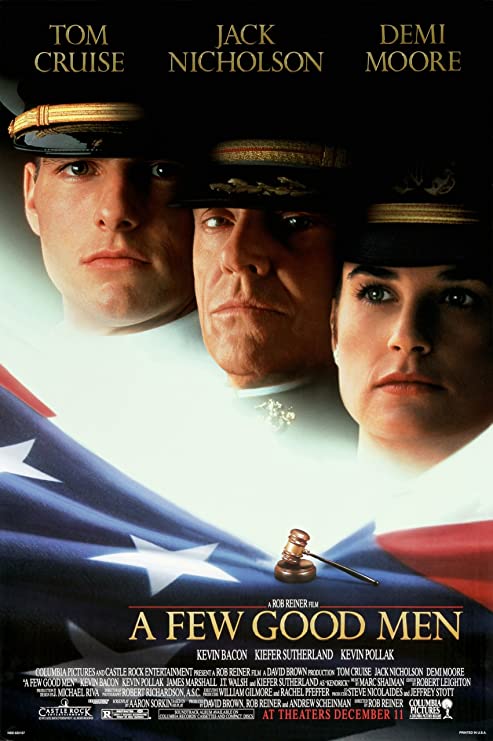
 Gradually, though, Rob Reiner approached less light-hearted material, starting with a grand-guignol-style horror flick, Misery, based on Stephen King’s nightmarish novel. That was 1990; two years later Reiner garnered his only Oscar nomination, as producer (as well as director) of A Few Good Men. It’s a film I finally caught up with on a recent plane flight. Sure, I already knew the movie’s most famous exchange (“I want the truth!” “YOU CAN’T HANDLE THE TRUTH!”), but I wasn’t prepared for how riveting this courtroom thriller proved to be. A Few Good Men has a complicated, dialogue-heavy script (it was Aaron Sorkin’s first screenplay credit), and it deals with the arcane issue of a Code Red among U.S. Marines at Guantanamo Bay. But Reiner keeps things moving, and the film certainly made my hours in the friendly skies fly by.

 One of the pleasures of watching movies on a coast-to-coast flight is that you can skip from one genre (or era) to another. I started my flight with a true oldie, Grand Hotel, though in the age of COVID Greta Garbo’s “I want to be alone” certainly sounded anachronistic. Then, following A Few Good Men, I plunged into the most airy of comedies, 1988’s Big, in which a boy of 13 finds himself growing overnight into Tom Hanks. It was only in retrospect that I discovered a connection between these last two films. Big was directed by the late Penny Marshall, who for ten years (1971-1981) was married to Rob Reiner. What a wacky couple they must have made! Marshall revealed her own flair for comedy first as a TV actress (Laverne and Shirley) and then as a director of movies like A League of Their Own. Big, I feel, is her comic masterpiece, energized by her insight into the way kids look at the adult world.

 Directors who come from an acting background surely have a special flair for bringing out the best in their performers.  Big wouldn’t have worked without Hanks’ antsy, exuberant, very slightly horny performance. I laughed with delight at him trying to shimmy into a pair of much-too-small jeans, and then later (at a fancy cocktail party) having his first encounter with baby corn. The film’s romantic thread, involving a very adult co-worker, avoids being grotesque because of his spot-on childlike innocence.

 A Few Good Men too is beautifully cast, starting with Tom Cruise’s cocky but secretly sensitive young Navy attorney and Demi Moore’s conflicted Naval officer. (It’s a mark of the film’s maturity that—though there’s a smoldering subtext between these two—the script never breaks away for the obligatory romance.) Smaller roles are equally well handled, but of course the film’s secret weapon is its villain, Colonel Nathan Jessup, USMC. The cat-who-ate-the-canary part of this smug, haughty martinet fits Jack Nicholson like a glove. Good show!


Tuesday, February 5, 2019

Goodbye, Dolly. Well, Goodbye, Dolly . . .


It’s a sad time for those who love over-the-top comic personalities. Carol Channing left us on January 15, less than a week shy of her 98th birthday. Encyclopedias list her as an “American actress,” but it wasn’t exactly acting she was known for. No, she was more accurately described as a personality, someone who was always herself, and a self so distinctive that it could be imitated but never matched. With her long limbs, wide mouth, saucer eyes, and bright cloud of platinum hair, she looked like a cartoon character come to life. And her voice, that boisterous squawk, could have belonged to no one else.

Naturally, the Broadway musical stage was where she got her start. After appearing in some peppy reviews, she took Broadway by storm as Lorelei Lee, a flapper first created by Anita Loos in a breezy popular novel, Gentlemen Prefer Blondes. As the stage’s first Lorelei, Channing got to sing “I’m Just a Little Girl from Little Rock” and the indelible “Diamonds Are a Girl’s Best Friend” (music by Jule Styne and Leo Robin). It was one of the biggest Broadway hits of 1949, but the 1953 movie adaptation supplanted Channing with a much curvier, more obviously sexual Lorelei. Of course I mean Marilyn Monroe, who was actually billed second to more-widely-known Jane Russell, though not for long.

Channing was back with a Broadway triumph in 1964 with Hello, Dolly! This corny but lovable Jerry Herman hit is adapted from a play by Thornton Wilder, The Matchmaker. Wilder’s tale concerns a widow who sets her sights on a curmudgeonly but wealthy merchant. Object: matrimony. Ruth Gordon (later to star in Harold and Maude) was the widow of that non-musical version. For the musical, Broadway queens Ethel Merman and Mary Martin were approached. Both nixed the role of Dolly Gallagher Levi, but Channing made it a triumph, stamping it with her personal outlandish charm. I was lucky to see her perform the role in Los Angeles. No question that she was having the time of her life. Her antics included waving bye-bye to the audience from underneath the descending stage curtain. You couldn’t help loving her.

Still, Hollywood saw fit to give the plum role of Dolly to another screen newcomer, the 27-year-old Barbra Streisand. The behemoth production covered the back lot of 20th Century Fox, even enlisting studio neighbors to swell the ranks of onlookers in the big parade scene. That‘s how my mother, sister, and husband-to-be all got to make their Hollywood debuts. I may be showing family disloyalty, but I’ve got to admit that the screen Hello, Dolly! Is a turkey. Happily for Carol Channing, by the time Hello, Dolly! was filmed she had finally gotten herself a good movie role. In the 1967 romp, Thoroughly Modern Millie, Channing plays an endearingly wacky socialite named Muzzy von Hossmere. (It seems to me I recall her being shot out of a cannon, among other things.) Fittingly, she was nominated for an Oscar for best supporting actress. Though she lost out to Estelle Parsons for Bonnie and Clyde, it was good to see Hollywood acknowledge one of the comedy greats.

Speaking of which, I don’t want to completely overlook the death of Penny Marshall, another inspired comic actress, one whose nasal Bronx-ese in Laverne & Shirley and other shows I’ll find hard to forget. Not just a performer, Marshall made the transition into directing, responsible for such big screen hits as Big and A League of Their Own. As a female director she was a pathfinder, and she will surely be missed.