Showing posts with label Rob Reiner. Show all posts

Friday, July 17, 2026

“The Bear”: What’s a Sitcom Anyway?

Having just binge-watched the fifth and final season of The Bear, I have some strong thoughts on how TV has changed over time. From 1972 to 1983 I was devoted to M*A*S*H, a sort-of sitcom set during the Korean War. Lasting eleven years, the show—about a military surgical unit a stone’s throw from the front lines—focused on the hijinks of young surgeons, nurses, and other American military personnel far from home. So this series (with Alan Alda as “Hawkeye” Pierce, its central figure) blended outrageous comedy with a deep awareness of the tragedies of war and the challenges faced by healers in times of crisis.

 My friend Elias Davis, who co-wrote the famous final episode of M*A*S*H , implies that the show’s outcome was by no means fully planned from the start. But it’s clear that The Bear—officially labeled a comedy, though much of the family backstory is dead serious—was building throughout most of its five-year run toward a very specific conclusion. In the past, American TV didn’t work that way. In long-running comic shows there would be changes over the years as key actors came and went. See, for instance, how the M*A*S*H dynamic evolved when the obtuse Major Frank Burns, as played by Larry Linville, was replaced by the know-it-all snob Charles Emerson Winchester III (David Ogden-Stiers) as Hawkeye’s tent mate.

 Today, of  course, TV series tend to have much shorter seasons: each of the past five years has seen the arrival of only eight episodes of The Bear. (Compare M*A*S*H , which typically had more than 20.) The Bear’s  tight timetable makes it much easier for the writing team to control the show’s narrative, and to plan out in advance where it is going, with some interesting detours along the way. Curiously, although there’s a good-sized cast portraying those who work in and around the Chicago restaurant known as The Bear, not much always happens from episode to episode. Some focus almost entirely on a single character, and it’s not necessarily star Carmy (Jeremy Allen White), a talented chef who agonizes over his decision to convert his dead brother’s sandwich shop into a fine-dining establishment. Each of the central characters has a complicated backstory, and the show sometimes pulls away from the restaurant setting to explore cousin Richie working on his people skills, line cook Tina discovering her professional abilities, pastry chef Marcus coping with the loss of his mother, or Somali kitchen helper Ebraheim shyly struggling to get the restaurant on a stronger financial footing. (His mentor is played by the late Rob Reiner, and there’s a subtle, touching tribute to Reiner in Ebraheim’s last-episode final line, “As you wish.” Jamie Lee Curtis as Carmy’s addled, sometimes alcoholic, mother does not enter the restaurant until the show’s very last episode, but she’s impossible to forget.  Because we come to know these people so well, we care about what they ultimately accomplish.

 One of my favorite things about The Bear is how it rewards viewers paying close attention. Early in season 4 there’s an episode in which maître d’ Richie, aiming to heighten the celebration of  a family whose daughter has just been declared cancer-free, mesmerizes them all by creating a magical summer snowfall. In passing, some attention is paid to the solo diner at the next table who sees and delights in the family’s joy. Who is this man? We don’t find out until the very last show of season 5, when his appreciation for his dining experience bears important fruit. It’s yet another tasty surprise for a very special show. 


Tuesday, May 19, 2026

The joys and the sadness of youth: “Stand by Me”

These days I suspect Stand By Me is best known as a song, one of those ageless ballads with which almost everyone can connect. It’s a paean to loyalty and friendship, which of course makes it perfect for campfire singalongs. It was recorded in 1961 by Ben E. King, who co-wrote it along with the invaluable popsters Jerry Leiber and Mike Stoller. When I hear “Stand by Me,” it puts me in a mellow mood, remembering back to memories—both happy and sad—of my own past.

 Today it also revives in me bittersweet memories of the late director Rob Reiner, for whom this was an early film project, just after This is Spinal Tap (1984) and just before The Princess Bride (1987). Based on a novella by horrormeister Stephen King, Stand by Me recounts the story of four young small-town pals who set out on a trek to see a dead body. (Their town, Castle Rock, would become the name of Reiner's own production company.

 The four leads were played by talented young actors just coming into their own. In the story, they are pals largely because all of them suffer from various forms of trauma. Sensitive Gordie (Wil Wheaton) is mourning the loss of his older brother, his parents’ favorite, in an accident. Chris (River Phoenix) is used to having his natural intelligence and leadership qualities overlooked because he comes from a family of scofflaws and ne’er-do-wells. Teddy (Corey Feldman) is the oddball son of an Army vet with serious mental issues. Vern (Jerry O’Connell) is a good kid, but the doofus of the group. Most of the film details their overnight trek to locate the body of a missing classmate who apparently was hit by a train. They figure that if they announce to the world where the body can be found, they will be accepted as heroes.

 What they aren’t counting on is the gang of roving teens, led by the always scary Kiefer Sutherland, who have their own dibs on the body. Sutherland and his cronies are just one of the jeopardies the four pals need to face down. There are leeches in the local stream, and very real danger from an oncoming locomotive. The four are also grappling with impending maturity and their own challenging pasts. What happens to them in the long run is established by the film’s narrator (Richard Dreyfuss) who opens and closes Stand by Me. Once one of the four, he’s now an established writer retelling his own story.  

 One of the things that makes Stand by Me fascinating to today’s viewers is the real-life fate of those involved. Kiefer Stuherland, of course, has had a rich acting career that rivals the success once enjoyed by his late father, Donald. Richard Dreyfuss has starred in blockbusters (yes, Jaws!) and won an Oscar for The Goodbye Girl. John Cusack, who plays Gordie’s older brother in some brief flashbacks, became beloved for his romantic turn in Say Anything.

 For the film’s four main boys, career success has been a sometime thing. Jerry O’Connell has had a long career but few standout roles. Wil Wheaton now mostly limits himself to voiceover work. The irrepressible Corey Feldman still performs, at 54, but has struggled with drug and alcohol abuse. River Phoenix, a 1988 Oscar nominee for Running on Empty, died of a drug overdose in 1993, at age 23. 

 And of course Rob Reiner himself died on December 14, 2025 when he and wife Michele were allegedly stabbed to death by their son Nick. Life can sometimes be very, very sad.


Tuesday, March 17, 2026

Jessie Buckley and the Luck of the Irish

Well, it’s all over now but the shouting. The 98th annual Academy Awards ceremony is in the books, and most viewers (me included) are rather happy about the outcome. Timothée Chalamet was gracious in defeat as Michael B. Jordan was hailed for his lead performance(s) in Sinners. (Trivia time: the only other actor who won the Oscar for playing twins was Lee Marvin for Cat Ballou.) Some of the actresses on display looked suitably gorgeous while others (I’m looking at YOU, Renate Reinsve) just seemed, well, a bit weird. Host Conan O’Brien was a hoot wearing Amy Madigan’s red fright wig from Weapons, being chased up the aisle of the Dolby Theatre by a pack of very excited kids. The glamorous and uninhibited Teyana Taylor seemed to have surgically attached herself to the leg of Paul Thomas Anderson as he strode to the stage to receive one of three long-overdue statuettes. There was real heartfelt emotion in the In Memorian segment, particularly in Billy Crystal’s tribute to Rob and Michele Reiner.

 But I want to focus on one of the evening’s least suspenseful awards: that for Best Actress. Everyone seemed to agree from the get-go that Jessie Buckley was a lock for  playing Shakespeare’s grieving wife in Hamnet. I too loved her performance, but it made me more curious than ever about how her career evolved. I first spotted Buckley in a small 2018 film called Wild Rose. It focuses on a young Scottish single mother who loves American country music and dreams of traveling to Nashville. Buckley impressed me in that role, and I figured she was a talented young Scot with a bright career ahead of her. Wrong! Buckley is Irish, and apparently the first Irish actress ever to win a major acting Oscar. So her win was well-timed, just ahead of St. Patrick’s Day.

 As to the question of how Buckley’s career got started, I’ve discovered something quite charming. Back in 2008, at the ripe old age of 18, she was a contestant on a BBC competition show called I’d Do Anything. The show’s title came from a perky song in the musical, Oliver! (based on Dickens’ Oliver Twist) which was a massive hit in London and New York before being transformed into an Oscar-winning film. The gimmick of the TV show was that various aspiring young singing actresses were competing to win the star role of Nancy in an upcoming West End revival of Oliver!, with votes from the public making all the difference. You can find the show’s finale on YouTube, with Buckley and another singer-actress, costumed identically, each singing Nancy’s big torch number, “As Long as He Needs Me.” 

Guess what! Buckley came in second, though guest panelist Andrew Lloyd Webber passionately campaigned on her behalf. For me, looking back on the competition after several decades, Buckley was a star in the making. I am not expert enough at singing to comment on the technical prowess of the two contestants, but there’s no question that Buckley was better at pouring into this song a deep well of emotions. Clearly, she understood the lyrics. 

 The Jessie Buckley of 2008 was not exactly the woman we saw on stage at the Dolby. At 18 she was very slim with a mop of curly hair and a fair amount of makeup, not the more austere look she seems to favor these days, as a wife, a new mother, and a recognized dramatic actress. She was adorable back then, but I wouldn’t have guessed what she’d go on to do. Now, though, the sky’s the limit. Brava! 


Tuesday, December 16, 2025

The Late Rob Reiner: All in the Family

Not exactly a festive start to the holiday season. First the horrific first-night-of-Hanukkah shootings on Bondi Beach in Sydney, and then the news of the murder of actor/director Rob Reiner and wife Michele in Brentwood, California. Frankly, I can’t wait for 2025 to be over. 

 All I can do (and it certainly isn’t much) is to remember Reiner and the joy he’s given me over the decades. I never met him, though we had some extremely remote connections, like the fact that (in the course of my very first summer  job) I presided over the bus on which his little brother rode to day camp back in the 1960s. In about that same era, as a theatre writer for the UCLA Daily Bruin, I was sent to a local theatre to review a short play called The Howie Rubin Story. This one-person playlet, written by Reiner and his longtime creative partner, featured Rob as a naïve high school kid who dreams of Hollywood stardom. At that point I’d never heard of Rob Reiner, though I certainly knew about the career of his talented father Carl. The younger Reiner’s on-stage charm and always-helpful family connections seemed to promise that he was on the brink of a great career. And so it went.

 Most fans associate Rob Reiner with the role of Archie Bunker’s left-leaning son-in-law, not so affectionately nicknamed Meathead, om All in the Family (1971-1979). Somewhere in that era, Reiner participated in a prank I still remember with great amusement. At the time he was married to the late Penny Marshall, who was featured on a sitcom version of Neil Simon’s The Odd Couple as Myrna, a particularly hangdog secretary with bad posture and an excruciatingly nasal voice. She’s pining for her lost beau. Naturally, Tony Randall’s character (the fastidious Felix Unger) tries to remake her into a more suitable love object for the fickle Sheldn (whose name was misspelled on his birth certificate). When Sheldn finally shows up to encounter the remade Myrna, it’s Rob Reiner in a really bad wig. Clearly Penny Marshall was not expecting to see her hubby in this scene: the studio audience laughed in delight at her desperate attempts to keep a straight face, and at home I laughed too. For me this was one of the most delightful live TV moments of all time.

 Everyone who loves movies knows the great films that Reiner so lovingly directed: romcoms like When Harry Met Sally and The American President, dramas like Misery and A Few Good Men. His debut film as a director, This is Spinal Tap (1984) was such a memorable mockumentary of a British rock group that lines like “up to eleven” have entered our daily lingo, and a sequel was released just this past year. I think a lot of us have a special affection for The Princess Bride, a blend of fairytale romance and adventure fable that is also a tribute to the bonds of familial love. In the original film a modern kid (Fred Savage) is read the story of the Princess Bride by his grandpa (Peter Falk) when he’s sick in bed. At the end, the film becomes a sweet tribute to their intergenerational affection. In the dark days of the pandemic, Hollywood performers amused themselves by re-enacting scenes from The Princess Bride and posting on YouTube. Ultimately Rob Reiner himself played the kid and his father Carl had the grandpa role. The on-camera tenderness between them was deeply touching, and I’d like to remember Reiner like that, not for family relationships that apparently went horribly wrong.  


Monday, August 21, 2023

“Jury Duty”: A TV Star is Born

The prank show is as old as television. How well I remember Candid Camera, various versions of which were around from 1948 to 2014. This hidden-camera reality show delighted in putting the unsuspecting in awkward situations (like encountering a mailbox from which a human hand reaches out to take your mail). There was lots of innocent merriment to be had in seeing others fooled by wacky oddities.

 Then there’s the so-called mockumentary. It’s realistically filmed, as though a camera crew just happens to be looking in on some everyday but slightly eccentric folk. Among movies, I’d cite 1984’s This is Spinal Tap, in which actor Rob Reiner—making his directorial debut—appears on-screen as Martin Di Bergi, earnestly interviewing four members of what is called “one of England’s loudest bands.” Among the droll rockers in Spinal Tap is one played by Christopher Guest, who went on to produce and direct his own series of mockumentaries. These have included my favorite, Waiting for Guffman, as well as the deathless Best in Show, an hilarious send-up of the snooty kennel-club world. The mockumentary format has been used on TV on such sitcoms as The Office, the U.S. version of which pretends to be filming a workplace documentary about the employees punching their time-cards at Dunder Mifflin Paper Company.

 All of this, I suppose, paves the way for an 8-part TV series produced by Amazon Studios and now nominated for three Emmy awards, including Outstanding Comedy Series. It too is a mockumentary, with jurors and other courtroom personnel being interviewed by off-camera journalist-types, supposedly for a film about what it’s like to serve on an American jury. Here’s the key difference from most mockumentaries: though the judge, the bailiff, and eleven jurors are all actors playing roles, the jury foreman has no idea that he’s at the center of an elaborate prank. Ronald Gladden, of San Diego, is a good-natured young man excited about serving on a jury for the very first time.  

 What he experiences is a trial that at first seems straight-forward: the well-heeled owner of a T-shirt manufacturing business is suing a derelict employee who—drunk and disorderly—befouled a huge stack of her product. But nothing goes as planned. The plaintiff is obnoxious; the defendant’s attorney is hopelessly inept; one juror suffers a near-fatal fall; a second is having a major romantic crisis; a third keeps falling asleep in the courtroom; a fourth is a total space-cadet who enters the jury room wearing his own bizarre invention--“chair-pants.” To add to the chaos, the jury’s alternate member is a semi-well-known actor, James Marsden, who can’t help reminding everyone of his celebrity at every turn. (“James Marsden” is played by James Marsden, best known for films like X-Men and Hairspray. His obnoxious but somehow endearing lampoon of his own public image earned him an Emmy nomination.)  Because of Marsden’s outrageous shenanigans to get out of serving, the jury ends up sequestered in a local motel, where many adventures await them, involving both sex and plumbing.

 None of this would work if it were not for Ronald Gladden. As the one person who’s not in on the joke, he’s trying hard to be both a good juror and a friend to all. Yes, he deals with some pretty unspeakable things, but it’s made clear at the end that everyone on the cast and crew loves him. By the end of Episode 8, you will too. I suspect this will not be his last time on the tube. And I know law students will be in stitches over this very funny show.  


Friday, March 25, 2022

All in the Family: “Big” and “A Few Good Men”

Years ago, when I was a camp counselor, one of the kiddies was Lucas Reiner, youngest child of comedy legend Carl. I confess I kept an eye on little Lucas, waiting for him to say something funny. Lucas has since turned to screenwriting, but it’s his older brother who has gone on to a major Hollywood career. Rob Reiner started as an actor, first in local little theatres and then as Mike Stivic (aka Meathead) on TV’s groundbreaking All in the Family (1971-1979). But it was not long before Rob tried his hand at directing. Starting with the hilarious mockumentary, This is Spinal Tap (1984), he particularly excelled at comedy, helming such classics as The Princess Bride (1987) and When Harry Met Sally . . . (1989).

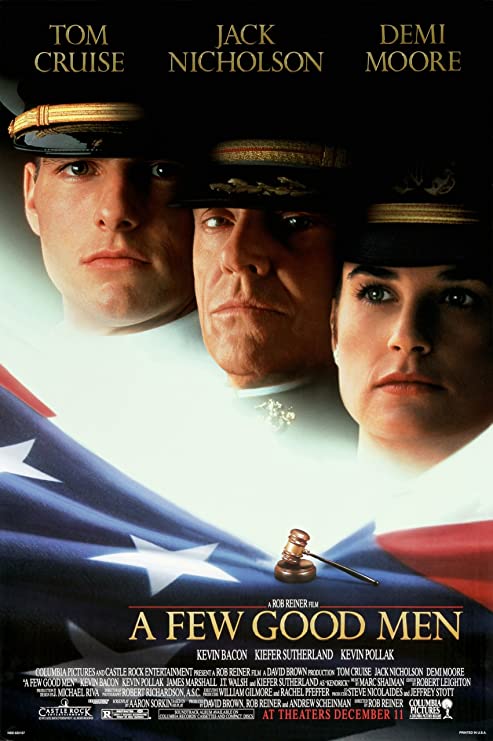
 Gradually, though, Rob Reiner approached less light-hearted material, starting with a grand-guignol-style horror flick, Misery, based on Stephen King’s nightmarish novel. That was 1990; two years later Reiner garnered his only Oscar nomination, as producer (as well as director) of A Few Good Men. It’s a film I finally caught up with on a recent plane flight. Sure, I already knew the movie’s most famous exchange (“I want the truth!” “YOU CAN’T HANDLE THE TRUTH!”), but I wasn’t prepared for how riveting this courtroom thriller proved to be. A Few Good Men has a complicated, dialogue-heavy script (it was Aaron Sorkin’s first screenplay credit), and it deals with the arcane issue of a Code Red among U.S. Marines at Guantanamo Bay. But Reiner keeps things moving, and the film certainly made my hours in the friendly skies fly by.

 One of the pleasures of watching movies on a coast-to-coast flight is that you can skip from one genre (or era) to another. I started my flight with a true oldie, Grand Hotel, though in the age of COVID Greta Garbo’s “I want to be alone” certainly sounded anachronistic. Then, following A Few Good Men, I plunged into the most airy of comedies, 1988’s Big, in which a boy of 13 finds himself growing overnight into Tom Hanks. It was only in retrospect that I discovered a connection between these last two films. Big was directed by the late Penny Marshall, who for ten years (1971-1981) was married to Rob Reiner. What a wacky couple they must have made! Marshall revealed her own flair for comedy first as a TV actress (Laverne and Shirley) and then as a director of movies like A League of Their Own. Big, I feel, is her comic masterpiece, energized by her insight into the way kids look at the adult world.

 Directors who come from an acting background surely have a special flair for bringing out the best in their performers.  Big wouldn’t have worked without Hanks’ antsy, exuberant, very slightly horny performance. I laughed with delight at him trying to shimmy into a pair of much-too-small jeans, and then later (at a fancy cocktail party) having his first encounter with baby corn. The film’s romantic thread, involving a very adult co-worker, avoids being grotesque because of his spot-on childlike innocence.

 A Few Good Men too is beautifully cast, starting with Tom Cruise’s cocky but secretly sensitive young Navy attorney and Demi Moore’s conflicted Naval officer. (It’s a mark of the film’s maturity that—though there’s a smoldering subtext between these two—the script never breaks away for the obligatory romance.) Smaller roles are equally well handled, but of course the film’s secret weapon is its villain, Colonel Nathan Jessup, USMC. The cat-who-ate-the-canary part of this smug, haughty martinet fits Jack Nicholson like a glove. Good show!