Showing posts with label Elia Kazan. Show all posts

Monday, October 5, 2026

When a Face Emerges from the Crowd

When I was in, perhaps, the seventh grade, I enjoyed a weekly trip to the local library with my mom and little sister. As a voracious reader with a special appreciation for stage musicals and comedies, I would curl up in the theatre section and read to my heart’s content. One day I came across a work I didn’t know: A Face in the Crowd, by Budd Schulberg. The title and the author’s  name were both unfamiliar to me. But I was well-acquainted with the star of the production. Andy Griffith, who had appeared on the Broadway stage and then the film adaptation of No Time for Sergeants. This was the comic tale of a hillbilly bumpkin drafted into the U.S. Army during World War II. My father, a veteran himself, loved good-hearted humorous takes on military protocol, and so I saw—and adored—the film at an early age. With Andy Griffith as the leading man, I  assumed A Face in the Crowd would be equally lovable and funny.

 Wrong! This 1957 work (which turns out to have been a film script based on Schulberg’s original story) does star Griffith as a country boy not much used to sophisticated folk. But he’s far from good-hearted. When we first meet him, he’s drunk and disorderly in a smalltown Southern jail, one that just happens to be visited by an attractive young radio producer (Patricia Neal) searching out local color. Discovering his gift of gab and his easy way with an acoustic guitar, she christens him “Lonesome” Rhodes, and helps turn him into the star of his own local radio show. Then TV comes calling. Soon he’s attracting serious attention, especially from women of all ages. When I discovered his sexual adventuring, both with Neal and with a young high school cheerleader (Lee Remick was introduced in this role), I was seriously shocked. (Needless to say, in the late-1950s, the physical nature of these relationships was not shown on screen, but I certainly got the message. And I’ve always considered A Face in the Crowd  my jump into adult reading material.)

 Today I’m a lot less easily shocked. But A Face in the Crowd still startles in its prescience about the way demagogues get started. Lonesome Rhodes is not simply interested in pretty women. He also quickly realizes that, thanks to the new medium of television, his homespun charm is his ticket into the halls of power. We see him instinctively discovering how to spread a sponsor’s message for an essentially worthless product. And before long he’s advising a major U.S. Senate candidate on how to improve upon his stuffy image, by way of a cute nickname and some new folksy mannerisms.  

 Essentially, the country boy is turning into a monster, one who is well aware that—thanks to the hold he has on his enormous TV audience—there’s nothing to stop him from making his own power grab in the near future. Surely we can well imagine him joking and crooning his way into the White House. Sound familiar? Back in the day, screenwriter Budd Schulberg and director Elia Kazan pointed to Will Rogers, Arthur Godfrey, and other media folk of the era as partial models for their central character, along with preacher Billy Graham and populist politician Huey Long. Today there are some obvious celebrity types who’ve made far bigger gains in the political world. Thanks to their street smarts as well as their ability to break all the rules and come out smiling, it sometimes seems as though nothing can stop them. 


Friday, July 3, 2026

They Could Have Been Contenders: The Hollywood Blacklist

I’m just back from a week in Washington, DC. To my surprise, the nation’s capital currently seems a lot more bipartisan than I would have guessed. Yes, there were giant Trump portraits hanging from some prominent government buildings. But I also saw a major Washington boulevard shut down on behalf of a wild and crazy Gay Pride festival. And overt dissent was on display nearby: outside a tent manned by some dedicated anti-Trumpers, I spotted a large placard that gave MAGA a new definition: Make Algae Great Again.

 Washington’s wonderful Smithsonian museums (open daily and free to all comers) seemed as welcoming and as even-handed as ever, pointing up our nation’s failings but also its glories.  Some of the city’s private museums, though, were clearly interested in viewing today’s deep political divide in the context of past eras that were equally contentious. That certainly seemed part of the reason the Capital Jewish Museum is now hosting an exhibit called “Blacklisted: An American Story.” Its focus is on the era—starting in 1947 and lasting until the early Sixties—when the House Un-American Activities Committee was terrorizing Hollywood, forcing the major studios to remove from their ranks anyone (Jewish or otherwise) who had ever been sympathetic to the Communist party. (The only way to return to the film industry’s good graces in that era was to dish up the names of others whose politics were—or had ever been—suspect.)

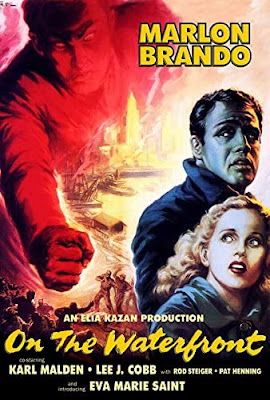
 As part of this exhibit, the museum showed a series of film clips relevant to the blacklist period. Two of the films were directed by Elia Kazan. Gentleman’s Agreement (1947) makes a brave argument against the built-in anti-Semitism of that era; the clip from On the Waterfront (1954) shows Marlon Brando as a longshoreman and would-be boxer climatically choosing to risk everything by bringing a mob boss to justice. Because Kazan was infamously known as one of those who “named names” to save his own career, many in Hollywood never forgave him. Orson Welles, for one, disparaged the latter film as “a celebration of the informant.”

 Three films written by Dalton Trumbo are also included in this montage. Two are from 1960, when the once-disgraced Trumbo was finally able to resume getting on-screen credit for his work. After writing Spartacus, he was championed by star Kirk Douglas, to whom he said, “Thanks, Kirk, for giving me back my name.” On earlier Trumbo films that appeared during the blacklist era, Trumbo had had to submit each of his scripts under a fictive monicker, or that of another writer. The screenwriting Oscar he won in 1954 for crafting under an assumed name the delightful (and totally apolitical) Roman Holiday was not awarded to him until 1993, almost three decades after his death.

 The exhibit also focuses on the sad example of John Garfield, one of many actors whose careers (and lives) were destroyed during the blacklist years. Garfield (born Jacob Garfinkle on New York’s Lower East Side) was a longtime supporter of liberal causes. He began appearing in major Hollywood films in 1938, usually in blue-collar roles, and was twice nominated for Oscars, notably for his lead role in the 1947 boxing film, Body and Soul. But his refusal to speak against his wife (once a member of the Communist Party) as well as his unwillingness to provide the House committee with the names of other Hollywood “Reds” ultimately destroyed him. He died of a heart attack in 1932 at the age of 39, just after a dream project in which he was to star was abruptly cancelled.

Despite it all, Happy 4th of July!

John Garfield, with quote from his daughter


Friday, May 5, 2023

Two Women: “Wanda” and “Iris”


By happenstance I recently saw two old films named after their leading female characters.  It’s always refreshing for me to watch a movie with a female focus. But Wanda and Iris couldn’t be more different.

 Wanda, from 1970, has nothing to do with a fish. (I loved the zany British black comedy, A Fish Called Wanda, which came out in 1988, featuring members of the Monty Python crew and a pre-Oscar Jamie Lee Curtis)  It is instead an ambitious indie, written and directed by Barbara Loden, an actress who had famously played the Marilyn Monroe role in Arthur Miller’s semi-autobiographical After the Fall at Lincoln Center. The play had been directed by the great Elia Kazan, who mentored Loden and subsequently  married her in 1966.

 Despite her years as an actress and a glamorous New York model, Loden understood from her own upbringing how a woman can be vulnerable to self-doubt and male manipulation. That’s why she chose to feature in her film-directing debut a blue-collar young woman from small-town Pennsylvania whose fundamental passivity makes her easy prey for conniving men. Immediately following her divorce (she arrives in court late, with her hair full of rollers) and the loss of all her cash, Wanda ends up in bed with a violent small-time crook who initiates her into a life of crime. This is hardly Bonnie and Clyde, in which a n attractive young woman discovers self-expression by learning to knock off banks. Wanda (convincingly played by Loden herself) is terrified, but lives for her man’s faint praise when she follows his lead.

 Despite its title character’s dependence on male approval, Wanda is considered a pre-feminist landmark, parly because it’s the rare film of its era made by a woman. It’s a straight-forward character study that knows how to put its limited resources on the screen. Upon release, it won an award at the prestigious Venice Film Festival. Years later, it was lovingly restored by the UCLA Film & Television Archive, and in 2017 was inducted into the National Film Registry of the Library of Congress. Though Loden next planned a cinematic version of Kate Chopin’s The Awakening, she succumbed to cancer at age 46. 

 In contrast to Wanda, with its unsung heroine, Iris (2001) is about a very famous woman indeed: the much-honored British novelist Iris Murdoch. I’m often annoyed by films that hop around in time, but this one justifies its complicated structure by playing the college-age Iris (Kate Winslet) off against her elder self (Judi Dench). The youthful Iris is vibrant, reckless, and intensely sexual; her older counterpart is a revered public figure, until she starts succumbing to the ravages of Alzheimer’s disease. Thus we cut from young Iris blissfully ocean-swimming in the nude to the old one recoiling in terror from the sea. Both actresses have been lauded for their performances, but equally impressive are Hugh Bonneville and Jim Broadbent, who play Iris’s ever-loyal swain-turned-husband, a scholar named John Bayley. Broadbent was to win a well-deserved Oscar in his supporting role. The film is based on the memoir Bayley published after Iris’s death, and one of its central strands is the ordeal of watching someone you love disintegrate before your eyes into a person you don’t know.   

 The British film industry is so good at exploring complicated lives. Having seen this intelligent, beautifully conceived film, I’m eager to spend more time with Murdoch’s fiction. But the exploration of her lapse into dementia also remind me, oh so painfully, of my grandmother’s similar decline. Is Alzheimer’s the cruelest disease of them all? 

.


Thursday, December 16, 2021

Soaring Over the Waterfront with Marlon Brando and Company

The opening credits of On the Waterfront are punctuated by the sound of a solo trumpet played in a minor key. It’s Leonard Bernstein at his bluesy finest: this was the maestro’s only original film score, and it earned him one of the film’s 12 Oscar nominations. A later, more gentle track from that Bernstein score is called “Dead Pigeons.” That’s an odd-sounding name for a musical interlude, but it’s one that fits this particular story nicely. On the Waterfront is based on a Pulitzer-Prize-winning series, published in the New York Sun, chronicling union corruption at the local dockyards. The film version (set on the Hoboken docks) is full of ships, and cargo, and tough guys with fiery tempers. But its plot and some of its key images involve pigeons, the kind that slum kids raise on the roofs of their buildings, showing tenderness to dumb creatures that will one day soar high above them and their grim little lives.

 Pigeons? Think of the metaphorical implications of being a stool pigeon, one of the most hated types in the gangster universe. The men at the dockyards well know they’re required to be “D & D.” This stands for ”deaf and dumb”: though the union bosses are ripping them off at every turn, few of them dare complain. When one brave (or foolhardy) idealist shows a willingness to testify in front of a governmental crime commission, he’s lured to his death. That death starts things happening: the gutsy local priest gets involved, as does the dead man’s genteel sister, raised by nuns to be a school teacher but now determined to fight for her brother’s memory. But the focal point of the story is Terry Malloy, played by Marlon Brando in the role that sealed his reputation as the best actor of his time. Terry, once a promising young boxer, is now a favorite of union boss Johnny Friendly, who runs the docks with an iron fist. At the start of the film Terry is a cog in a smoothly-running machine. But his involvement in Joey Doyle’s murder and his growing interest in Doyle’s sister Edie slowly convince him to rethink his life. It’s a film that puts the spotlight on an evolving hero, though the courage shown here is strictly devoid of phony sentimentality.

 This is the sort of bracing movie in which everything works: a smartly told story, vivid black & white cinematography, that Bernstein score. Hence the film collected 8 Oscars, in a year that saw such major successes as The Caine Mutiny, A Star is Born, and the charming Seven Brides for Seven Brothers. In addition to Best Picture, On the Waterfront won for its direction (Elia Kazan), its screenplay (Budd Schulberg), and the performance of Eva Marie Saint in her debut film. Brando deservedly received the Best Actor statuette, and -- yes! –walked to the stage, wearing a tuxedo, to gratefully accept it from Bette Davis. No fewer than three actors from On the Waterfront were nominated in support: Karl Malden as the priest, Lee J. Cobb as the corrupt union boss, Rod Steiger as Brando’s older brother, to whom he famously muses, “I coulda been a contender.” .

 It’s worth noting that when the film was released, in 1954, the U.S. was still caught up in the McCarthy Era, So the idea of testifying in front of a government committee took on a certain coloration, especially because director Elia Kazan had famously named names before the House Un-American Activities Committee two years earlier.  This film’s focus, though, is not politics but honor.