Showing posts with label Eva Marie Saint. Show all posts

Tuesday, August 11, 2026

Hitchcock: Man and Myth

Alfred Hitchcock is hardly filmdom’s forgotten man. Although Hitchcock passed from the scene in 1980, every year seems to bring forth another few books about his films and his life. One of the latest, from University Press of Kentucky, is A Century of Hitchcock: The Man, The Myths, The Legacy by British filmmaker Tony Lee Moral. Moral, who poses in his book jacket author-photo with a vicious-looking crow on his arm, has previously published studies of both Hitchcock’s Marnie and The Birds. This new Moral work goes back to the beginning, showing Hitchcock developing his filmmaking talents among the German Expressionist. Still, Moral spends the bulk of his time on the late Hollywood Hitchcock, especially on his fraught relationship with anointed star-in-the-making Tippi Hedren.

 The interaction between Hitchcock and Hedren was clearly complex. Once the exquisite Grace Kelly had departed for Monaco, there to take the throne as Princess Grace, Hitchcock was casting around for a new leading lady. There’s not much discussion of why such later Hitchcock blondes as Doris Day (The Man Who Knew Too Much), Kim Novak (Vertigo), and Eva Marie Saint (North by Northwest) didn’t entirely fill the bill. But Hickock was apparently after a Hollywood newcomer whom he could mold to his own aesthetic specifications. He found Hedren, a successful New York cover-girl model, while watching a TV commercial for a diet drink. Their first project together, The Birds (1963), proved to be a physical and emotional challenge for the newcomer. But the film’s massive box-office success led to Hedren being given another opportunity, this time for the title role in Hitchcock’s Marnie. This 1964 film, with its lurid sexual subtext, earned mixed reviews and box-office earnings (though it has been rediscovered by critics since). But ultimately tension between director and star led to a break in their relationship, and Hedren never acted for Hitchcock again. In fact, she was later to claim that he actively worked to sabotage her future film career.

 Enter Donald Spoto, a young scholar and film critic who began by idolizing Hitchcock. (His first book, The Art of Alfred Hitchcock, was published in 1976).) Though, while teaching in Los Angeles,  he got to meet his idol, Moral posits that Spoto was disappointed not to be able to establish a closer connection. Ultimately, after meeting Tippi Hedren, Spoto published a sensational second book, 1983’s The Dark Side of Genius, which explores what he sees as Hitchcock’s bad behavior toward Hedren and other actresses. He was to expand on this theme once again in 2008’s Spellbound by Beauty: Alfred Hitchcock and His Leading Ladies, a study even more lurid than the previous one. Moral, after doggedly questioning Hedren and other Hitchcock cast and crew members, is deeply skeptical about what Spoto sees as Hitchcock’s warped psyche and possessive attitude toward women. (For the record, Hitchcock had a long and apparently successful marriage to screenwriter and film editor Alma Reville, who was his frequent collaborator and sounding-board on his films. He had as well as a solid relationship with daughter Pat, who plays a key role in her father’s Strangers on a Train and continues to defend him today.)

 Frankly, I was surprised by how much of this book focuses on Spoto (including an exploration of his personal sexuality and his rather arcane  religious views). But Moral does make the valid point that, in a “Me Too” era, movie fans are less forgiving of behavior that once might have seemed quite normal on a film set. Did Hitchcock really demand sexual favors of Tippi Hedren? I guess we’ll never know.


Thursday, December 16, 2021

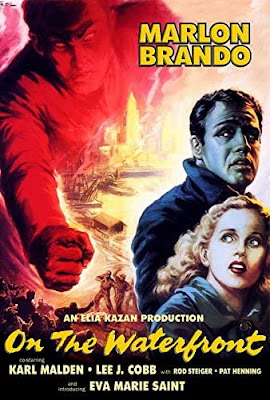
Soaring Over the Waterfront with Marlon Brando and Company

The opening credits of On the Waterfront are punctuated by the sound of a solo trumpet played in a minor key. It’s Leonard Bernstein at his bluesy finest: this was the maestro’s only original film score, and it earned him one of the film’s 12 Oscar nominations. A later, more gentle track from that Bernstein score is called “Dead Pigeons.” That’s an odd-sounding name for a musical interlude, but it’s one that fits this particular story nicely. On the Waterfront is based on a Pulitzer-Prize-winning series, published in the New York Sun, chronicling union corruption at the local dockyards. The film version (set on the Hoboken docks) is full of ships, and cargo, and tough guys with fiery tempers. But its plot and some of its key images involve pigeons, the kind that slum kids raise on the roofs of their buildings, showing tenderness to dumb creatures that will one day soar high above them and their grim little lives.

 Pigeons? Think of the metaphorical implications of being a stool pigeon, one of the most hated types in the gangster universe. The men at the dockyards well know they’re required to be “D & D.” This stands for ”deaf and dumb”: though the union bosses are ripping them off at every turn, few of them dare complain. When one brave (or foolhardy) idealist shows a willingness to testify in front of a governmental crime commission, he’s lured to his death. That death starts things happening: the gutsy local priest gets involved, as does the dead man’s genteel sister, raised by nuns to be a school teacher but now determined to fight for her brother’s memory. But the focal point of the story is Terry Malloy, played by Marlon Brando in the role that sealed his reputation as the best actor of his time. Terry, once a promising young boxer, is now a favorite of union boss Johnny Friendly, who runs the docks with an iron fist. At the start of the film Terry is a cog in a smoothly-running machine. But his involvement in Joey Doyle’s murder and his growing interest in Doyle’s sister Edie slowly convince him to rethink his life. It’s a film that puts the spotlight on an evolving hero, though the courage shown here is strictly devoid of phony sentimentality.

 This is the sort of bracing movie in which everything works: a smartly told story, vivid black & white cinematography, that Bernstein score. Hence the film collected 8 Oscars, in a year that saw such major successes as The Caine Mutiny, A Star is Born, and the charming Seven Brides for Seven Brothers. In addition to Best Picture, On the Waterfront won for its direction (Elia Kazan), its screenplay (Budd Schulberg), and the performance of Eva Marie Saint in her debut film. Brando deservedly received the Best Actor statuette, and -- yes! –walked to the stage, wearing a tuxedo, to gratefully accept it from Bette Davis. No fewer than three actors from On the Waterfront were nominated in support: Karl Malden as the priest, Lee J. Cobb as the corrupt union boss, Rod Steiger as Brando’s older brother, to whom he famously muses, “I coulda been a contender.” .

 It’s worth noting that when the film was released, in 1954, the U.S. was still caught up in the McCarthy Era, So the idea of testifying in front of a government committee took on a certain coloration, especially because director Elia Kazan had famously named names before the House Un-American Activities Committee two years earlier.  This film’s focus, though, is not politics but honor.